Two Veteran Populations and Two Different Trends
What the Latest Suicide Report Reveals About Enrollment and Access
Two trends in the VA’s latest suicide report deserve careful attention. Between 2001 and 2024, the suicide rate among veterans enrolled in VA health care decreased 2.2 percent, while the rate among veterans who were not enrolled increased 70.8 percent. The most recent year also showed movement in opposite directions. For Mission Roll Call, these findings raise questions about access, engagement and the support available to veterans throughout their lives after service.
The distinction is about trends, however, rather than proof that enrolled veterans have lower suicide rates. The full report shows that in 2024, the unadjusted rate was 37.1 deaths per 100,000 enrolled veterans and 35.9 among veterans who were not enrolled. Enrolled veterans had the higher rate that year, even as their trend improved. Presenting both facts is necessary to explain what the comparison actually reveals.
What the comparison can tell us
From 2023 to 2024, the unadjusted suicide rate declined 4.8 percent among enrolled veterans and increased 3.7 percent among those who were not enrolled. Unadjusted rates do not account for differences in the populations’ age or other characteristics. These figures should guide further investigation rather than serve as a verdict on any single program. The two groups are also changing over time as eligibility, enrollment and the broader veteran population change.
Enrollment is separate from receiving care. The report’s finding that about 62 percent of veterans who died by suicide had no recent VA health care refers to encounters during 2024 or the preceding year. It should not be restated as the percentage who were unenrolled. An enrolled veteran may not have used VA services recently, and a veteran without recent VA care may have received treatment elsewhere. These distinctions matter when deciding which outreach efforts to expand.
Enrollment is separate from receiving care.
An invitation must lead to accessible support
The policy response should examine what helps veterans connect with support and remain engaged. MRC’s September 2025 wellness survey offers a useful perspective. In the published chart below, 48 percent of veteran respondents said they would be very likely to participate in preventive wellness programs supported or endorsed by the VA, and 33 percent said somewhat likely. Those responses suggest interest in a VA role that extends into community activities. They do not measure actual enrollment or participation.
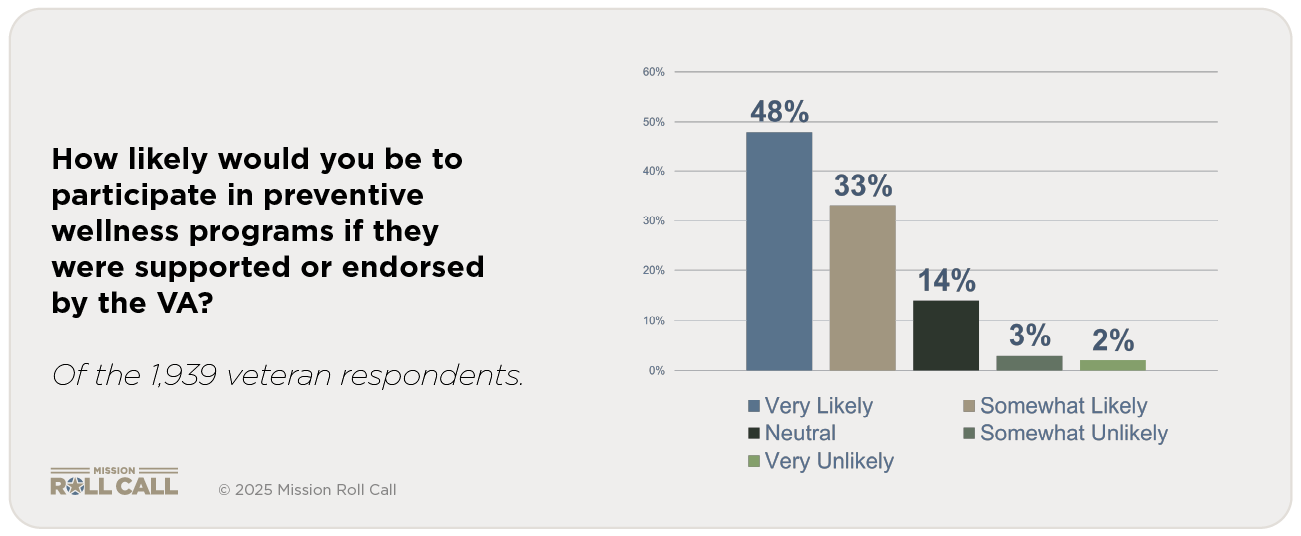
Interest in preventive programs supported by the VA. Original MRC chart. Veteran respondents, n = 1,939.
Turning that interest into participation requires attention to daily constraints. A veteran may welcome an invitation yet be unable to travel, attend during working hours or pay a fee. Outreach should explain available options and help people choose a realistic next step. For someone seeking treatment, that could mean assistance arranging an appointment. For someone looking for connection, it could mean an introduction to a nearby peer group.
Among veteran respondents, 83 percent selected local availability and 69 percent selected free access as factors that would encourage participation.
MRC’s original chart on participation conditions makes that practical dimension clear. Among veteran respondents, 83 percent selected local availability and 69 percent selected free access as factors that would make them most likely to participate in a preventive program offered through or supported by the VA. Respondents could select multiple answers. These preferences support testing programs designed around convenience and affordability, rather than assuming that endorsement alone will bring veterans through the door.
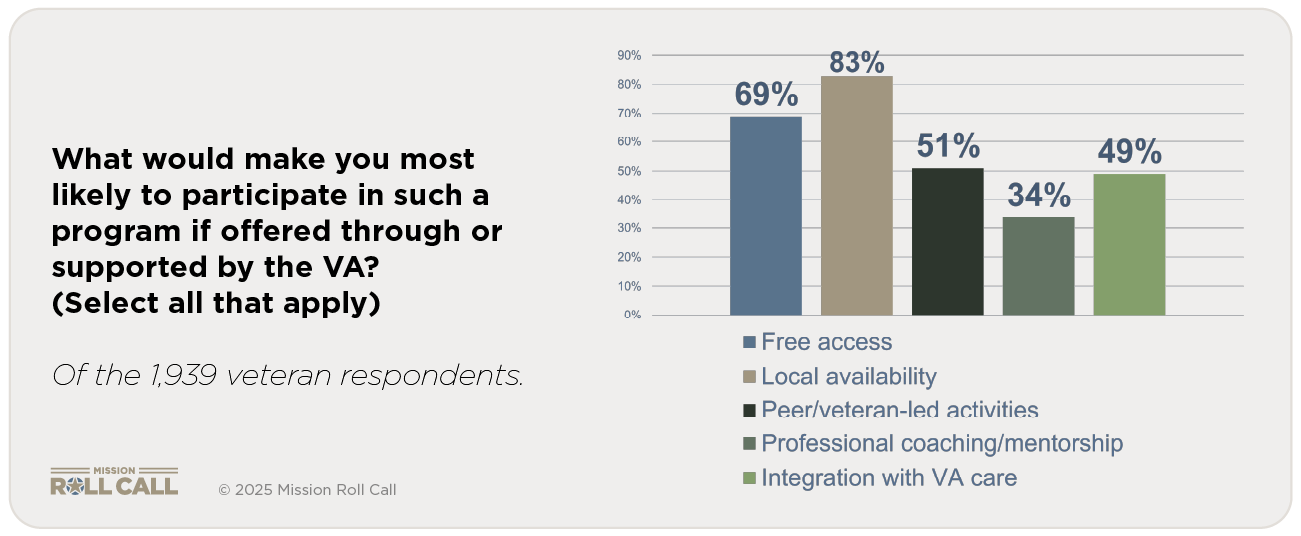
Conditions that would encourage preventive program participation. Original MRC chart. Veteran respondents, n = 1,939. Select all that apply; percentages may total more than 100%.
Use the findings to improve the next connection
Public officials have emphasized the need to maintain access to care. Responding to the report on October 5, 2026, Senator Richard Blumenthal said, “The high rate of veteran suicide remains distressing.” His statement called for timely mental health care and stronger prevention resources. That concern should inform the response across both populations, including veterans already enrolled who have difficulty obtaining or continuing care and veterans who have never sought VA assistance.
Congress and the VA should examine why veterans remain unenrolled, why some enrolled veterans stop using care, and which community partnerships help people obtain appropriate support. Research should account for differences in health needs and demographics before attributing outcomes to enrollment. MRC’s left of clinical work adds another question: what can communities do earlier, while a veteran is still deciding whether to seek formal help?
The report also notes that the VA serves veterans with substantial health needs and exposure to suicide risk factors. That context helps explain why a higher rate within the enrolled population cannot be read as evidence that care is harmful. Similarly, an improving trend cannot establish that enrollment caused the improvement. Policymakers need analysis that separates differences in the people being served from differences in the support they receive.
The divergent trends provide a reason to investigate and act carefully. Enrollment can create a route into care, but prevention also depends on whether useful help is available and whether veterans can sustain a connection with it. A stronger strategy would make those connections easier, evaluate what happens afterward and continue supporting veterans across clinical and community settings. The report should sharpen that work, with its limitations understood and its implications taken seriously.
Chart note: MRC survey responses describe participants’ experiences and preferences. They are separate from the VA national mortality data and do not establish program effectiveness. Percentages in the text follow the rounded labels in the original charts.