At Mission Roll Call, everything begins with listening. This year, thousands of veterans, family members, and supporters across the country shared their experiences and perspectives through our annual priorities survey. Together, those voices have shaped our path forward.
Based on what we heard from you, four priorities will guide our work in 2026:
- Access to Quality Healthcare (VA and Non-VA)
- Support for Service-Connected Injuries and Conditions
- Veteran Suicide Prevention
- Housing Access and Homelessness Prevention
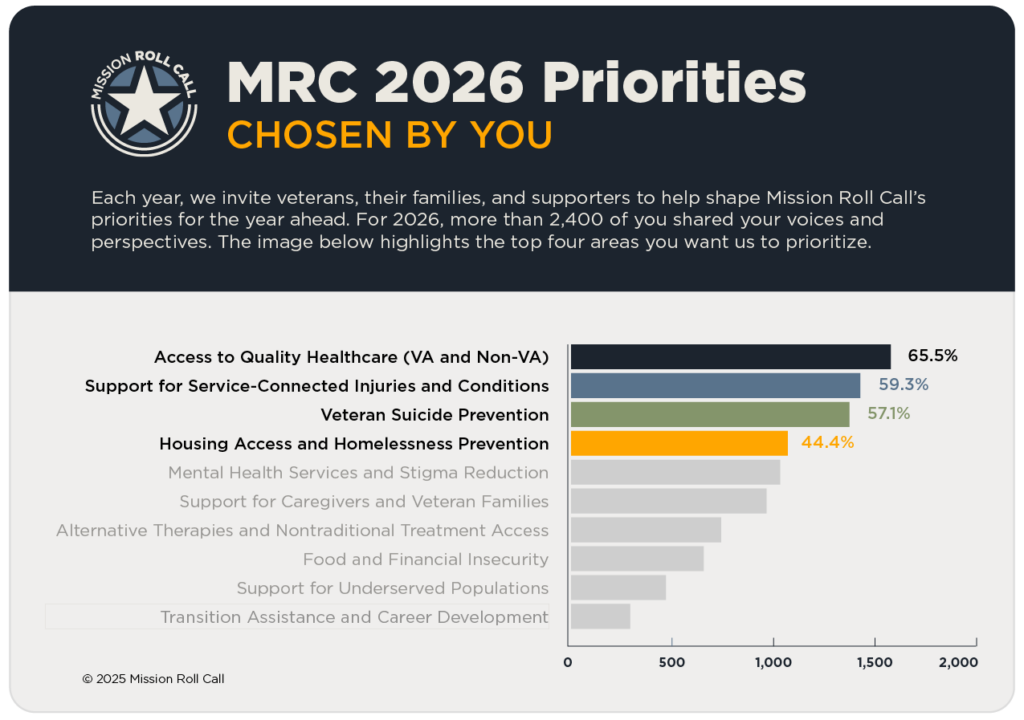
These priorities represent both the challenges veterans and families face and the opportunities we have to create meaningful impact in the year ahead.
When veterans, families, and supporters share their stories with us, they shape national conversations. Veteran feedback directly influences how we advocate, the research we conduct, and the partnerships we build to drive progress. Your voices matter!
Access to Quality Healthcare:
Veterans consistently tell us that timely, high-quality care is one of their most urgent needs. Mission Roll Call is currently conducting research to understand where barriers exist and how to improve care across the system. The findings will be published before the end of 2025 and will help guide our advocacy to make access and outcomes stronger for every veteran.
Support for Service-Connected Injuries and Conditions:
From visible wounds to chronic conditions, many veterans face long-term challenges tied to their service. Mission Roll Call is focused on ensuring they receive the care, benefits, and support they’ve earned. This includes spotlighting policy updates, caregiver perspectives, and programs that promote recovery and independence.
Veteran Suicide Prevention:
Suicide prevention remains a top priority. We are gathering data to better understand risk and resilience among veterans and their families. Through upcoming articles, podcasts, and research, we’ll explore ways to strengthen protective supports and expand preventive approaches to mental wellness.
Housing Access and Homelessness Prevention:
Every veteran deserves a safe place to live. Yet too many remain without stable housing. Mission Roll Call continues to highlight stories, research, and resources that address the root causes of veteran homelessness. To learn more about our efforts in 2025, visit our spotlight page on housing and homelessness.
Working Together for Greater Impact
Mission Roll Call’s work is strengthened by collaboration with Veteran Service Organizations (VSOs) featured in our Veteran Resource Directory. These partnerships help veterans connect to trusted local resources while ensuring that on-the-ground experiences inform our collective efforts.
Throughout 2026, we’ll share updates, research findings, and real stories through articles, blogs, podcasts, and Mission Roll Call University (MRCU). We’ll also report on progress tied to each of these priorities so that the community remains informed and engaged as we move forward.
Why Your Voice Matters
Every story shared and every survey completed moves the mission forward. Veterans and their families help us see where progress is happening and where it’s still needed, guiding how Mission Roll Call educates, informs, engages, and connects.
Because of you, we are turning individual experiences into collective impact. You’re helping build a stronger future for those who have served, and for the generations that will follow.
Thank you for lending your voice to the mission.
When joining the military, recruits are generally expected to be in peak health to ensure they can meet the rigorous demands of training and the job itself. This includes both physical and mental well-being. Going from peak health to being discharged with a service-connected disability is an incredibly tough change. While leaving the military with a disability can qualify a service member for various benefits, including disability compensation from the VA, not all disabled veterans are eligible, and additional support is often needed to ensure they get the help they deserve.
Veterans with Service-Connected Disabilities
You might think this is a small group, but the numbers say otherwise. In 2023, roughly 30% of veterans in the U.S.—about 5.2 million people—had a service-connected disability. Additionally, about 50% of all veterans reported having some form of disability, including both service-connected conditions and self-reported disabilities via the American Community Survey (ACS).
With millions of veterans living with disabilities, how can we better support them?
7 Key Areas of Support for Veterans with Service-Connected Disabilities
- Donate to organizations: Groups like Disabled American Veterans (DAV), Wounded Warrior Project (WWP), and Paralyzed Veterans of America (PVA) rely on donations to provide transportation, financial help, and other essential services.
- Volunteer your time: Help out by driving veterans to appointments, assisting at VA hospitals, or offering administrative help through nonprofits.
- Advocate for veterans: Reach out to your elected officials and support policies that improve healthcare, education, and job opportunities for veterans.
- Offer direct assistance: Whether it’s yard work, transportation, or just being a good listener, small acts of support can go a long way in your community.
- Hire veterans: Create opportunities by hiring veterans, offering internships, or providing job training and mentorship.
- Spread awareness: Learn about the challenges veterans face and help others do the same. Share info about helpful organizations and ways to get involved.
- Support families of veterans: Caregivers need care, too. Programs like the VA’s Program of Comprehensive Assistance for Family Caregivers provide much-needed support—help families know where to turn.
Making a Difference
By taking even one of these steps, you can make a real impact in the lives of disabled veterans and show your appreciation for their service and sacrifice. Whether you’re giving time or money, there’s a way for everyone to get involved.
To join us in advocating for veterans and ensuring their voices are heard, visit www.missionrollcall.org.
At Mission Roll Call, we connect veterans with organizations like PVA and WWP that offer support across the spectrum. Join the mission by being part of our Veteran Resource Directory. If your organization supports veterans or their families, apply today to be featured.
If you’re a veteran or service member living with a service-connected disability, your home should support your independence. Thankfully, the Department of Veterans Affairs offers several disability housing grants that can help you buy, build, or modify a home to better meet your needs.
In our latest episode of Mission Roll Call University (MRCU), we break down everything you need to know about VA’s three main housing grant programs: who qualifies, how much you could receive in 2024, and how to apply.
Here’s what you need to know:
- Three types of grants are available:
- Specially Adapted Housing (SAH) Grant: Up to $117,014 in 2024 for major modifications or a new home.
- Special Housing Adaptation (SHA) Grant: Up to $23,444 in 2024 for different qualifying disabilities.
- Temporary Residence Adaptation (TRA) Grant: Up to $47,130 for SAH-qualified veterans or $8,415 for SHA-qualified veterans living temporarily with family.
- Eligibility is based on service-connected disabilities, such as loss of limbs, blindness, severe burns, or respiratory injuries.
- You can use the grant up to six times across your lifetime—giving you flexibility as your needs change.
- Applications are submitted through VA Form 26-4555, either online, by mail, or in person at a VA regional office.
- Additional tools are available, including the VA’s Housing Design Handbook and step-by-step YouTube guides.
Want to explore your options or help someone else get started? Watch the full episode of MRCU to see how these grants work and how to apply.
Watch now:
For more veteran-focused resources, tips, and walkthroughs, check out our other episodes on the MRCU YouTube channel.
Because every veteran deserves a home that works for them.
Freedom and Independence: Basic Veteran Needs
More than 750,000 people in the United States, including veterans, live with spinal cord injury or disease (SCI/D). The Paralyzed Veterans of America (PVA) is a key organization dedicated to supporting these veterans. PVA ensures that every veteran living with a spinal cord injury or disease can reclaim what they fought for: their freedom and independence.
At Mission Roll Call, we believe that amplifying veteran voices includes connecting them to valuable resources, especially organizations like PVA that help fill the gaps and restore the freedom so many fought to protect.
PVA supports research, educational programs, and other initiatives that unite people and activities toward a single mission: improved quality of life for everyone with SCI/D. PVA is the only nonprofit Veteran Service Organization dedicated solely to helping veterans with spinal cord injuries and disorders (SCI/D), and diseases, like MS and ALS.
Founded on Experience
PVA was founded by a group of service members who returned home from World War II in 1946 with spinal cord injuries and few to no solutions to the major challenges they faced. Unable to comfortably live in their homes or get around by public transportation, they found barriers to independence everywhere.
On a mission to improve accessibility for themselves, their fellow paralyzed veterans, and all people with disabilities, these veterans joined together to form PVA. Today, more than 75 years later, PVA remains a major support system for our nation’s paralyzed and disabled heroes. These wounded heroes made a decision not just to live, but to live with dignity as contributors to society.
PVA and Mission Roll Call have similar goals in that we both amplify veteran voices through research, resources, and fight for actual change.
PVA’s Impact by the Numbers:
- PVA’s Impact on Benefits: PVA has secured over $1.2 billion in benefits for veterans and their families.
- Accessibility Assistance: In 2022 alone, PVA provided over $32.8 million for veterans’ home accessibility modifications and $9.6 million for vehicle adaptations.
- Research Funding: PVA has invested $49,870,331 in grants through its Research Foundation since its inception in 1976, according to PVA’s 2019 legislative priorities.
- Employment Support: PVA has helped over 4,100 veterans, military spouses, and caregivers find meaningful employment, according to PVA’s 2019 legislative priorities.
- Benefits Secured: In 2024, PVA’s General Counsel National Appeals Office and NSOs recovered $7 million for veterans, according to PVA’s 2024 annual report.
- Favorable Decision Rates: PVA has a 100% favorable decision rating with the Court of Appeals for Veterans Claims and an 87% favorable decision rating with the Board of Veterans Appeals, according to PVA’s 2024 annual report.
Veterans are Counting on Us
More than 12,000 people in the US, including veterans, sustain a spinal cord injury each year. This often leads to a loss of motor and/or sensory function. While PVA plays a vital role in advocating for and assisting these veterans, there are ways we can all help.
To give veterans independence, you can support organizations like Paralyzed Veterans of America, volunteer with specific advocacy groups, or offer direct assistance by helping with transportation to appointments or providing emotional support. At Mission Roll Call, we amplify the voices of veterans and their families and connect them with the resources they need to thrive. Every action matters. With your support, paralyzed and disabled veterans can access the programs and services that make a life of dignity and independence possible. With one action, you can help paralyzed and disabled veterans move forward in life by supporting programs and services they rely on to live a life of dignity and independence.
Fuel Veteran Voices
A small gift powers the research and advocacy that brings veterans to the decision-making table.
Donate $5+