Veteran suicide rates have remained stubbornly flat for nearly two decades despite billions invested and countless initiatives. The model we rely on still waits until veterans are already in crisis, and by then, the primary tools left are prescriptions and clinical interventions that treat symptoms but rarely restore purpose or connection. VA’s latest report still reflects thousands of veteran lives lost each year, which is why veterans in our survey delivered a near-unanimous mandate for preventive partnerships. At Mission Roll Call, we believe it is time to test a different path.
In Part One of this series, we examined what veterans lose in transition: the camaraderie, networks, and healthy outlets that once gave them purpose and belonging. In Part Two, we explored what prevention could look like if built left of clinical—fitness, service, mentorship, and creative outlets delivered in ways veterans say they want, and with barriers like cost and awareness removed.
Part Three now asks the hardest question: if veterans overwhelmingly want preventive wellness, who should lead the effort? Our survey results and broader research point to a three-legged stool: the VA providing authority and validation, Congress delivering funding and flexibility, and VSOs and nonprofits supplying the programs veterans already trust. Together, these three legs can finally create the upstream system veterans are asking for.
Part Three: Building Left of Clinical – The Three-Legged Stool of Preventive Wellness
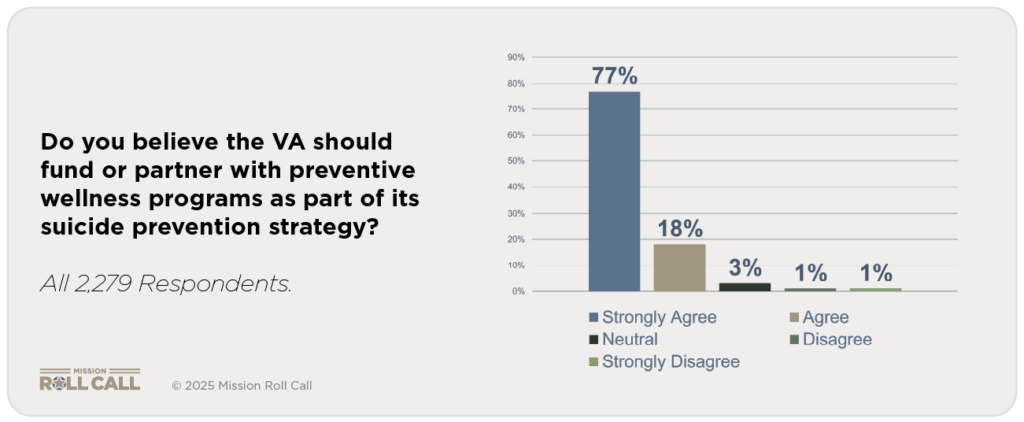
The results of our latest survey leave little room for doubt. When asked if the VA should fund or partner with preventive wellness programs as part of its suicide prevention strategy, 78.5 percent of veterans strongly agreed, and another 17.8 percent agreed. That is as close to a mandate as we will ever see in veteran policy.
But the VA cannot build this effort alone. Congress cannot simply legislate camaraderie into existence. And while VSOs and nonprofits already deliver strong models of preventive wellness, they cannot scale nationally without support. The solution is a three-legged stool: VA authority, congressional backing, and community partnership. Each leg is essential, and only together can they move the system left of clinical.
The Role of the VA
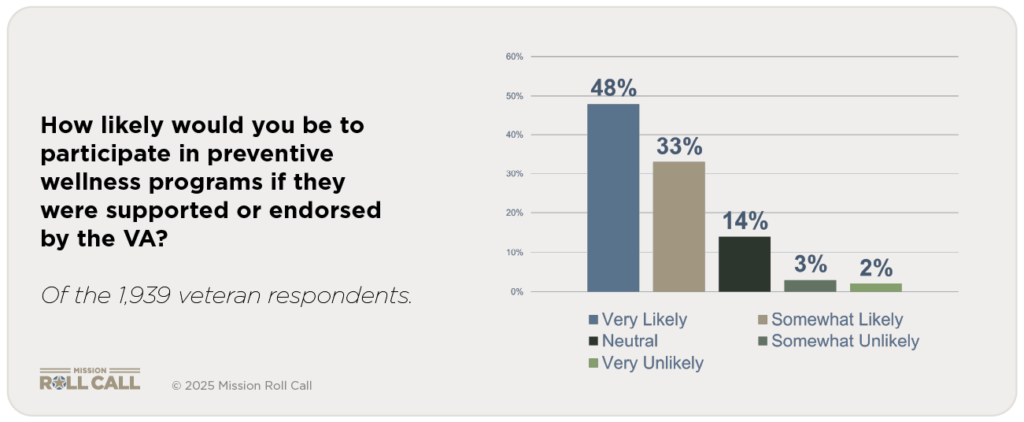
The VA is the anchor. It has the national reach, the trust of veterans, and the authority to set standards. Our survey showed that 48.1 percent of veterans would be “very likely” and another 33.3 percent “somewhat likely” to participate in preventive wellness programs if the VA endorsed them. That endorsement matters. It conveys legitimacy, safety, and continuity of care.
But the VA is not equipped to become a wellness operator. Its infrastructure is built for clinics and claims, rather than rucks, service projects, or peer-led groups. Where it can excel is in convening, validating, and integrating. Through Whole Health programs, Veteran Community Partnerships, and suicide prevention outreach pilots, the VA can create space for preventive wellness to be embedded into transition and care. The VA has some experience with this, though limited in scope, having already piloted community-based social connection models that increased engagement with services.
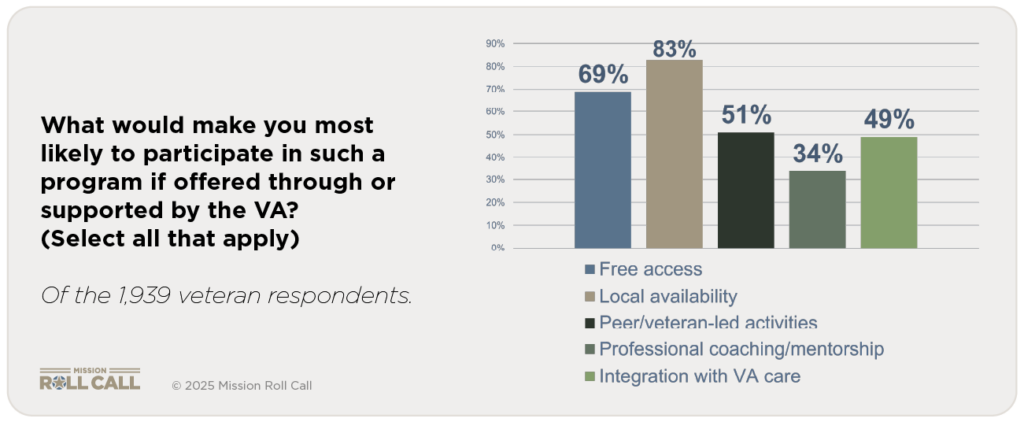
Veterans also told us what would tip the balance: free access, local availability, peer-led activities, and integration with VA systems. Those are levers the VA can pull through grants, co-branding, and referrals that treat preventive wellness as part of the benefit, not a side project.
The Role of Congress
Congress provides the tools. Without targeted legislative support, the VA cannot fund or scale preventive wellness. Congress can:
- Create dedicated funding streams for preventive wellness partnerships with VSOs and nonprofits.
- Expand pilot authorities so the VA can contract directly with non-clinical organizations for fitness, peer support, and community service programs.
- Mandate preventive wellness integration into transition and suicide prevention strategies.
- Provide budget flexibility so dollars can be used for prevention, not only crisis care.
These changes do not require a wholesale rewrite of VA’s mission. They require targeted authorities that enable the VA to meet veterans where they are — before they enter the clinical system. Preventive wellness costs less, produces stronger outcomes, and reduces reliance on polypharmacy and emergency services. Congress can make that possible.
The Role of VSOs and Community Organizations
The third leg of the stool is the nonprofit community. Organizations like Team Red, White & Blue, O2X, GoRuck, The Mission Continues, and Boot Campaign already deliver the kinds of preventive wellness veterans say they want: fitness, service, peer mentorship, creative outlets, and holistic wellness.
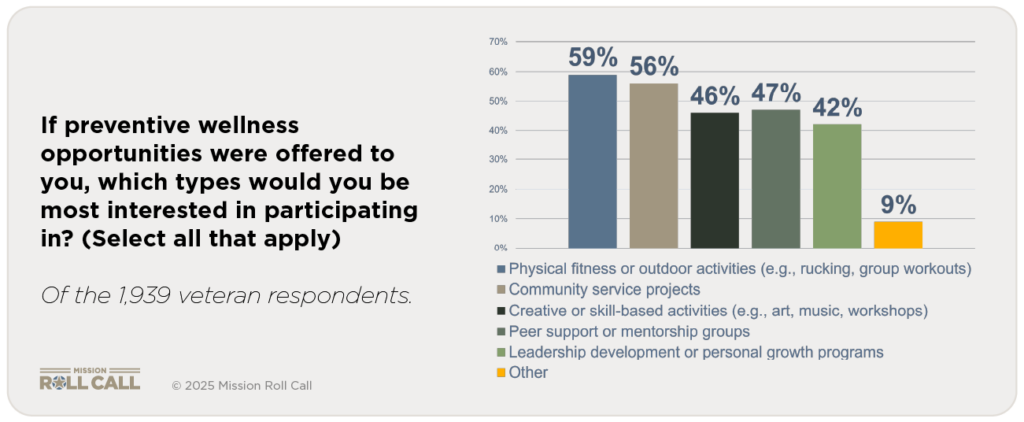
In our survey, when asked which preventive opportunities they would most prefer, veterans pointed to fitness and outdoor activities, community service projects, peer mentorship groups, and creative or skill-based workshops. These are exactly what VSOs and nonprofits already provide.
But nonprofits cannot scale nationally on their own. Their strength is agility, community credibility, and dedication to serving veterans. They know how to design programs veterans trust. What they lack is reach, official backing, and financial stability. That is where VA partnership and congressional support become essential.
The Path Forward
If each leg of the stool plays its part, preventive wellness becomes not only possible but powerful:
- The VA convenes, validates, and integrates preventive wellness into standard services.
- Congress provides the programs, intent, funding, and legal authorities to start small and then scale those efforts nationally.
- VSOs and nonprofits deliver the programs veterans want most, with the credibility and agility only community-based groups can provide.
This is not about a new bureaucracy. Rather, it’s about re-aligning our focus and resources in a way that better meets the needs of veterans. It is about using what already works, aligning it with VA’s reach, and giving it the legislative foundation to last.
Why Left of Clinical Matters
Without this three-legged stool, too many veterans will continue to arrive at the VA only when crisis is at their doorstep. By then, stress has hardened into anxiety, isolation into despair, and the only tools left are medication and clinical intervention. Our survey showed that the biggest barrier today is awareness — 53.7 percent of veterans said they simply don’t know what programs exist.
If the VA, Congress, and VSOs together remove those barriers, preventive wellness can shift the system left of clinical. That is where the real change happens — not just treating crisis, but preventing it by keeping veterans connected, active, and purposeful.
Closing
Veterans want preventive wellness. They know what kinds of programs will help. They are ready to participate if the VA supports them. And they expect their government to act.
The path forward is not VA alone. It is a three-legged stool of VA authority, congressional backing, and nonprofit partnership. Each leg is essential. Together, they can transform preventive wellness from an idea into a national reality — cheaper, more effective, and truer to what veterans say they need.
That is the veteran-led mandate to move left of clinical.
Left of Clinical is a Caregiving Imperative
This three-part series has shown the path veterans are asking us to take. In Part One, we saw the cost of losing camaraderie: isolation, stress, and unhealthy coping. In Part Two, we heard what preventive interventions could look like: fitness, service, mentorship, and creative outlets—accessible and structured to meet veterans where they are. And in Part Three, we mapped the roles of the VA, Congress, and community organizations in building the three-legged stool of preventive wellness.
Veterans are not rejecting clinical care—they are asking us to invest upstream. They want opportunities that keep them strong and connected long before the point of crisis. They want prevention that is cheaper, healthier, and more effective than a prescription.
If policymakers, the VA, and community partners take this mandate seriously, preventive wellness can become more than a concept. It can become a system that keeps veterans engaged, purposeful, and resilient. That is what it means to move Left of Clinical.
Veteran suicide rates have remained stubbornly flat for nearly two decades despite billions invested and countless initiatives. The current model largely waits until veterans are already in crisis, and by then, the tools left are prescriptions and clinical interventions that treat symptoms but rarely restore purpose and connection. At Mission Roll Call, we believe it is time to test a different path.
In Part One of this series, we saw the cost of lost camaraderie. Veterans told us they miss the team, struggle to build new networks, and often lack healthy outlets for stress. Nearly all agreed that structured opportunities for connectedness are essential. Without them, isolation grows, stress compounds, and too many veterans arrive at the VA only when a crisis is at their doorstep.
Part Two asks the next question: what would it look like to act Left of Clinical—to create preventive opportunities for connection, service, and purpose before the prescription pad comes out? Our survey results outline what veterans want, what keeps them from joining today, and what would make participation possible. The answers are clear, practical, and veteran-led.
Part Two: Designing Interventions Left of Clinical
Veterans told us exactly the kinds of interventions they would choose. When asked what preventive wellness opportunities mattered most, the top answers were physical fitness and outdoor activities, community service projects, peer mentorship groups, and creative or skill-based workshops.
These are not exotic solutions. They are the same habits that keep people healthier across all populations: exercise, social connection, meaningful activity, and self-expression. Veterans are pointing to everyday practices that build resilience — only they want them structured, accessible, and veteran-oriented. Independent research from Frontiers in Psychology also confirms that peer- and group-oriented programs have been shown to reduce loneliness and increase purpose and engagement among veterans.
What Keeps Veterans Out
So why aren’t more already engaged in these activities? The biggest barrier, by far, was lack of awareness. More than half of respondents (53.7 percent) said they simply don’t know what programs are available. Cost came next at 18.8 percent, followed by scheduling conflicts (11.3 percent) and transportation (7.5 percent).
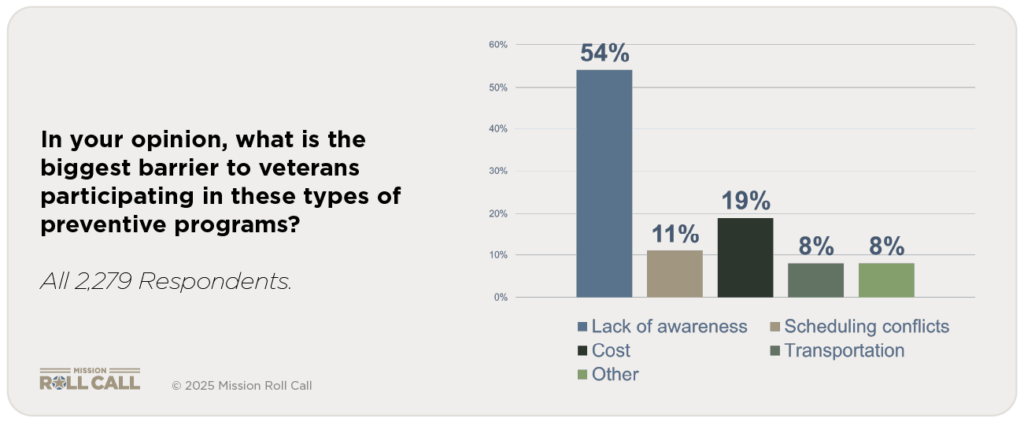
This tells us something important: veterans are not rejecting preventive wellness. Most just don’t know it exists or can’t make it fit into their lives. The problem is not demand. The problem is design. This tracks with what we’ve reported at Mission Roll Call about awareness and navigation challenges across VA systems.
What Would Tip the Balance
We also asked what would make veterans more likely to participate. The answers clustered around four practical needs: free access, local availability, peer- or veteran-led activities, and integration with VA care. These directly mirror the barriers: address cost, geography, trust, and legitimacy, and you unlock participation.
This is not about inventing something new, and it points directly to solutions. If we want preventive wellness to be real, we don’t need to invent a new model. We need to remove the obstacles veterans themselves have identified. Independent research from RAND catalogs preventive activities where peer and community strategies complement clinical care, suggesting VA endorsement and integration can multiply impact.
The Power of VA Endorsement
Finally, we asked how likely veterans would be to join preventive wellness programs if the VA supported or endorsed them. Nearly half (48.1 percent) said “very likely,” another 33.3 percent said “somewhat likely,” and only 4.7 percent said unlikely.
That endorsement matters. It signals credibility, safety, and legitimacy. Veterans are telling us they would proactively join preventive opportunities if those opportunities existed and if the VA put its weight behind them.
This is the essence of Left of Clinical. Veterans do not want to wait for crises. They are asking for earlier options that are cheaper, healthier, and more sustainable than endless clinical interventions. Broader research also associates routine physical activity with lower rates of mental-health problems and suicidality, underscoring why fitness-based, peer programs can be smart prevention.
Why This Matters
If half of veterans are already struggling with stress or isolation, and more than 80 percent say they would likely participate in preventive programs if endorsed by the VA, then the opportunity is enormous. We can intercept isolation and despair early. We can substitute connection and purpose for medication and symptom management.
The system has never truly invested in preventive wellness, but the message from veterans is unmistakable: they are ready. In Part Three, we turn to how the VA, Congress, and community organizations can work together to build the three-legged stool that makes preventive wellness real.
Veteran suicide rates have remained stubbornly flat for nearly two decades despite billions invested and countless initiatives. VA’s 2024 Annual Report tallied 6,407 veteran suicide deaths in 2022 (17.6 per day), underscoring how little progress the nation has made since 2001. The current model largely waits until veterans are already in crisis, and by then, the tools left are prescriptions and clinical interventions that treat symptoms but rarely restore purpose and connection. We’ve written extensively about the failure of progress in this regard, including our Suicide Prevention page, our survey addressing this topic, and our 2025 Update to our State of Veteran Suicide report. At Mission Roll Call, we believe it is time to test a different path.
In this three-part series, we explore the concept of moving “Left of Clinical”—acting earlier, while veterans are still strong and connected, rather than waiting until isolation and despair drive them to the edge. Our latest national survey of nearly 2,300 veterans and family members makes the case for preventive wellness: interventions that keep veterans engaged, purposeful, and resilient long before they ever need a prescription or diagnosis.
In Part One, we examine what veterans lose in transition and why connection matters. In Part Two, we look at what preventive interventions could actually look like in practice. And in Part Three, we map out how the VA, Congress, and community partners can work together to build a system that finally bends the curve on veteran suicide.
Part One: Veterans Value Preventive Connectedness
At Mission Roll Call, we listen to what veterans are telling us and bring those voices directly into the national conversation. In September 2025, we conducted a survey focused on a question that does not often get asked: what would it look like if the VA, and indeed our entire veteran care system, invested more heavily in preventive wellness programs that keep veterans strong and connected before they ever need medical intervention?
The message is unmistakable. Veterans are asking for a broader array of options that they can tailor to their specific needs, with greater say and influence over those decisions. But here is the harder truth: veteran suicide statistics have remained flat for nearly two decades.
Despite billions of dollars invested, the model we rely on is not moving the needle. We continue to meet veterans at the point of crisis, and too often the only tools available are prescriptions and clinical interventions that treat symptoms without addressing root causes. Preventive wellness offers a new and largely unexplored pathway — one that can help veterans stay connected, purposeful, and healthy long before they ever reach the edge of crisis.
With suicide rates unmoved and trust in current approaches strained, it’s time we begin holding serious discussions about how to achieve these aims.
What “Left of Clinical” Means
The phrase “left of clinical” comes from the same mindset that has guided military training and operations for generations. In military planning, being “left of” something means acting before the moment of crisis. In veteran health, being “left of clinical” means recognizing and addressing the challenges of transition and post-service integration into society long before they result in harmful self-talk or require a diagnosis or prescription.
Today, too many veterans only enter the care system once their struggles have reached a breaking point. Typically, by this point, isolation has taken root, stress has hardened into anxiety, and coping mechanisms have turned unhealthy. Too many veterans respond at that stage with alcohol or medication, or both, sometimes a cocktail of drugs prescribed with the best of intentions, but ultimately are not designed for prevention or long-term wellness and often create long-term dependencies and addiction. A case of the cure being worse than the disease.
Our latest survey gives weight to what many of us already know instinctively: veterans want healthier options long before they get to that point.
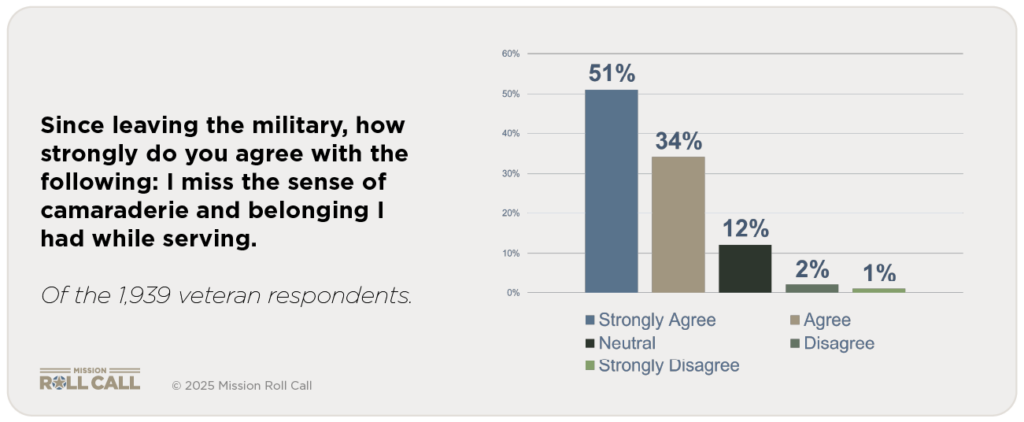
The strongest signal from our September survey is about what veterans value most after leaving the military. Almost 86 percent of respondents said they strongly agree or agree that they miss the sense of camaraderie and belonging they had while serving. Less than 3 percent disagreed. The bond of shared experience is not just a fond memory. It is the anchor that many veterans find missing in civilian life.
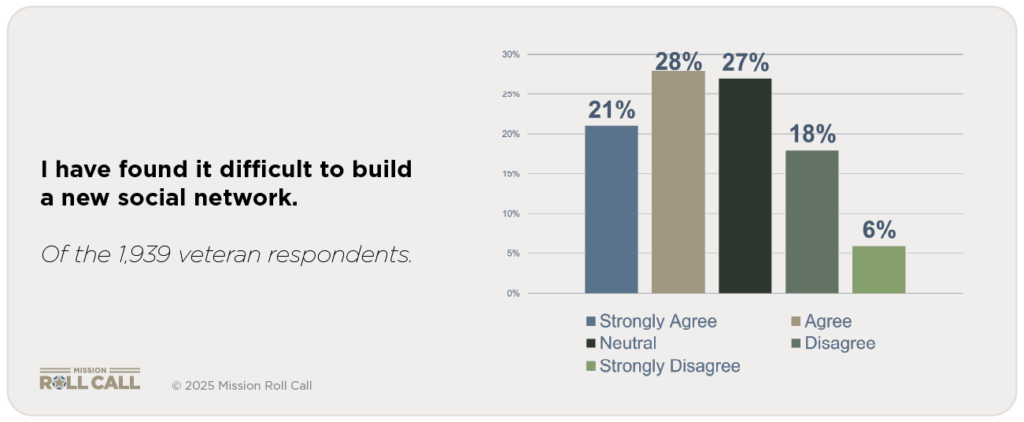
That loss has real consequences. Nearly half (49.5 percent) said they agree or strongly agree that they have found it difficult to build a new social network since leaving the military. Another 27 percent were neutral, meaning only about one in four veterans feels they have successfully rebuilt the same trust and community they once had in uniform. This is where isolation begins, and where stress compounds.
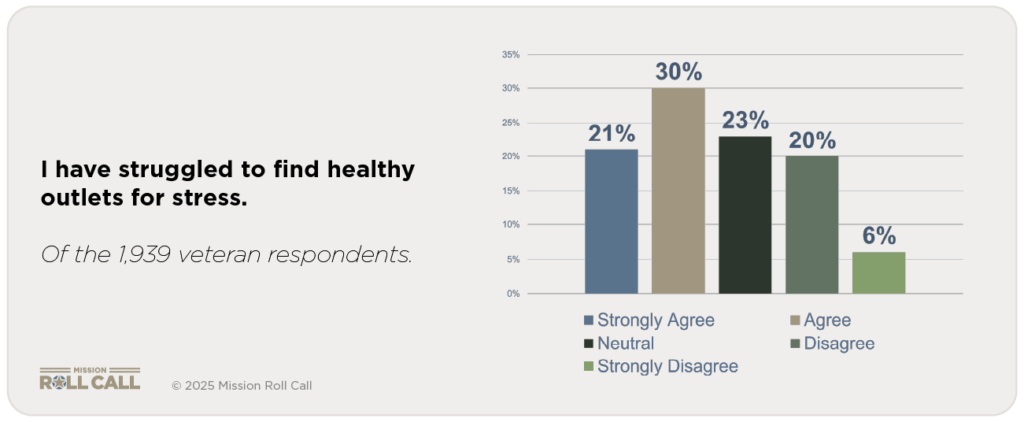
The same pattern appears when veterans talk about coping. Just over 50 percent said they have struggled to find healthy outlets for stress. A quarter were neutral, and only a quarter disagreed. Most veterans live in an environment where the old ways of managing stress—team, mission, shared purpose—are gone, and nothing equally strong has replaced them.
When asked directly, veterans did not hesitate about what they want instead. Over 95 percent said it is very important or somewhat important for transitioning service members to have structured opportunities for connectedness. Less than 1 percent said such opportunities are not important. In other words, nearly every veteran sees connectedness as essential to their well-being.
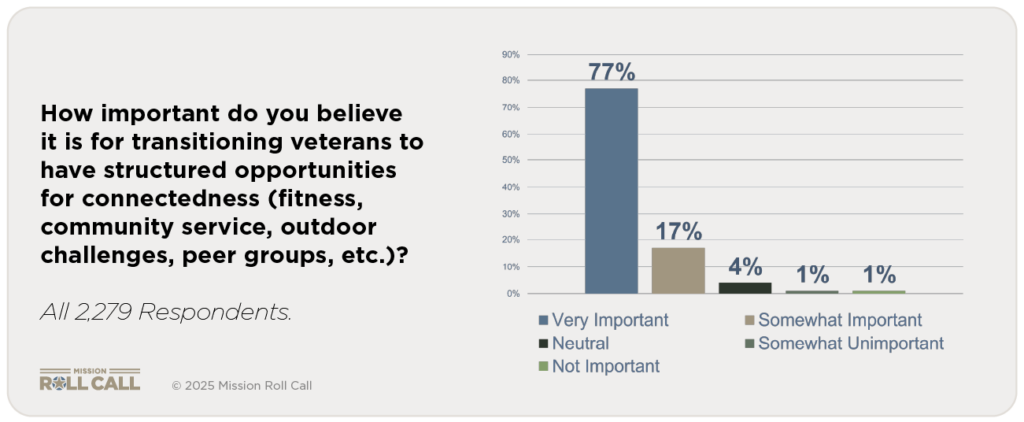
This matters because of where the absence of connectedness leads. Without community and purpose, isolation grows. Isolation becomes stress. Stress becomes unhealthy coping. And too often, the VA meets veterans for the first time only when they are already in crisis. At that point, the response is often medication—sometimes multiple prescriptions that dull symptoms without addressing the root cause: the loss of belonging.
Veterans are telling us they want something different. They want opportunities to connect, to be part of a team again, to build resilience before they ever need a prescription. They are asking for prevention that sits left of clinical—because they know that is where real strength is rebuilt.
The next question is obvious: what would those preventive wellness opportunities actually look like? In Part Two, we turn to the survey results that show which interventions veterans say they want most, what keeps them out of those programs today, and how the system can remove those barriers.
Fuel Veteran Voices
A small gift powers the research and advocacy that brings veterans to the decision-making table.
Donate $5+