Veteran suicide rates have remained stubbornly flat for nearly two decades despite billions invested and countless initiatives. The model we rely on still waits until veterans are already in crisis, and by then, the primary tools left are prescriptions and clinical interventions that treat symptoms but rarely restore purpose or connection. VA’s latest report still reflects thousands of veteran lives lost each year, which is why veterans in our survey delivered a near-unanimous mandate for preventive partnerships. At Mission Roll Call, we believe it is time to test a different path.
In Part One of this series, we examined what veterans lose in transition: the camaraderie, networks, and healthy outlets that once gave them purpose and belonging. In Part Two, we explored what prevention could look like if built left of clinical—fitness, service, mentorship, and creative outlets delivered in ways veterans say they want, and with barriers like cost and awareness removed.
Part Three now asks the hardest question: if veterans overwhelmingly want preventive wellness, who should lead the effort? Our survey results and broader research point to a three-legged stool: the VA providing authority and validation, Congress delivering funding and flexibility, and VSOs and nonprofits supplying the programs veterans already trust. Together, these three legs can finally create the upstream system veterans are asking for.
Part Three: Building Left of Clinical – The Three-Legged Stool of Preventive Wellness
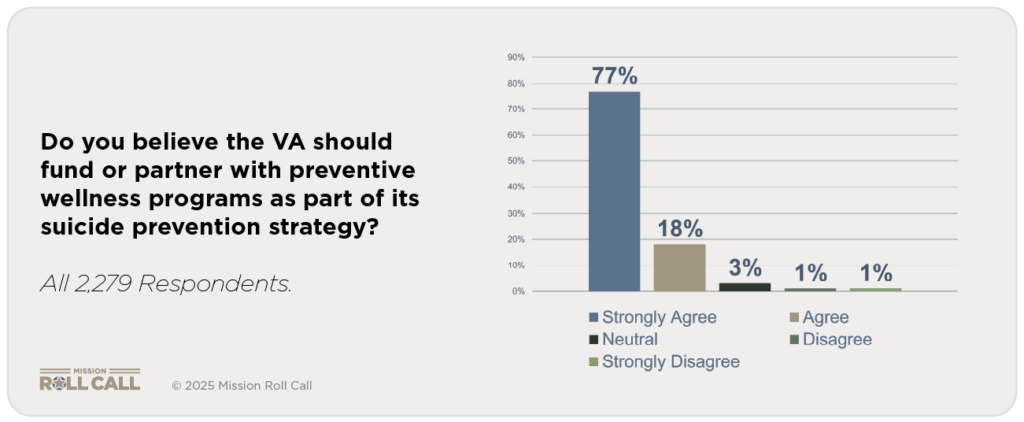
The results of our latest survey leave little room for doubt. When asked if the VA should fund or partner with preventive wellness programs as part of its suicide prevention strategy, 78.5 percent of veterans strongly agreed, and another 17.8 percent agreed. That is as close to a mandate as we will ever see in veteran policy.
But the VA cannot build this effort alone. Congress cannot simply legislate camaraderie into existence. And while VSOs and nonprofits already deliver strong models of preventive wellness, they cannot scale nationally without support. The solution is a three-legged stool: VA authority, congressional backing, and community partnership. Each leg is essential, and only together can they move the system left of clinical.
The Role of the VA
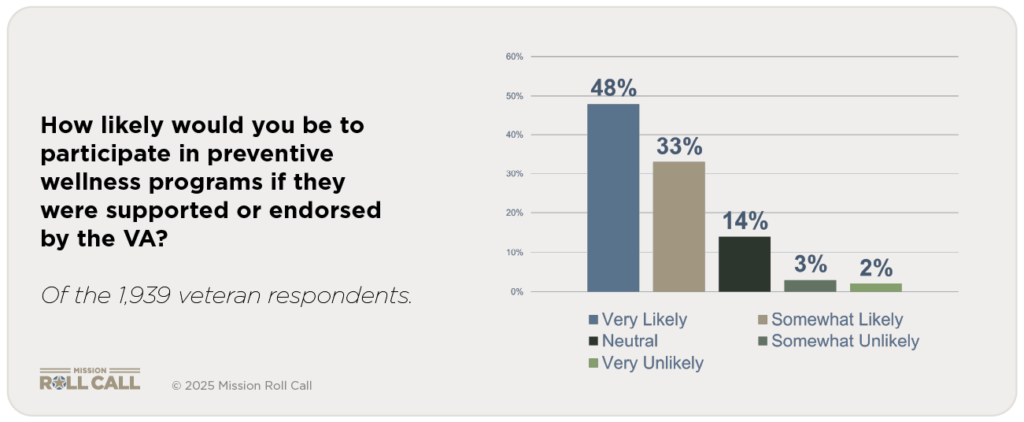
The VA is the anchor. It has the national reach, the trust of veterans, and the authority to set standards. Our survey showed that 48.1 percent of veterans would be “very likely” and another 33.3 percent “somewhat likely” to participate in preventive wellness programs if the VA endorsed them. That endorsement matters. It conveys legitimacy, safety, and continuity of care.
But the VA is not equipped to become a wellness operator. Its infrastructure is built for clinics and claims, rather than rucks, service projects, or peer-led groups. Where it can excel is in convening, validating, and integrating. Through Whole Health programs, Veteran Community Partnerships, and suicide prevention outreach pilots, the VA can create space for preventive wellness to be embedded into transition and care. The VA has some experience with this, though limited in scope, having already piloted community-based social connection models that increased engagement with services.
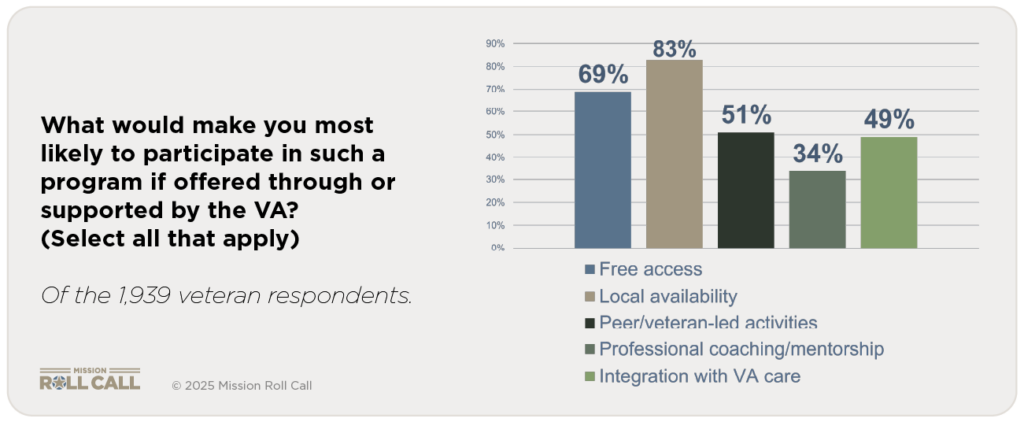
Veterans also told us what would tip the balance: free access, local availability, peer-led activities, and integration with VA systems. Those are levers the VA can pull through grants, co-branding, and referrals that treat preventive wellness as part of the benefit, not a side project.
The Role of Congress
Congress provides the tools. Without targeted legislative support, the VA cannot fund or scale preventive wellness. Congress can:
- Create dedicated funding streams for preventive wellness partnerships with VSOs and nonprofits.
- Expand pilot authorities so the VA can contract directly with non-clinical organizations for fitness, peer support, and community service programs.
- Mandate preventive wellness integration into transition and suicide prevention strategies.
- Provide budget flexibility so dollars can be used for prevention, not only crisis care.
These changes do not require a wholesale rewrite of VA’s mission. They require targeted authorities that enable the VA to meet veterans where they are — before they enter the clinical system. Preventive wellness costs less, produces stronger outcomes, and reduces reliance on polypharmacy and emergency services. Congress can make that possible.
The Role of VSOs and Community Organizations
The third leg of the stool is the nonprofit community. Organizations like Team Red, White & Blue, O2X, GoRuck, The Mission Continues, and Boot Campaign already deliver the kinds of preventive wellness veterans say they want: fitness, service, peer mentorship, creative outlets, and holistic wellness.
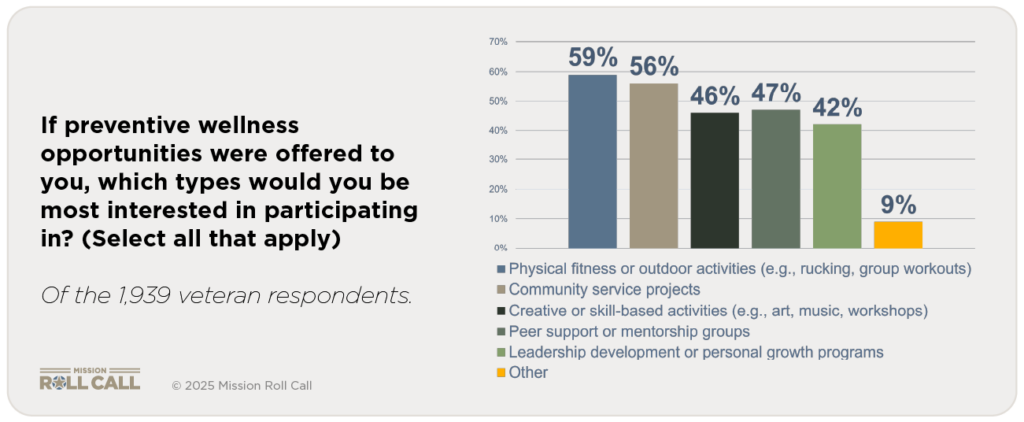
In our survey, when asked which preventive opportunities they would most prefer, veterans pointed to fitness and outdoor activities, community service projects, peer mentorship groups, and creative or skill-based workshops. These are exactly what VSOs and nonprofits already provide.
But nonprofits cannot scale nationally on their own. Their strength is agility, community credibility, and dedication to serving veterans. They know how to design programs veterans trust. What they lack is reach, official backing, and financial stability. That is where VA partnership and congressional support become essential.
The Path Forward
If each leg of the stool plays its part, preventive wellness becomes not only possible but powerful:
- The VA convenes, validates, and integrates preventive wellness into standard services.
- Congress provides the programs, intent, funding, and legal authorities to start small and then scale those efforts nationally.
- VSOs and nonprofits deliver the programs veterans want most, with the credibility and agility only community-based groups can provide.
This is not about a new bureaucracy. Rather, it’s about re-aligning our focus and resources in a way that better meets the needs of veterans. It is about using what already works, aligning it with VA’s reach, and giving it the legislative foundation to last.
Why Left of Clinical Matters
Without this three-legged stool, too many veterans will continue to arrive at the VA only when crisis is at their doorstep. By then, stress has hardened into anxiety, isolation into despair, and the only tools left are medication and clinical intervention. Our survey showed that the biggest barrier today is awareness — 53.7 percent of veterans said they simply don’t know what programs exist.
If the VA, Congress, and VSOs together remove those barriers, preventive wellness can shift the system left of clinical. That is where the real change happens — not just treating crisis, but preventing it by keeping veterans connected, active, and purposeful.
Closing
Veterans want preventive wellness. They know what kinds of programs will help. They are ready to participate if the VA supports them. And they expect their government to act.
The path forward is not VA alone. It is a three-legged stool of VA authority, congressional backing, and nonprofit partnership. Each leg is essential. Together, they can transform preventive wellness from an idea into a national reality — cheaper, more effective, and truer to what veterans say they need.
That is the veteran-led mandate to move left of clinical.
Left of Clinical is a Caregiving Imperative
This three-part series has shown the path veterans are asking us to take. In Part One, we saw the cost of losing camaraderie: isolation, stress, and unhealthy coping. In Part Two, we heard what preventive interventions could look like: fitness, service, mentorship, and creative outlets—accessible and structured to meet veterans where they are. And in Part Three, we mapped the roles of the VA, Congress, and community organizations in building the three-legged stool of preventive wellness.
Veterans are not rejecting clinical care—they are asking us to invest upstream. They want opportunities that keep them strong and connected long before the point of crisis. They want prevention that is cheaper, healthier, and more effective than a prescription.
If policymakers, the VA, and community partners take this mandate seriously, preventive wellness can become more than a concept. It can become a system that keeps veterans engaged, purposeful, and resilient. That is what it means to move Left of Clinical.
Fuel Veteran Voices
A small gift powers the research and advocacy that brings veterans to the decision-making table.
Donate $5+