At Mission Roll Call, every year starts by listening. In our 2025 annual priorities survey, thousands of veterans, family members, and supporters shared their experiences and perspectives. The result: four core priorities have emerged to guide our work in 2026.
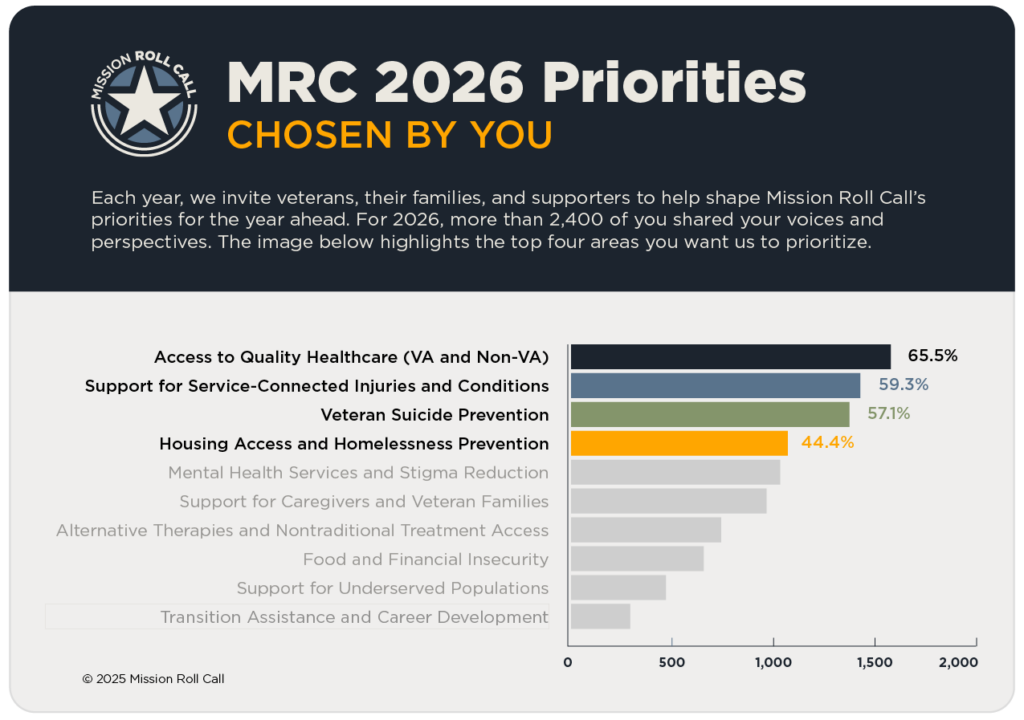
But hearing those priorities is only the beginning. Below are six focus areas that we are carrying forward into 2026. These 6 areas are where veteran voices are driving action, and where we are committed to turning plans into progress.
1. Expanding Access to Quality Healthcare (VA & Non‑VA)
Veterans consistently tell us that timely, high‑quality care is one of their most urgent needs.
In 2026, we are stepping up our efforts to map the barriers veterans face in accessing care and to advocate for policies that remove those obstacles. Expect more research, more storytelling, and more collaborative partnerships aimed at improving outcomes and reducing travel or wait‑time burdens.
Why it matters: Healthcare may be a system, but real care happens person to person. Keeping veterans at the center of the design ensures the system serves, not impedes, them.
2. Supporting Service‑Connected Injuries and Conditions
Many veterans live with long‑term, service‑connected injuries and conditions both visible and invisible.
In 2026, our work will zero in on caregivers, the complexity of chronic care, transitions between active duty and civilian life, and the advocacy required to make sure the benefits and programs veterans earned actually work for them.
Why it matters: Service doesn’t stop at discharge. The condition may persist and the support should too.
3. Enhancing Veteran Suicide Prevention
Preventing veteran suicide remains a top priority.
But in 2026, we’re refining the approach. We’ll explore not only crisis intervention, but prevention before crisis such as peer networks, community connection, non‑clinical wellness, and early engagement.
Why it matters: Countless initiatives exist, but veterans are telling us that what’s missing is reaching them before they hit the edge. We’re committed to shifting earlier on the timeline.
4. Expanding Housing Access & Homelessness Prevention
Every veteran deserves a safe, stable place to live and yet too many remain without it.
Our 2026 efforts will shine a spotlight on the root causes of veteran homelessness: economic instability, healthcare gaps, transitions, and family breakdowns. We’ll profile promising models, support policy change, and elevate veteran‑led solutions in housing stability.
Why it matters: A home is more than a roof—it’s a platform for healing, purpose, and community reintegration.
5. Amplifying Veteran, Family & Caregiver Voices
The four key priorities above emerged because veterans spoke up. This priority remains at the core of Mission Roll Call.
In 2026, we’ll carry forward not just issue‑areas but the method: listening to veterans, families, and caregivers, and turning their perspectives into action. That means more surveys, more regional outreach, more transparency in how we use what we hear.
Why it matters: Change without input is incomplete. When those most affected have a seat at the table, the outcome is stronger.
6. Strengthening Partnerships & Resource Networks
Our advocacy is built on collaboration with veteran service organizations (VSOs), community groups, policymakers, and families.
In 2026, we’ll expand our resource‑directory model, deepen local‑level partnerships, and ensure that knowledge and connection travel as fast as policy changes. That means more stories, more tool‑kits, more live events, and more ways for every veteran to link into the network of support.
Why it matters: When resources are scattered and hard to find, they may as well not exist. Bringing them together amplifies impact.
Looking Ahead
These six focus areas are not silos; they’re interconnected threads in a broader mission. Veterans and families told us what matters; now we carry that work into action.
At Mission Roll Call, we are honored to amplify your voices, turn your feedback into policy and practice, and build a future where every veteran is seen, heard, and supported.
If you haven’t yet participated in our Veteran Voices survey, now’s your chance. Your experience matters, and your voice remains the fuel for change. Join us and be part of the movement.
When you don’t have a dedicated caregiver, it can feel like you’re going it alone. You may be wondering: who’s going to check in? Who’s going to make sure I’m okay when things get heavy? The good news is, you don’t have to rely solely on a traditional caregiver model. Community is care. For veterans, peer networks and veteran-led groups are proving to be powerful alternatives or complements to formal caregiving.
Why community-based support matters
Veterans often find healing in connection with people who “get it” and have walked the same path. Peer-to-peer programs have been shown to offer real benefits. For example, a study found that veterans identified peer support as offering social support, a sense of purpose, hope, and normalization of symptoms
Another study showed that community-based peer networks helped with reintegration into civilian life. These programs improve social support, enhance coping, and strengthen community connection.
In short, if you don’t have a caregiver, a support circle built from peers, veteran-led groups, or community networks can help fill the gap.
What types of support exist when caregiving isn’t available
- Peer support networks: These are groups where veterans voluntarily support one another by sharing experiences, challenges, and resources. You don’t need to be “in crisis” to join.
- Gallant Few: Assists members of the Ranger community in reintegrating from active duty service to the civilian world. Gallant Few is an Army Ranger-led active duty and veteran military support organization founded in 2010.
- Team Red, White & Blue (Team RWB): Connects veterans through physical activity, leadership development, and community events. Their chapters host weekly runs, yoga, and fitness meetups that help build camaraderie.
- The Warrior’s Journey: Offers online and in-person support groups, mentorship, and spiritual connection for veterans navigating life’s challenges.
- Veterans Recovery Network: Peer-led support groups inside VA medical centers for veterans in recovery from mental health or substance use disorders.
- Veteran-led advocacy and community groups: These groups often combine social connection with a shared mission or volunteer activity. Being part of something bigger than yourself can shift the dynamic from “I need help” to “We’re in this together.”
- The Mission Continues: Empowers veterans to serve through community service projects, creating purpose-driven teams and strong local networks.
- Travis Manion Foundation: Offers leadership and mentorship opportunities for veterans, including school talks and service projects that reinforce identity and community connection.
- Team Rubicon: Serves communities all over the country, from a glacial flood in Alaska to the devastation of Hurricane Helene in the Southeast, from Long Term Recovery operations in Kentucky to wildfire response in California. This veteran-led organization builds belonging through service.
- Local Veteran Service Organizations (VSOs) and community chapters: Groups like the American Legion, Veterans of Foreign Wars (VFW), and others often offer non-clinical support such as weekly gatherings, peer discussions, rides to appointments, or simply regular check-ins.
- Veterans of Foreign Wars (VFW): Beyond benefits claims, many VFW posts host peer check-ins, community meals, and volunteer opportunities.
- American Legion: Offers everything from benefit assistance to youth mentorship programs and local post events like breakfasts and meetings.
- Disabled American Veterans (DAV): Offers transportation to VA medical appointments, local chapter meetings, and peer navigation support for injured veterans.
- Online communities and remote networks: If mobility, geography, or logistics are barriers, virtual groups can help you connect with peers who understand.
- RallyPoint: A social media platform for service members and veterans to ask questions, share stories, and find community.
- Togetherall: A peer support community monitored by clinicians, free to U.S. veterans through the VA, offering a safe online space to talk through struggles anonymously.
- VA’s Peer Support Outreach: The VA offers virtual and in-person peer support services nationwide. You can request to be connected with a trained peer specialist through your local VA medical center.
- RallyPoint: A social media platform for service members and veterans to ask questions, share stories, and find community.
How to build your own informal “care network”
- Acknowledge your needs without shame
Recognizing that you don’t have a caregiver isn’t admitting defeat. It’s being strategic. Consider what you would want: regular check-ins, someone to pick up groceries, a peer to talk to when you’re struggling.
- Reach out rather than isolate
Look for a veteran peer group in your area or online. Ask someone at your local VSO, “Is there a peer-to-peer group for veterans who live alone or need social connection?”
- Create a circle of support
Think smaller than a “caregiver.” Identify two to four people you can count on such as a fellow veteran, a VSO volunteer, a mentor. Ask each one for one specific role. For example: “Will you call me once a week?” or “Will you come over on Saturdays?” This informal network acts like a team instead of putting everything on one person.
- Tap into tech and remote tools
Use apps, online groups, or virtual meet-ups to stay connected. The U.S. Department of Veterans Affairs (VA) reports that trained peer-sponsor networks help transitioning veterans overcome risk factors for isolation and improve outcomes.
- Volunteer or give back
One of the strongest ways to build community is to serve. When you help others, you build relationships, purpose, and reciprocity. That strengthens the network around you.
- Check in on your network regularly
Like any team, your circle needs maintenance. That could mean a quick text, a planned coffee meet-up, or a peer call. Staying connected now can prevent deeper struggles later.
You’re not alone, and you don’t need a traditional caregiver to get support
Not having a caregiver doesn’t mean you’re unsupported. Veterans supporting veterans, and communities embracing shared purpose, offer a powerful alternative. Research shows that peer-led and veteran-led networks improve belonging, reduce isolation, and enhance well-being.
Start today by taking one small action: join a veteran peer group, ask a fellow veteran to be your weekly check-in buddy, or attend a local veteran gathering. Your community is out there. Building your own support team is not only possible — it’s powerful.
Need a place to begin? Explore Mission Roll Call’s Resource Directory to find veteran-led organizations, mental health services, peer networks, and local support programs near you. Whether you’re looking for a group to join or help with navigating your next step, this directory is a great place to start connecting with the care and community you deserve.
Fuel Veteran Voices
A small gift powers the research and advocacy that brings veterans to the decision-making table.
Donate $5+