For Our Most Severely Wounded Veterans, the Numbers Have Not Changed. The Costs Have.
How the Briley-Edmundson Act Seeks to Update Benefits for These Veterans
For veterans living with catastrophic service-connected injuries and for surviving spouses/children who lost a loved one because of military service, financial support is supposed to provide stability in the face of lifelong hardship. But while the nature and cost of care have changed dramatically over the past three decades, the foundational structure of many of these benefits has remained largely frozen in time. Congress is now debating whether that should finally change through the Briley-Edmundson Act (H.R. 6047), legislation aimed at increasing support for the nation’s most severely injured veterans and surviving families. The debate has forced lawmakers to wrestle with difficult questions surrounding fairness, priorities, and how expanded support should be funded within existing federal budget rules.

At the center of the legislation are Dependency and Indemnity Compensation (DIC) benefits for surviving spouses and Special Monthly Compensation (SMC) benefits for veterans with catastrophic injuries requiring daily care. These are not convenience benefits or occasional forms of assistance. They are critical support systems for veterans who often depend on full time caregiving, specialized medical equipment, rehabilitation services, housing modifications, and long-term care simply to remain outside institutional settings. Yet despite the intensity of those needs, many of the underlying benefit structures have not seen meaningful base rate changes since the late 1980s and early 1990s. While annual cost of living increases have occurred, those adjustments have generally followed ordinary inflation rather than the much steeper rise in medical and caregiving costs. Over time, the gap has become impossible for many families to ignore.
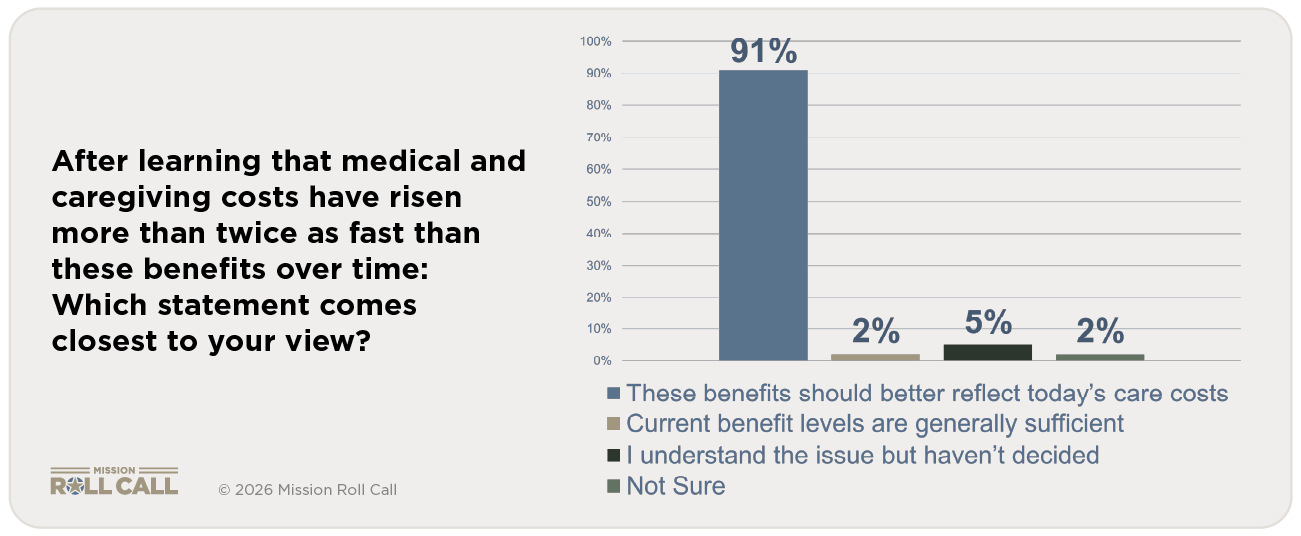
Mission Roll Call’s recent national survey on the Briley-Edmundson Act found overwhelming support among veterans, caregivers, and military families for revisiting these outdated benefit structures. More than 845 respondents participated in the survey, which examined support for expanding DIC and SMC benefits as well as broader attitudes surrounding funding tradeoffs and fiscal responsibility. After learning that medical and caregiving costs have risen more than twice as fast as these benefits over time, ninety one percent of respondents said benefits should better reflect today’s care costs. One veteran participating in the survey summarized the frustration simply: “These families are dealing with costs that didn’t even exist when these rates were first created. The system has not kept up with reality.”
The survey also revealed broad agreement that Congress has a responsibility to revisit older benefit structures when economic realities fundamentally change. Eighty-eight percent of respondents agreed it is reasonable to reevaluate benefits that were established decades ago and adjusted primarily through inflation increases alone. Respondents also consistently identified support for severely injured veterans and surviving families as one of the most important priorities within the broader veteran support system. For many families, the issue is not theoretical. Caregivers often spend years or decades providing around the clock support while sacrificing careers, retirement savings, and long-term financial stability in the process. After the veteran passes away, surviving spouses can face an abrupt financial cliff despite years spent serving as unpaid caregivers inside the home. As one surviving spouse explained, “When my husband passed, the caregiving stopped but the financial pressure didn’t. The bills and responsibilities were still there, but the support system suddenly changed overnight.”

The broader veteran community is increasingly unified on the issue. In a joint letter to House Veterans’ Affairs Committee leadership, organizations including Paralyzed Veterans of America, Wounded Warrior Project, Disabled American Veterans, AMVETS, and the Elizabeth Dole Foundation argued that updating these programs is “long overdue.” The groups emphasized that Special Monthly Compensation provides veterans with profound service-connected disabilities the financial ability to maintain some level of independence and quality of life, while Dependency and Indemnity Compensation protect surviving spouses from financial instability after the loss of a veteran.
Importantly, veterans responding to the survey also acknowledged the complexity of balancing competing priorities across the VA system. Many respondents supported balancing expanded catastrophic injury benefits with preserving broader programs like the VA Home Loan program. But even amid those tradeoffs, the central message remained remarkably consistent: veterans and families carrying the heaviest burdens should not continue falling behind because support systems failed to evolve alongside modern medical and caregiving realities. As another respondent stated, “No one is asking for luxury. They’re asking for benefits to reflect what caregiving and survival actually cost in 2026.”
The wars of the last twenty years produced a generation of veterans surviving injuries that would not have been survivable in earlier conflicts. Advances in battlefield medicine saved lives, but many of those survivors now require decades of intensive and expensive care. For many veterans, the Briley-Edmundson Act ultimately comes down to a question of fairness. The nation asked these veterans and families to carry extraordinary burdens in service to the country. Expecting financial support systems built around economic assumptions from the late 1980s and early 1990s to fully sustain those burdens today is becoming increasingly difficult to justify. As Congress debates the legislation in the coming weeks, veterans are sending a clear message: support for the nation’s most severely injured veterans and surviving families should reflect the realities of modern caregiving, modern medical costs, and modern life.