Every year, Mission Roll Call (MRC) connects directly with America’s veterans through polls, surveys, and open discussions to better understand their experiences and priorities. In 2025, thousands of veterans across the country shared their thoughts on healthcare, access, family well-being, and the systems designed to serve them.
Their insights reveal not only what veterans need, but what they teach all of us about resilience, leadership, and the importance of being heard.
Here are ten things veterans taught us in 2025.
1. Choice and Flexibility in Care Matter.
A May 2025 poll on the ACCESS Act of 2025 found that 67% of respondents believe the legislation will improve healthcare outcomes, and 71% of rural veterans said it would enhance timely access.
Lesson: Veterans taught us that empowering individuals with options matters, and one size does not fit all when it comes to care. Whether it’s choosing a provider, accessing services locally, or finding the right treatment, flexibility leads to better outcomes.
2. Innovation Is Essential for Wellness.
In a 2025 poll, 74% of veterans said they would use an online portal to schedule and track their care if one were available.
Lesson: Veterans showed us that innovation and convenience in healthcare aren’t luxuries; they’re expectations. As technology continues to transform the medical landscape, digital tools can bridge gaps, reduce wait times, and help veterans take charge of their health.
3. Transparency Builds Trust.
A March/April 2025 MRC survey found that 64% of veterans said they were concerned or strongly concerned that staffing reductions at the VA would affect their care.
Lesson: Veterans taught us the importance of transparency and stability. When systems change, people feel the impact. Open communication and accountability are critical to maintaining trust with those who’ve served.
4. Inclusion Strengthens Community.
In a November 2025 MRC survey on veteran community and belonging, many respondents reported feeling only “somewhat connected” or “neutral” to the broader veteran community, underscoring the importance of inclusive and generational recognition. The survey is still open, and veterans are encouraged to share their own experiences and perspectives at MissionRollCall.org/Veteran-Voices-Survey.
Lesson: Veterans reminded us that respect spans generations and service eras. From World War II to Iraq and Afghanistan, every story counts, and every veteran deserves recognition.
5. Food Security Is Still a Battle.
In an October 2025 poll, many veterans said they or someone they know had relied on food assistance such as SNAP or local food banks. In a separate Mission Roll Call poll during the federal government shutdown, 91% of veterans said they were concerned about losing access to food assistance, with SNAP benefits set to run dry on November 1.
Lesson: Behind the uniform are real lives, and veterans told us that meeting basic needs like food security is essential. Supporting programs that address hunger among veterans and their families must remain a national priority.
6. Staffing and Resources Shape Real Experiences.
A Mission Roll Call poll found that 44% of veterans were “very concerned” about the impact of recent VA staffing cuts, and 20% were “concerned.” Another 19% were not concerned at all, highlighting the varied experiences across the veteran community.
Lesson: Veterans showed us that staffing and resource changes are more than budget decisions; they directly affect the quality and timeliness of care. Sustainable investment in people and infrastructure matters.
7. Vigilance Protects Those Who Served.
In a July 2025 MRC poll, a significant number of veterans reported having been targeted by financial scams or fraud, highlighting the heightened vulnerability of those who’ve served.
Lesson: Veterans taught us the importance of vigilance and protection. Strong safeguards, education, and awareness are essential to preventing exploitation.
Lesson: Veterans taught us the importance of vigilance and protection. We must continue advocating for stronger safeguards, education, and awareness to prevent financial abuse among those who’ve served.
8. Voices Drive Change.
The ACCESS Act poll reached 1,292 respondents across all 50 states, 85% of whom identified as veterans.
Lesson: Veterans showed us that when they speak, leaders pay attention. Policies grounded in lived experience lead to more meaningful change.
9. Access Means Freedom of Choice.
In the same ACCESS Act poll, 60% of veterans said they were comfortable receiving mental health care from non-VA providers, and 79% said allowing veterans and families to seek care in the community without a VA referral would improve access.
Lesson: Veterans remind us that access isn’t just about eligibility; it’s about proximity, convenience, and the freedom to choose what works best for them and their families.
10. Systems Should Meet Veterans Where They Are.
Across polls and conversations, veterans expressed a common desire for systems that are “user-friendly, efficient, and meet them where they are.”
Lesson: Veterans remind us to design systems around people and not to force people to adapt to systems. When we prioritize accessibility, simplicity, and respect, everyone benefits.
Looking Ahead
This year’s insights show that veterans are not just asking for help; they are offering wisdom. Their opinions, based on our 2025 polls, taught us to lead with compassion, prioritize flexibility, and hold systems accountable to serve the people they were created to support. At Mission Roll Call, we are proud to amplify these voices because when veterans speak, America listens.
Join the Mission. Share Your Voice. Shape the Future.
Mission Roll Call’s 2026 polls are coming, and your voice matters. By participating, you help ensure that every veteran’s perspective is heard by the people who make decisions that affect your life and community.
Join Mission Roll Call today at MissionRollCall.org and be part of the conversation shaping the future for all who served.
Veteran suicide rates have remained stubbornly flat for nearly two decades despite billions invested and countless initiatives. The model we rely on still waits until veterans are already in crisis, and by then, the primary tools left are prescriptions and clinical interventions that treat symptoms but rarely restore purpose or connection. VA’s latest report still reflects thousands of veteran lives lost each year, which is why veterans in our survey delivered a near-unanimous mandate for preventive partnerships. At Mission Roll Call, we believe it is time to test a different path.
In Part One of this series, we examined what veterans lose in transition: the camaraderie, networks, and healthy outlets that once gave them purpose and belonging. In Part Two, we explored what prevention could look like if built left of clinical—fitness, service, mentorship, and creative outlets delivered in ways veterans say they want, and with barriers like cost and awareness removed.
Part Three now asks the hardest question: if veterans overwhelmingly want preventive wellness, who should lead the effort? Our survey results and broader research point to a three-legged stool: the VA providing authority and validation, Congress delivering funding and flexibility, and VSOs and nonprofits supplying the programs veterans already trust. Together, these three legs can finally create the upstream system veterans are asking for.
Part Three: Building Left of Clinical – The Three-Legged Stool of Preventive Wellness
The results of our latest survey leave little room for doubt. When asked if the VA should fund or partner with preventive wellness programs as part of its suicide prevention strategy, 78.5 percent of veterans strongly agreed, and another 17.8 percent agreed. That is as close to a mandate as we will ever see in veteran policy.
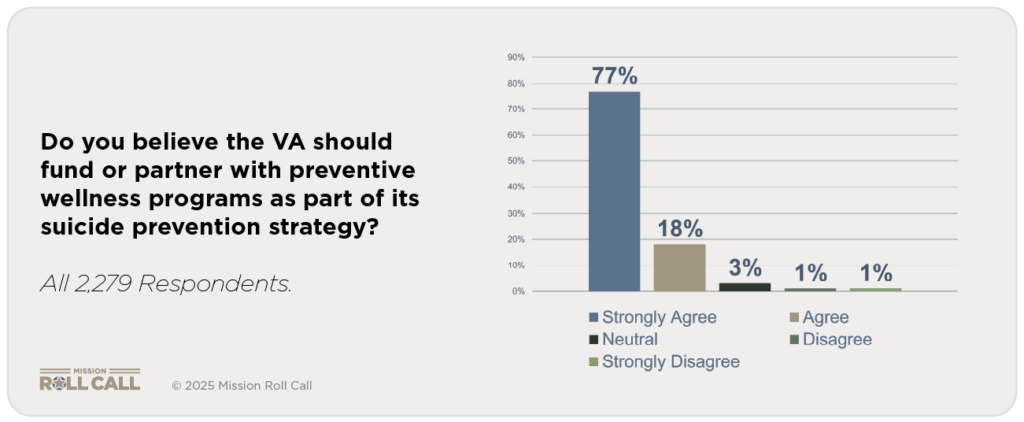
But the VA cannot build this effort alone. Congress cannot simply legislate camaraderie into existence. And while VSOs and nonprofits already deliver strong models of preventive wellness, they cannot scale nationally without support. The solution is a three-legged stool: VA authority, congressional backing, and community partnership. Each leg is essential, and only together can they move the system left of clinical.
The Role of the VA
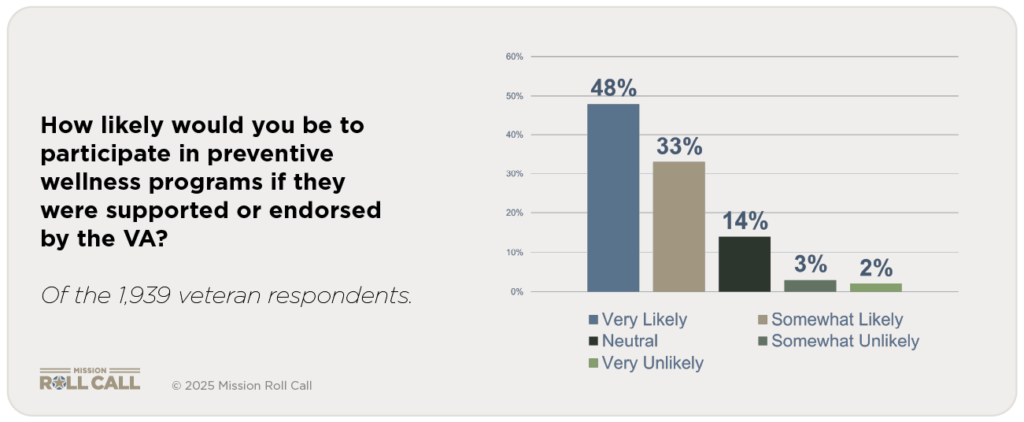
The VA is the anchor. It has the national reach, the trust of veterans, and the authority to set standards. Our survey showed that 48.1 percent of veterans would be “very likely” and another 33.3 percent “somewhat likely” to participate in preventive wellness programs if the VA endorsed them. That endorsement matters. It conveys legitimacy, safety, and continuity of care.
But the VA is not equipped to become a wellness operator. Its infrastructure is built for clinics and claims, rather than rucks, service projects, or peer-led groups. Where it can excel is in convening, validating, and integrating. Through Whole Health programs, Veteran Community Partnerships, and suicide prevention outreach pilots, the VA can create space for preventive wellness to be embedded into transition and care. The VA has some experience with this, though limited in scope, having already piloted community-based social connection models that increased engagement with services.
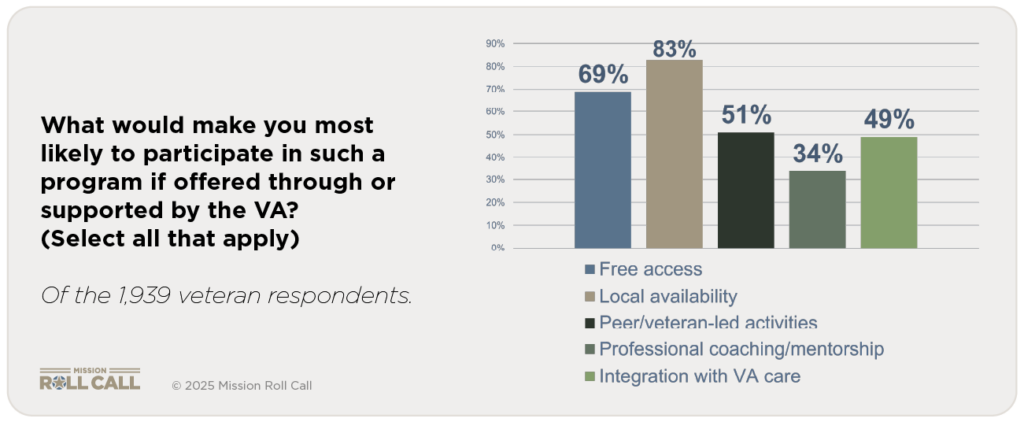
Veterans also told us what would tip the balance: free access, local availability, peer-led activities, and integration with VA systems. Those are levers the VA can pull through grants, co-branding, and referrals that treat preventive wellness as part of the benefit, not a side project.
The Role of Congress
Congress provides the tools. Without targeted legislative support, the VA cannot fund or scale preventive wellness. Congress can:
- Create dedicated funding streams for preventive wellness partnerships with VSOs and nonprofits.
- Expand pilot authorities so the VA can contract directly with non-clinical organizations for fitness, peer support, and community service programs.
- Mandate preventive wellness integration into transition and suicide prevention strategies.
- Provide budget flexibility so dollars can be used for prevention, not only crisis care.
These changes do not require a wholesale rewrite of VA’s mission. They require targeted authorities that enable the VA to meet veterans where they are — before they enter the clinical system. Preventive wellness costs less, produces stronger outcomes, and reduces reliance on polypharmacy and emergency services. Congress can make that possible.
The Role of VSOs and Community Organizations
The third leg of the stool is the nonprofit community. Organizations like Team Red, White & Blue, O2X, GoRuck, The Mission Continues, and Boot Campaign already deliver the kinds of preventive wellness veterans say they want: fitness, service, peer mentorship, creative outlets, and holistic wellness.
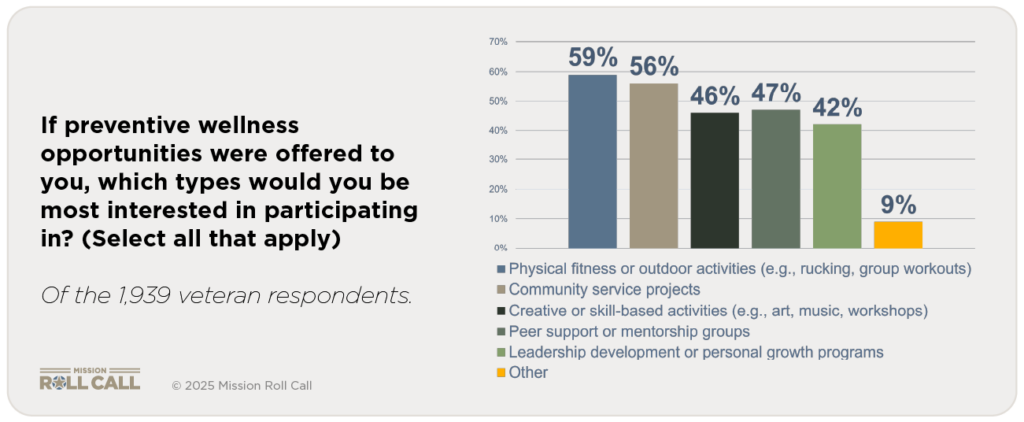
In our survey, when asked which preventive opportunities they would most prefer, veterans pointed to fitness and outdoor activities, community service projects, peer mentorship groups, and creative or skill-based workshops. These are exactly what VSOs and nonprofits already provide.
But nonprofits cannot scale nationally on their own. Their strength is agility, community credibility, and dedication to serving veterans. They know how to design programs veterans trust. What they lack is reach, official backing, and financial stability. That is where VA partnership and congressional support become essential.
The Path Forward
If each leg of the stool plays its part, preventive wellness becomes not only possible but powerful:
- The VA convenes, validates, and integrates preventive wellness into standard services.
- Congress provides the programs, intent, funding, and legal authorities to start small and then scale those efforts nationally.
- VSOs and nonprofits deliver the programs veterans want most, with the credibility and agility only community-based groups can provide.
This is not about a new bureaucracy. Rather, it’s about re-aligning our focus and resources in a way that better meets the needs of veterans. It is about using what already works, aligning it with VA’s reach, and giving it the legislative foundation to last.
Why Left of Clinical Matters
Without this three-legged stool, too many veterans will continue to arrive at the VA only when crisis is at their doorstep. By then, stress has hardened into anxiety, isolation into despair, and the only tools left are medication and clinical intervention. Our survey showed that the biggest barrier today is awareness — 53.7 percent of veterans said they simply don’t know what programs exist.
If the VA, Congress, and VSOs together remove those barriers, preventive wellness can shift the system left of clinical. That is where the real change happens — not just treating crisis, but preventing it by keeping veterans connected, active, and purposeful.
Closing
Veterans want preventive wellness. They know what kinds of programs will help. They are ready to participate if the VA supports them. And they expect their government to act.
The path forward is not VA alone. It is a three-legged stool of VA authority, congressional backing, and nonprofit partnership. Each leg is essential. Together, they can transform preventive wellness from an idea into a national reality — cheaper, more effective, and truer to what veterans say they need.
That is the veteran-led mandate to move left of clinical.
Left of Clinical is a Caregiving Imperative
This three-part series has shown the path veterans are asking us to take. In Part One, we saw the cost of losing camaraderie: isolation, stress, and unhealthy coping. In Part Two, we heard what preventive interventions could look like: fitness, service, mentorship, and creative outlets—accessible and structured to meet veterans where they are. And in Part Three, we mapped the roles of the VA, Congress, and community organizations in building the three-legged stool of preventive wellness.
Veterans are not rejecting clinical care—they are asking us to invest upstream. They want opportunities that keep them strong and connected long before the point of crisis. They want prevention that is cheaper, healthier, and more effective than a prescription.
If policymakers, the VA, and community partners take this mandate seriously, preventive wellness can become more than a concept. It can become a system that keeps veterans engaged, purposeful, and resilient. That is what it means to move Left of Clinical.
At Mission Roll Call, veterans consistently tell us that mental health and suicide prevention are their top priorities. These are not abstract statistics or distant issues — they are real challenges that affect real people, every single day. That’s why it is critical to hear the lived experiences of veterans and amplify their voices.
Stories like Don Legun’s not only shed light on what it feels like to live with depression but also help others recognize warning signs in themselves or their loved ones.
Meet Don Legun
Lieutenant Don Legun is no stranger to discipline, resilience, and achievement. Before his military career, he was an elite college gymnast and a respected gymnastics coach, known for bringing out the best in his athletes. He also taught high school industrial arts, investing in young people and building confidence both inside and outside the gym.
When the opportunity arose to fly, Don changed course. He went through Aviation Officer Candidate School and became a Naval Flight Officer (B/N), flying the A-6 Intruder. Over his 10-year career, he logged more than 1,000 flight hours, completed 200 carrier landings, and deployed three times. He later taught marketing and sales in the Officer Recruiting Command, and then managed flight schedules and coordinated training exercises for deployed air wings.
After leaving the Navy, Don’s entrepreneurial spirit led him to open a windsurfing and kite shop and launch an award-winning “Learn to Windsurf” school. He also volunteered in local classrooms, using kites to teach kids the principles of flight.
In the final months of Don’s service, he incurred a new battle to conquer. Due to environmental and emotional events while serving, depression entered his life. While this underlying challenge often undercuts his drive, it has also fueled a deeper purpose: to understand his own journey and share it so that others might survive theirs. As Don puts it, “It provides purpose for my pain.”
Don also writes and speaks about his experience, including in his book, My Side of Depression.
Mapping the Experience
For years, Don searched for ways to understand and manage his depression. During one particularly difficult period of medication adjustment, he began to notice a pattern. His depression didn’t simply arrive in an instant — it unfolded step by step. Small shifts were built into more consuming changes until he felt cut off entirely.
So he started keeping track. Each time his depression deepened, he wrote down what he was experiencing. Over time, he realized that his journey wasn’t random. It followed a recognizable sequence.
What he discovered has resonated with other veterans and civilians who’ve read his work. Many said they saw themselves in his description, recognizing familiar patterns in their own lives.
The Depression Progression
Depression looks different for everyone, but Don’s careful notes highlight how it can progress if left unrecognized or untreated. Here are 17 common signs (broken into 7 categories) to watch for in yourself or in someone you care about:
DISTANCING
- Lack of eye contact – avoiding meeting eyes in conversation, looking down often.
- Disengagement – no longer starting conversations; giving short, closed responses.
- Anxiety or restlessness – a tense, on-edge feeling, like the body is fighting itself.
- Seeking solitude – turning off music, withdrawing to a bedroom or quiet space.
FATIGUE
- Fatigue – feeling tired all the time, lacking energy for normal activities.
SHORT FUSE
- Irritability – snapping at others, becoming frustrated over small things.
- Frustration – nothing feels satisfying; a sense that life is working against you.
- Impatience – low tolerance for mistakes, responding with quick anger.
UNPROVOKED ANGER*
- Persistent anger – staying angry without a clear reason; feeling like a different person.
- Anger turned inward – frustration with oneself for not “being normal,” which fuels more rage.
SELF-RECOGNITION
- Loss of joy – activities, music, or hobbies that once brought happiness now feel empty or painful.
- Awareness of impact – recognizing that your mood is dragging others down but feeling powerless to change it.
DETACHMENT
- Avoidance of others – pulling away socially, feeling out of place, or being unable to connect.
- The “curtain” effect – a sense of being cut off from the world, able to see it but not engage with it.
- Isolation – ignoring calls, staying in bed, sleeping excessively, limiting interactions.
GIVING UP
- False comfort – growing used to withdrawal and convincing yourself it’s fine to be left alone.
- Suicidal thoughts – believing you are a burden, thinking of ending your life, and even planning it.
These signs don’t always appear in the same order, and not everyone will experience all of them. But being aware of the progression can make it easier to notice shifts sooner, and step in with support before things reach a crisis point. These patterns reflect broader trends in how mental health challenges affect veterans. To better understand the full scope, explore key insights into veteran mental health today.
One of the most important lessons Don learned is that support isn’t a straight line. That’s why Mission Roll Call created a Mental Health Thermometer, a companion tool that visualizes these stages and shows how different types of support can help at any point along the way.
The resources on the thermometer aren’t listed in order, because there is no single “right” way to get help. Depending on where you are in the progression, you might use one, several, or all of these options at different times:
- Friend in Confidence: Sometimes the first step is the simplest: talking to someone you trust. Opening up to a friend or loved one can help you process what’s happening before it deepens.
- Peer Groups: Shared experience matters. Connecting with others who’ve walked similar paths can reduce isolation and remind you that you’re not alone.
- Counselor: A licensed counselor can help you recognize patterns, develop coping tools, and work through underlying issues.
- Seek Professional Help: If symptoms persist or worsen, reaching out to a mental health professional, such as a psychologist or psychiatrist, can make a meaningful difference.
- Psychologist: Talk therapy is often the first step. Psychologists help you recognize patterns, develop coping tools, and work through underlying issues in a non-medical setting. They can also advise when additional treatment may be helpful.
- Psychiatrist: If medication is recommended, either by a psychologist or another doctor, a psychiatrist is the specialist best equipped to prescribe and manage mental health medications. They monitor side effects, adjust doses, and guide you through the process. Medication is not one-size-fits-all, so professional oversight is essential.
- Hospital: If you feel unsafe with your thoughts or believe you might act on them, going to the hospital is a vital and life-saving choice.
*A note on safety: If you’re experiencing intense, unprovoked anger or emotional outbursts that feel beyond your control, taking proactive steps to protect yourself and others is an act of strength, not weakness. Consider storing firearms or other weapons securely, with access managed by a trusted person who understands your situation. Depression can distort thinking and override logic, and limiting immediate access to lethal means during volatile periods can be a powerful preventive measure.
Above all, help is always available. If you or someone you know is thinking about suicide, call the Suicide & Crisis Lifeline at 988 (press 1 for the Veterans Crisis Line). This free, confidential support is available 24/7.
Why It Matters
Don’s courage in naming his stages and sharing them openly is exactly why Mission Roll Call exists. When veterans tell us that suicide prevention is a top priority, we don’t just listen. We amplify voices like Don’s to bring understanding, resources, and hope to others.
Depression can feel isolating, but as Don shows, even in the darkest stages, there is a way to recognize what is happening and reach for help.
This is just the beginning. Mission Roll Call will continue to share more articles and resources in partnership with Don and other mental health thought leaders, so together we can advance awareness, prevention, and support for every veteran and family.
If you or someone you know is struggling, call the Suicide & Crisis Lifeline at 988 (press 1 for the Veterans Crisis Line). You are not alone.
When it comes to healing from the invisible wounds of war, many veterans find themselves searching for relief beyond traditional treatments. One increasingly talked-about option is Hyperbaric Oxygen Therapy (HBOT)—a treatment that’s been around for decades but is now gaining attention for its potential to help veterans, especially those dealing with traumatic brain injuries (TBI) and post-traumatic stress (PTS).
But what exactly is HBOT? How does it work? And why are more people, including members of Congress, urging the Department of Veterans Affairs (VA) to embrace it? Let’s break it down.
What Is Hyperbaric Oxygen Therapy?
Hyperbaric Oxygen Therapy involves breathing pure oxygen in a pressurized chamber. The pressure is typically about 1.5 to 3 times higher than normal atmospheric pressure. This environment allows your lungs to take in significantly more oxygen than they would at sea level.
Why does that matter? Because oxygen is essential for healing. In a hyperbaric chamber, the oxygen you breathe dissolves into your blood plasma and spreads more effectively throughout your body, even to areas with poor circulation or tissue damage. This super-oxygenation helps fight infection, reduce inflammation, promote the growth of new blood vessels, and stimulate the body’s natural healing processes.
HBOT is FDA-approved for several conditions, including carbon monoxide poisoning, diabetic foot ulcers, and decompression sickness (aka “the bends” in divers). But it’s the emerging applications—like treating brain injuries—that are drawing attention from the veteran community.
How Can HBOT Help Veterans?
Veterans returning from military service often face a unique set of health challenges. Chief among these are TBIs and PTS—both of which can have long-term effects on mental clarity, memory, sleep, and emotional well-being.
Several studies and anecdotal reports suggest that HBOT may offer relief. The theory is that by flooding the brain with oxygen, HBOT can reduce inflammation and promote the repair of damaged brain tissue. For veterans who’ve suffered from blast injuries or repeated concussions, this could be a game-changer.
In some cases, veterans undergoing HBOT have reported improvements in:
– Cognitive function and memory
– Mood and emotional regulation
– Sleep quality
– Headache frequency and severity
– Anxiety and depression levels
While HBOT is not a cure-all, it appears to offer promising results when used alongside other therapies. For many veterans, especially those who’ve tried traditional medications or counseling without success, HBOT can feel like a long-overdue breath of hope.
Which Veterans Are Most Likely to Use or Need It?
HBOT is most commonly considered for veterans who:
– Have suffered a TBI from explosions, falls, or combat incidents.
– Are diagnosed with PTS, particularly when accompanied by symptoms like brain fog or chronic fatigue.
– Experience chronic pain, such as from wounds that have healed poorly or nerve damage.
– Struggle with treatment-resistant conditions, where conventional treatments haven’t provided relief.
In particular, veterans of the Iraq and Afghanistan wars—where improvised explosive devices (IEDs) were a constant threat—are among the most likely candidates. However, HBOT may also benefit older veterans with lingering effects from service-connected injuries.
Who’s Funding the Research?
Research into HBOT for brain injuries and PTS has been a mix of private and public funding, though much of the recent momentum has come from private organizations and state-level pilot programs.
Nonprofits like HBOT4Heroes, The TreatNOW Coalition, and The Healing Arizona Veterans Foundation have stepped up to sponsor HBOT treatments and conduct studies outside of the traditional VA system. Meanwhile, some state governments—like those in Oklahoma, Texas, and Florida—have launched their own HBOT pilot programs for veterans.
On the public side, there has been limited but growing federal interest. Agencies like the Department of Defense (DoD) have funded some HBOT studies, but the VA has been slower to act, citing a need for more conclusive scientific evidence.
That said, many in the medical and veteran communities argue that the real-world results speak for themselves—and that further inaction may be costing lives.
What’s Happening in Congress?
The push to make HBOT more accessible to veterans isn’t just coming from doctors and advocacy groups—it’s also gaining traction in Washington.
Over the past few years, several bills and resolutions have been introduced in Congress urging the VA to recognize and adopt HBOT as a treatment option. These efforts are typically bipartisan, reflecting widespread concern for veterans’ mental health across the political spectrum.
Some of these legislative efforts have aimed to:
– Authorize funding for HBOT pilot programs within the VA.
– Allow veterans to seek HBOT treatment from approved private providers and have it covered by the VA.
– Mandate further research into HBOT’s effectiveness for TBI and PTS.
Though progress has been slow, the increasing pressure from veterans’ groups and state-level successes is pushing the issue forward. Advocates argue that if the VA won’t offer HBOT, it should at least allow veterans to access it through the Veterans Community Care Program, which enables treatment from non-VA providers.
The Bottom Line
Hyperbaric Oxygen Therapy isn’t new, but its application for veterans with TBI and PTS is. As more veterans share stories of healing and as research continues to show promise, the momentum behind HBOT is growing.
While it’s not yet widely adopted within the VA, there’s hope on the horizon. From state-funded pilot programs to bipartisan efforts in Congress, the push to give veterans access to this therapy is gaining steam.
For many veterans, especially those who feel like they’ve tried everything else, HBOT could offer not just treatment, but renewed hope for recovery.
If you or someone you know is a veteran struggling with TBI, PTS, or chronic pain, it may be worth exploring whether HBOT is available in your state and keeping an eye on future developments from the VA and Congress.
Because sometimes, the path to healing really is just a matter of taking a deep breath.
In June, we turned our focus to two groups who too often go unseen—underserved veterans in rural and minority communities, and those living with the effects of post-traumatic stress. Through storytelling, research, media outreach, and open polling, we continued our mission to elevate the voices of veterans, advocate for policy that meets their needs, and provide tools that support their well-being.
From local heroes rebuilding after disaster to national conversations about suicide prevention and access to care, we worked to ensure that no one who served is left behind.
Here’s what you might have missed:
Underserved Veterans and PTS Awareness in Focus
We shined a light on rural and minority veterans and their families, exploring the barriers they face and the work being done to close the gaps. From highlighting key facts about rural veteran populations to uplifting efforts like Operation Honor: Rural Salute, June’s features challenged us to pay closer attention to the communities that are often overlooked.
– Connecting Rural Veterans and Their Families Through Operation Honor: Rural Salute
– 6 Things You Might Not Know About Rural Veterans
– Veterans Are Speaking Clearly on the ACCESS Act. Congress Should Listen.
– The State of Veteran Post-Traumatic Stress
– How to Find Mental Health Care If You’re A Veteran – Even In A Rural Area
– 7 Everyday Ways to Support Veterans’ Mental Health
The Lasting Mission Podcast
In June, The Lasting Mission podcast wrapped up its two-part conversation on the opioid epidemic with Voices for Non-Opioid Choices. We also continued our coverage of veteran homelessness with Part 2 of Matthew Landis’ powerful story—from hitting rock bottom to rediscovering purpose and community.
Subscribe to The Lasting Mission on YouTube or your favorite podcast platform, and help us spread these critical conversations by sharing the podcast with others.
Mission Roll Call University (MRCU)
Our YouTube channel, Mission Roll Call University, continues to grow as a trusted resource for veterans and families. In June, we released a practical guide to locating VA facilities near you—an important step in connecting to care and support.
Watch, subscribe, and share to help us ensure veterans have access to the guidance and resources they need to thrive.
MRC Town Hall: Your Voice, Your Power
We hosted a live-streamed Veteran Town Hall, bringing together voices from across the country to talk about real veteran experiences and solutions. From policy gaps to personal stories, these conversations help guide our work—and remind us how powerful it is when veterans speak directly to one another and to leaders.
MRC in the Media: Real Stories, Real Impact
In June, our work was featured in national and local media outlets, amplifying veteran voices and advocating for smarter, more compassionate policy solutions. From thoughtful conversations around VA reform to spotlighting events like Hockey Heals 22, our media presence underscored our mission.
– Smart Budget Cuts at the VA Could Help Preserve Critical Services – The Hill
– 5th Annual Hockey 22 Event Raises Awareness for Veteran Suicide – FOX 13
– Veterans Play 22 Hours of Hockey for Suicide Awareness – NPR Affiliate
From the Blog: Stories That Matter
This month’s stories included a look at veteran-led disaster recovery efforts in the Palisades, a historical reflection on 250 years of military service, and a recap of a community hockey event that raises awareness for the veteran suicide crisis.
– Where the Flag Still Flies: Veterans Rebuild the Palisades
– Hockey Heals 22
– 250 Years of the Military
Speak Up: Participate in Our Open Polls
Your voice shapes our work. We’re actively gathering feedback on topics like VA care, suicide prevention, and rural veteran access. These surveys help us bring real-time concerns to lawmakers and leaders who can make a difference.
– Take Our Open Polls
– Participate in Our Veteran Suicide Survey
Looking Ahead: Independence Through Support and Access
In July, we’ll focus on veteran independence—honoring the strength and resilience of wounded veterans, caregivers, and those navigating life after service with courage and adaptability. We’ll explore how accessibility, autonomy, and practical support can help more veterans thrive on their own terms.
Stay tuned for new stories, new research, and new opportunities to connect.
If there is something we have learned about supporting our veterans, it is that mental health is one of the most complicated problems to tackle, especially for veterans in rural areas. VA reports have found that veterans are most vulnerable in the first three months following separation from military service, although suicide risk “remains elevated for years after the transition.” With this information, we can better support our veterans and their families to get them the assistance they need.
While veterans can access mental health care through a variety of channels, knowing what is available to them and gaining access are common hurdles for not just rural veterans but all veterans. These barriers reflect a broader set of challenges veterans face after service—explore the challenges veterans face after service for additional context.
The two main mental health resources are the VA and the Veteran Crisis Line.
VA Mental Health Services
- VA mental health services are available to all veterans, regardless of their discharge status, and even if they don’t qualify for full VA benefits.
- The VA offers various mental health services, including individual and group therapy, medication management, and support groups.
- You can find a VA medical center or Vet Center near you through the VA.gov website.
Veterans Crisis Line (988, then press 1)
- This is a crucial resource for veterans experiencing a crisis or needing immediate support. It’s accessible 24/7, offering confidential counseling through phone, text, and online chat.
- If you or the veteran or service member in your life shows signs of crisis, contact the Veterans Crisis Line. In the United States, dial 988 then press 1 or text 838255.
- You can chat online with a VA responder from anywhere.
- If you are overseas, you can connect with the Veterans Crisis Line Chat. If you prefer a phone call, you can request this via chat. A crisis line responder will call the number you provide at no charge.
But if those are unavailable to you due to location or other reasons, here’s a list of other mental health resources you might not know about.
Boulder Crest is the home of Posttraumatic Growth (PTG). They offer life-changing programs free of charge to members of the military, veterans, and first responder communities, and their families.
America’s Warrior Partnership
America’s Warrior Partnership’s mission is to partner with communities to prevent veteran suicide. Their programs accomplish this by starting at the community level and understanding the unique situations of veterans and their families.
Avalon Action Alliance connects our nation’s veterans and first responders with life-changing programs. Their Alliance Partners offer a wide range of treatments, training and support tailored to the unique needs of our veterans and first responders.
Shields & Stripes provides a top-tier rehabilitation program for our military veterans and first responders.
Warrior Canine Connection utilizes a Mission Based Trauma Recovery model to help Warriors recovering from the stress of combat reconnect with their families, communities, and life. By interacting with the dogs as they move from puppyhood to training to adult service dogs, Warrior Trainers benefit from a physiological and psychological animal-human connection.
Wounded Warrior Project
Provides various mental health services, including individual and couples counseling, and PTSD and addiction treatment.
Military OneSource
Offers resources for veterans, including mental health information and a directory of services.
Mission Roll Call’s Veteran Resource Directory
Our comprehensive directory connects veterans and their families to organizations ready to help.
When it comes to the mental health of veterans and their families, we know there’s not one solution that fits all. But what we do know is that we need to be more proactive. Help exists for veterans and their families; they just need to know what is available to them. Share this article with a veteran – they might need it or know someone else who does.
Supporting a veteran’s mental health requires active listening, encouragement, and resourcefulness. It involves creating a safe space for them to share their feelings, finding local support groups or mental health professionals, and being patient and understanding. Small, everyday gestures like offering a helping hand with tasks, expressing empathy, and attending local veterans’ events can also make a significant difference.
Here are 7 everyday ways to support veterans’ mental health:
1. Be present and consistent. Let them know you care and are there for them, even if you don’t fully understand what they’re going through. Offer encouraging words and focus on their strengths and resilience.
2. Encourage without pushing. Acknowledge that recovery takes time, and don’t pressure them to “get better” quickly. Be patient and understanding as they navigate their journey. Allow the veteran to decide when and how they want to share their feelings. Offer space for them to share if they wish, but don’t pressure them.
3. Help navigate resources. Help them find resources like local support groups, mental health professionals, or the VA’s mental health services. Mission Roll Call and the Veterans Crisis Line can also provide valuable resources, information, and assistance. Knowing that there is a path to recovery with tailored resources is its own kind of reassurance.
4. Share space without judgment. Be a supportive listener, offering a non-judgmental space for the veteran to share their experiences and feelings. Give them your full attention and avoid offering unsolicited advice.
5. Offer practical help. Support them with everyday tasks like grocery shopping, meal planning, or errands if they are struggling to manage their routine.
6. Stay connected regularly. Staying connected with veterans in your life can provide a sense of purpose and community. If your veteran is hard to get a hold of, consider social media platforms or other online routes to keep the conversation going at their preferred speed. Also, small actions like attending veteran-specific events with them can go a long way to make them feel connected with you and other veterans.
7. Self-Care for you. Supporting someone with mental health challenges can be emotionally taxing. It’s important to prioritize your own well-being and seek support for yourself if needed. You cannot pour from an empty cup, and it is important for those who support our veterans to give them our best – to do this, you must take care of yourself.
By employing these strategies, both veterans and those who care about them can foster stronger connections and build supportive communities, ultimately leading to greater well-being and a sense of belonging. These efforts often address deeper challenges many veterans experience after service.
Looking for more mental health information and resources? Discover the support you need in Mission Roll Call’s Veteran Resource Directory. Our comprehensive directory connects veterans and their families to organizations ready to help.
If you or a veteran in your life needs support, consider requesting help from the AWP Network. The AWP Network is staffed by a dedicated team of case coordinators with social services backgrounds who are experts at holistically identifying problems and finding one-size-fits-one solutions. For immediate support, call the Veterans Crisis Line – dial 988 then press 1.
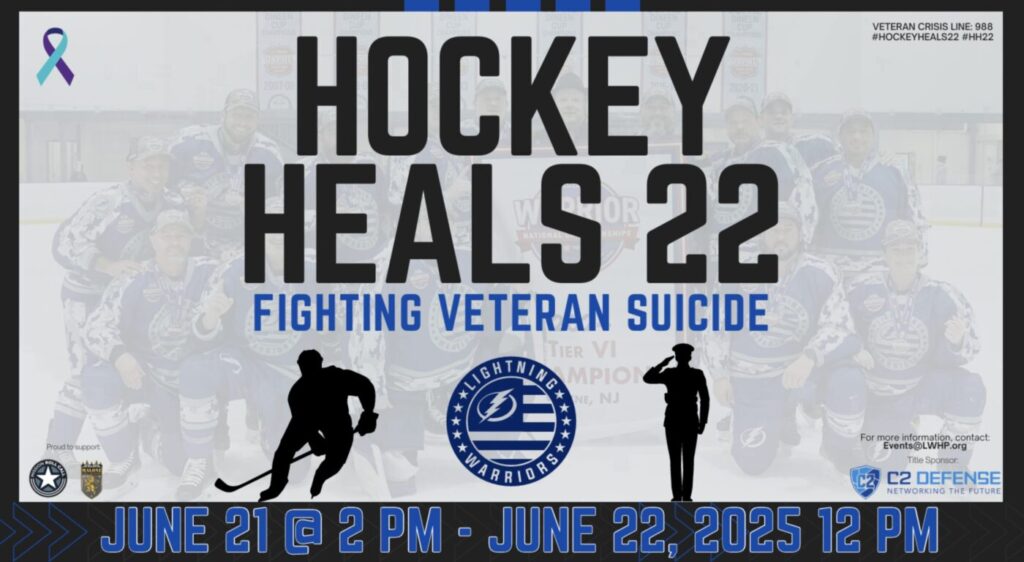
This June 21-22, Mission Roll Call is proud to join forces with the Lightning Warriors Hockey Program and the Malone Family Foundation for Hockey Heals 22, an inspiring event where 22 hours of continuous hockey are dedicated to one powerful mission: ending veteran suicide.
Veteran suicide is a national crisis. For years, the number “22” has served as a symbol, representing the estimated 22 veterans lost to suicide each day. While different studies and data sources have offered varied figures over time, the truth remains painfully clear: we are losing far too many heroes to invisible wounds.
Behind every number is a name, a family, and a story. And events like Hockey Heals 22 remind us that awareness alone isn’t enough—we need action, connection, and purpose to drive real change.
The Lightning Warriors
Founded in 2017 and formally incorporated in 2020, the Lightning Warriors Hockey Program is a Tampa-based 501(c)(3) nonprofit dedicated to serving the disabled veteran community through hockey. Their mission is to create a therapeutic and educational environment—both recreational and competitive—that fosters healing, camaraderie, and a renewed sense of purpose.
Hockey Heals 22 is an extension of that mission. It brings together athletes, veterans, and supporters to raise awareness, build community, and honor those we’ve lost by fighting for those still here.
MRC’s Role
As a national, 501(c)(3) nonprofit, Mission Roll Call gives a voice to veterans and their families through real-time polling, storytelling, and advocacy. Our mission is simple: to ensure every veteran is seen, heard, and supported.
In 2025, we’re focused on four critical priorities:
- Suicide prevention
- Homelessness
- Access to healthcare
- Food and financial insecurity
These challenges are deeply interconnected. That’s why we listen directly to veterans, share their experiences, and advocate for smart, effective policies—like the Senator Elizabeth Dole 21st Century Veterans Healthcare and Benefits Improvement Act, which expands mental health care access and support for underserved communities.
Events like Hockey Heals 22 help bring our work to life, uniting national advocacy with local action and community care.
MRC is proud to share this space with the Malone Family Foundation, a fellow co-beneficiary whose mission centers on mental wellness and recovery for veterans, first responders, and their families. Their work—especially through sport-based wellness programs—echoes the values at the heart of this event.
If you’re in the Tampa area, we invite you to join us in person for Hockey Heals 22, as we stand alongside the Lightning Warriors, the Malone Family Foundation, and all those who are committed to saving lives and building a stronger future for our nation’s veterans and their families. If you can’t make it, follow along on MRC’s social channels for photos, stories, and updates from the event.
Together, we can help ensure that every veteran knows: you are not alone, and your life matters.
May is a month rooted in reverence, honoring those who serve, those we’ve lost, and the invisible battles many veterans still fight every day. At Mission Roll Call, we used this month to spotlight both Military Appreciation Month and Mental Health Awareness Month, elevating the importance of recognition, resilience, and reform.
From celebrating the contributions of our service members to confronting the mental health crisis within the veteran community, May’s stories, interviews, and insights brought our mission into sharper focus.
Here’s what you might have missed:
Military Appreciation and Mental Health Awareness in Focus
We explored the true meaning of appreciation and support—not just in words, but in action.
– The Real Meaning of Military Appreciation
– Carrying the Mission of Memorial Day All Year
– From Waves to Wellness with Operation Surf
– 2025 Military Appreciation Month Discounts
Helpful Tips and Awareness
– Real ID and Veterans: What You Need to Know
– 5 Essential Financial Tips for Life After the Military
– The Military Fix-All That Held It All Together
The Lasting Mission Podcast
In May, The Lasting Mission podcast continued to elevate critical conversations that impact the veteran community.
This month’s episode features U.S. Representative Greg Landsman in part one of a two-part discussion on the opioid epidemic and how bipartisan action can lead to safer, non-opioid alternatives for pain management.
Listen to the episode
Subscribe to The Lasting Mission on YouTube or your favorite podcast platform, and help us spread these important conversations by sharing the podcast with others.
Mission Roll Call University (MRCU)
Our YouTube channel, Mission Roll Call University, continues to serve as a go-to resource for veterans, families, and supporters. This month, we released a new episode focused on managing finances and reducing stress before and after separation from military service.
– Break FREE from Financial Stress: Prepare for Your Military Transition NOW
Watch, subscribe, and share to help us ensure veterans have access to the guidance and tools they need to thrive.
MRC in the Media: Advocacy that Resonates
– Lawmakers Move to Stop VA from Quietly Taking Gun Rights from Veterans
– Veterans Concerned About Proposed VA Cuts
– VA Reform: Veteran Advocate Calls for Less Bureaucracy, Better Care
– Newsmax Interview with CEO Jim Whaley
– The Tony Kinnett Podcast – Daily Signal Interview
– Veterans group rises to Collins’s defense over VA cuts: ‘Gotta think differently’
Speak Up: Participate in Our Open Polls
Your voice shapes our mission. From VA services to veteran employment, our open polls help guide where we focus next.
Take the latest poll
Support the Mission: $25 for 250 Campaign
As we honor 250 years of military service, we’re asking supporters to give just $25 to power our next chapter. Every gift helps amplify the voices of veterans and their families.
Donate and explore the timeline
Looking Ahead: Rural and Minority Veterans, PTS Awareness, and Mental Health Resources
In June, we’ll shine a light on rural and minority veterans, communities often overlooked in national conversations, and honor Post-Traumatic Stress Awareness Month with practical resources, inspiring stories, and expert insights. From navigating VA enrollment to supporting mental health in everyday life, we’re committed to supporting veterans and families and bridging gaps in care.
Stay tuned for new research, new conversations, and new ways to get involved.
Fuel Veteran Voices
A small gift powers the research and advocacy that brings veterans to the decision-making table.
Donate $5+