At Mission Roll Call, every year starts by listening. In our 2025 annual priorities survey, thousands of veterans, family members, and supporters shared their experiences and perspectives. The result: four core priorities have emerged to guide our work in 2026.
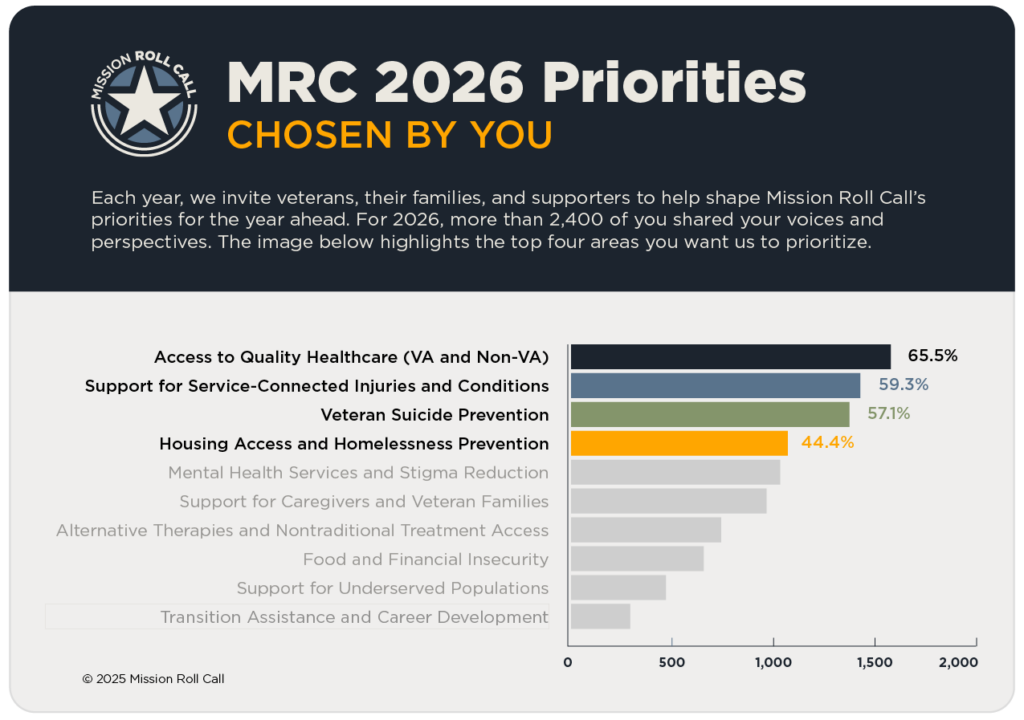
But hearing those priorities is only the beginning. Below are six focus areas that we are carrying forward into 2026. These 6 areas are where veteran voices are driving action, and where we are committed to turning plans into progress.
1. Expanding Access to Quality Healthcare (VA & Non‑VA)
Veterans consistently tell us that timely, high‑quality care is one of their most urgent needs.
In 2026, we are stepping up our efforts to map the barriers veterans face in accessing care and to advocate for policies that remove those obstacles. Expect more research, more storytelling, and more collaborative partnerships aimed at improving outcomes and reducing travel or wait‑time burdens.
Why it matters: Healthcare may be a system, but real care happens person to person. Keeping veterans at the center of the design ensures the system serves, not impedes, them.
2. Supporting Service‑Connected Injuries and Conditions
Many veterans live with long‑term, service‑connected injuries and conditions both visible and invisible.
In 2026, our work will zero in on caregivers, the complexity of chronic care, transitions between active duty and civilian life, and the advocacy required to make sure the benefits and programs veterans earned actually work for them.
Why it matters: Service doesn’t stop at discharge. The condition may persist and the support should too.
3. Enhancing Veteran Suicide Prevention
Preventing veteran suicide remains a top priority.
But in 2026, we’re refining the approach. We’ll explore not only crisis intervention, but prevention before crisis such as peer networks, community connection, non‑clinical wellness, and early engagement.
Why it matters: Countless initiatives exist, but veterans are telling us that what’s missing is reaching them before they hit the edge. We’re committed to shifting earlier on the timeline.
4. Expanding Housing Access & Homelessness Prevention
Every veteran deserves a safe, stable place to live and yet too many remain without it.
Our 2026 efforts will shine a spotlight on the root causes of veteran homelessness: economic instability, healthcare gaps, transitions, and family breakdowns. We’ll profile promising models, support policy change, and elevate veteran‑led solutions in housing stability.
Why it matters: A home is more than a roof—it’s a platform for healing, purpose, and community reintegration.
5. Amplifying Veteran, Family & Caregiver Voices
The four key priorities above emerged because veterans spoke up. This priority remains at the core of Mission Roll Call.
In 2026, we’ll carry forward not just issue‑areas but the method: listening to veterans, families, and caregivers, and turning their perspectives into action. That means more surveys, more regional outreach, more transparency in how we use what we hear.
Why it matters: Change without input is incomplete. When those most affected have a seat at the table, the outcome is stronger.
6. Strengthening Partnerships & Resource Networks
Our advocacy is built on collaboration with veteran service organizations (VSOs), community groups, policymakers, and families.
In 2026, we’ll expand our resource‑directory model, deepen local‑level partnerships, and ensure that knowledge and connection travel as fast as policy changes. That means more stories, more tool‑kits, more live events, and more ways for every veteran to link into the network of support.
Why it matters: When resources are scattered and hard to find, they may as well not exist. Bringing them together amplifies impact.
Looking Ahead
These six focus areas are not silos; they’re interconnected threads in a broader mission. Veterans and families told us what matters; now we carry that work into action.
At Mission Roll Call, we are honored to amplify your voices, turn your feedback into policy and practice, and build a future where every veteran is seen, heard, and supported.
If you haven’t yet participated in our Veteran Voices survey, now’s your chance. Your experience matters, and your voice remains the fuel for change. Join us and be part of the movement.
At Mission Roll Call, everything begins with listening. This year, thousands of veterans, family members, and supporters across the country shared their experiences and perspectives through our annual priorities survey. Together, those voices have shaped our path forward.
Based on what we heard from you, four priorities will guide our work in 2026:
- Access to Quality Healthcare (VA and Non-VA)
- Support for Service-Connected Injuries and Conditions
- Veteran Suicide Prevention
- Housing Access and Homelessness Prevention
These priorities represent both the challenges veterans and families face and the opportunities we have to create meaningful impact in the year ahead.
When veterans, families, and supporters share their stories with us, they shape national conversations. Veteran feedback directly influences how we advocate, the research we conduct, and the partnerships we build to drive progress. Your voices matter!
Access to Quality Healthcare:
Veterans consistently tell us that timely, high-quality care is one of their most urgent needs. Mission Roll Call is currently conducting research to understand where barriers exist and how to improve care across the system. The findings will be published before the end of 2025 and will help guide our advocacy to make access and outcomes stronger for every veteran.
Support for Service-Connected Injuries and Conditions:
From visible wounds to chronic conditions, many veterans face long-term challenges tied to their service. Mission Roll Call is focused on ensuring they receive the care, benefits, and support they’ve earned. This includes spotlighting policy updates, caregiver perspectives, and programs that promote recovery and independence.
Veteran Suicide Prevention:
Suicide prevention remains a top priority. We are gathering data to better understand risk and resilience among veterans and their families. Through upcoming articles, podcasts, and research, we’ll explore ways to strengthen protective supports and expand preventive approaches to mental wellness.
Housing Access and Homelessness Prevention:
Every veteran deserves a safe place to live. Yet too many remain without stable housing. Mission Roll Call continues to highlight stories, research, and resources that address the root causes of veteran homelessness. To learn more about our efforts in 2025, visit our spotlight page on housing and homelessness.
Working Together for Greater Impact
Mission Roll Call’s work is strengthened by collaboration with Veteran Service Organizations (VSOs) featured in our Veteran Resource Directory. These partnerships help veterans connect to trusted local resources while ensuring that on-the-ground experiences inform our collective efforts.
Throughout 2026, we’ll share updates, research findings, and real stories through articles, blogs, podcasts, and Mission Roll Call University (MRCU). We’ll also report on progress tied to each of these priorities so that the community remains informed and engaged as we move forward.
Why Your Voice Matters
Every story shared and every survey completed moves the mission forward. Veterans and their families help us see where progress is happening and where it’s still needed, guiding how Mission Roll Call educates, informs, engages, and connects.
Because of you, we are turning individual experiences into collective impact. You’re helping build a stronger future for those who have served, and for the generations that will follow.
Thank you for lending your voice to the mission.
At Mission Roll Call, veterans consistently tell us that mental health and suicide prevention are their top priorities. These are not abstract statistics or distant issues — they are real challenges that affect real people, every single day. That’s why it is critical to hear the lived experiences of veterans and amplify their voices.
Stories like Don Legun’s not only shed light on what it feels like to live with depression but also help others recognize warning signs in themselves or their loved ones.
Meet Don Legun
Lieutenant Don Legun is no stranger to discipline, resilience, and achievement. Before his military career, he was an elite college gymnast and a respected gymnastics coach, known for bringing out the best in his athletes. He also taught high school industrial arts, investing in young people and building confidence both inside and outside the gym.
When the opportunity arose to fly, Don changed course. He went through Aviation Officer Candidate School and became a Naval Flight Officer (B/N), flying the A-6 Intruder. Over his 10-year career, he logged more than 1,000 flight hours, completed 200 carrier landings, and deployed three times. He later taught marketing and sales in the Officer Recruiting Command, and then managed flight schedules and coordinated training exercises for deployed air wings.
After leaving the Navy, Don’s entrepreneurial spirit led him to open a windsurfing and kite shop and launch an award-winning “Learn to Windsurf” school. He also volunteered in local classrooms, using kites to teach kids the principles of flight.
In the final months of Don’s service, he incurred a new battle to conquer. Due to environmental and emotional events while serving, depression entered his life. While this underlying challenge often undercuts his drive, it has also fueled a deeper purpose: to understand his own journey and share it so that others might survive theirs. As Don puts it, “It provides purpose for my pain.”
Don also writes and speaks about his experience, including in his book, My Side of Depression.
Mapping the Experience
For years, Don searched for ways to understand and manage his depression. During one particularly difficult period of medication adjustment, he began to notice a pattern. His depression didn’t simply arrive in an instant — it unfolded step by step. Small shifts were built into more consuming changes until he felt cut off entirely.
So he started keeping track. Each time his depression deepened, he wrote down what he was experiencing. Over time, he realized that his journey wasn’t random. It followed a recognizable sequence.
What he discovered has resonated with other veterans and civilians who’ve read his work. Many said they saw themselves in his description, recognizing familiar patterns in their own lives.
The Depression Progression
Depression looks different for everyone, but Don’s careful notes highlight how it can progress if left unrecognized or untreated. Here are 17 common signs (broken into 7 categories) to watch for in yourself or in someone you care about:
DISTANCING
- Lack of eye contact – avoiding meeting eyes in conversation, looking down often.
- Disengagement – no longer starting conversations; giving short, closed responses.
- Anxiety or restlessness – a tense, on-edge feeling, like the body is fighting itself.
- Seeking solitude – turning off music, withdrawing to a bedroom or quiet space.
FATIGUE
- Fatigue – feeling tired all the time, lacking energy for normal activities.
SHORT FUSE
- Irritability – snapping at others, becoming frustrated over small things.
- Frustration – nothing feels satisfying; a sense that life is working against you.
- Impatience – low tolerance for mistakes, responding with quick anger.
UNPROVOKED ANGER*
- Persistent anger – staying angry without a clear reason; feeling like a different person.
- Anger turned inward – frustration with oneself for not “being normal,” which fuels more rage.
SELF-RECOGNITION
- Loss of joy – activities, music, or hobbies that once brought happiness now feel empty or painful.
- Awareness of impact – recognizing that your mood is dragging others down but feeling powerless to change it.
DETACHMENT
- Avoidance of others – pulling away socially, feeling out of place, or being unable to connect.
- The “curtain” effect – a sense of being cut off from the world, able to see it but not engage with it.
- Isolation – ignoring calls, staying in bed, sleeping excessively, limiting interactions.
GIVING UP
- False comfort – growing used to withdrawal and convincing yourself it’s fine to be left alone.
- Suicidal thoughts – believing you are a burden, thinking of ending your life, and even planning it.
These signs don’t always appear in the same order, and not everyone will experience all of them. But being aware of the progression can make it easier to notice shifts sooner, and step in with support before things reach a crisis point. These patterns reflect broader trends in how mental health challenges affect veterans. To better understand the full scope, explore key insights into veteran mental health today.
One of the most important lessons Don learned is that support isn’t a straight line. That’s why Mission Roll Call created a Mental Health Thermometer, a companion tool that visualizes these stages and shows how different types of support can help at any point along the way.
The resources on the thermometer aren’t listed in order, because there is no single “right” way to get help. Depending on where you are in the progression, you might use one, several, or all of these options at different times:
- Friend in Confidence: Sometimes the first step is the simplest: talking to someone you trust. Opening up to a friend or loved one can help you process what’s happening before it deepens.
- Peer Groups: Shared experience matters. Connecting with others who’ve walked similar paths can reduce isolation and remind you that you’re not alone.
- Counselor: A licensed counselor can help you recognize patterns, develop coping tools, and work through underlying issues.
- Seek Professional Help: If symptoms persist or worsen, reaching out to a mental health professional, such as a psychologist or psychiatrist, can make a meaningful difference.
- Psychologist: Talk therapy is often the first step. Psychologists help you recognize patterns, develop coping tools, and work through underlying issues in a non-medical setting. They can also advise when additional treatment may be helpful.
- Psychiatrist: If medication is recommended, either by a psychologist or another doctor, a psychiatrist is the specialist best equipped to prescribe and manage mental health medications. They monitor side effects, adjust doses, and guide you through the process. Medication is not one-size-fits-all, so professional oversight is essential.
- Hospital: If you feel unsafe with your thoughts or believe you might act on them, going to the hospital is a vital and life-saving choice.
*A note on safety: If you’re experiencing intense, unprovoked anger or emotional outbursts that feel beyond your control, taking proactive steps to protect yourself and others is an act of strength, not weakness. Consider storing firearms or other weapons securely, with access managed by a trusted person who understands your situation. Depression can distort thinking and override logic, and limiting immediate access to lethal means during volatile periods can be a powerful preventive measure.
Above all, help is always available. If you or someone you know is thinking about suicide, call the Suicide & Crisis Lifeline at 988 (press 1 for the Veterans Crisis Line). This free, confidential support is available 24/7.
Why It Matters
Don’s courage in naming his stages and sharing them openly is exactly why Mission Roll Call exists. When veterans tell us that suicide prevention is a top priority, we don’t just listen. We amplify voices like Don’s to bring understanding, resources, and hope to others.
Depression can feel isolating, but as Don shows, even in the darkest stages, there is a way to recognize what is happening and reach for help.
This is just the beginning. Mission Roll Call will continue to share more articles and resources in partnership with Don and other mental health thought leaders, so together we can advance awareness, prevention, and support for every veteran and family.
If you or someone you know is struggling, call the Suicide & Crisis Lifeline at 988 (press 1 for the Veterans Crisis Line). You are not alone.
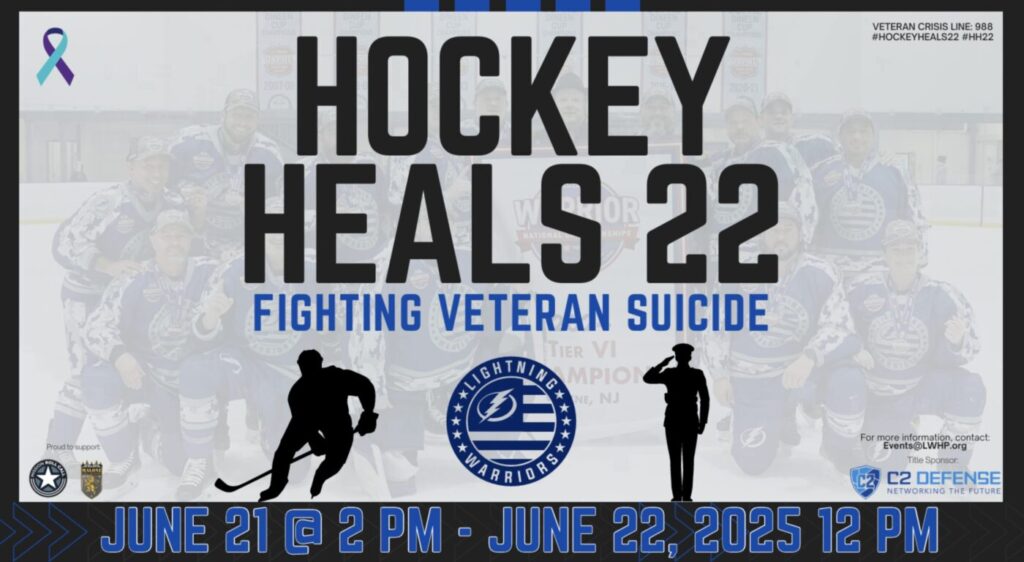
This June 21-22, Mission Roll Call is proud to join forces with the Lightning Warriors Hockey Program and the Malone Family Foundation for Hockey Heals 22, an inspiring event where 22 hours of continuous hockey are dedicated to one powerful mission: ending veteran suicide.
Veteran suicide is a national crisis. For years, the number “22” has served as a symbol, representing the estimated 22 veterans lost to suicide each day. While different studies and data sources have offered varied figures over time, the truth remains painfully clear: we are losing far too many heroes to invisible wounds.
Behind every number is a name, a family, and a story. And events like Hockey Heals 22 remind us that awareness alone isn’t enough—we need action, connection, and purpose to drive real change.
The Lightning Warriors
Founded in 2017 and formally incorporated in 2020, the Lightning Warriors Hockey Program is a Tampa-based 501(c)(3) nonprofit dedicated to serving the disabled veteran community through hockey. Their mission is to create a therapeutic and educational environment—both recreational and competitive—that fosters healing, camaraderie, and a renewed sense of purpose.
Hockey Heals 22 is an extension of that mission. It brings together athletes, veterans, and supporters to raise awareness, build community, and honor those we’ve lost by fighting for those still here.
MRC’s Role
As a national, 501(c)(3) nonprofit, Mission Roll Call gives a voice to veterans and their families through real-time polling, storytelling, and advocacy. Our mission is simple: to ensure every veteran is seen, heard, and supported.
In 2025, we’re focused on four critical priorities:
- Suicide prevention
- Homelessness
- Access to healthcare
- Food and financial insecurity
These challenges are deeply interconnected. That’s why we listen directly to veterans, share their experiences, and advocate for smart, effective policies—like the Senator Elizabeth Dole 21st Century Veterans Healthcare and Benefits Improvement Act, which expands mental health care access and support for underserved communities.
Events like Hockey Heals 22 help bring our work to life, uniting national advocacy with local action and community care.
MRC is proud to share this space with the Malone Family Foundation, a fellow co-beneficiary whose mission centers on mental wellness and recovery for veterans, first responders, and their families. Their work—especially through sport-based wellness programs—echoes the values at the heart of this event.
If you’re in the Tampa area, we invite you to join us in person for Hockey Heals 22, as we stand alongside the Lightning Warriors, the Malone Family Foundation, and all those who are committed to saving lives and building a stronger future for our nation’s veterans and their families. If you can’t make it, follow along on MRC’s social channels for photos, stories, and updates from the event.
Together, we can help ensure that every veteran knows: you are not alone, and your life matters.
Fuel Veteran Voices
A small gift powers the research and advocacy that brings veterans to the decision-making table.
Donate $5+