Veteran suicide rates have remained stubbornly flat for nearly two decades despite billions invested and countless initiatives. The current model largely waits until veterans are already in crisis, and by then, the tools left are prescriptions and clinical interventions that treat symptoms but rarely restore purpose and connection. At Mission Roll Call, we believe it is time to test a different path.
In Part One of this series, we saw the cost of lost camaraderie. Veterans told us they miss the team, struggle to build new networks, and often lack healthy outlets for stress. Nearly all agreed that structured opportunities for connectedness are essential. Without them, isolation grows, stress compounds, and too many veterans arrive at the VA only when a crisis is at their doorstep.
Part Two asks the next question: what would it look like to act Left of Clinical—to create preventive opportunities for connection, service, and purpose before the prescription pad comes out? Our survey results outline what veterans want, what keeps them from joining today, and what would make participation possible. The answers are clear, practical, and veteran-led.
Part Two: Designing Interventions Left of Clinical
Veterans told us exactly the kinds of interventions they would choose. When asked what preventive wellness opportunities mattered most, the top answers were physical fitness and outdoor activities, community service projects, peer mentorship groups, and creative or skill-based workshops.
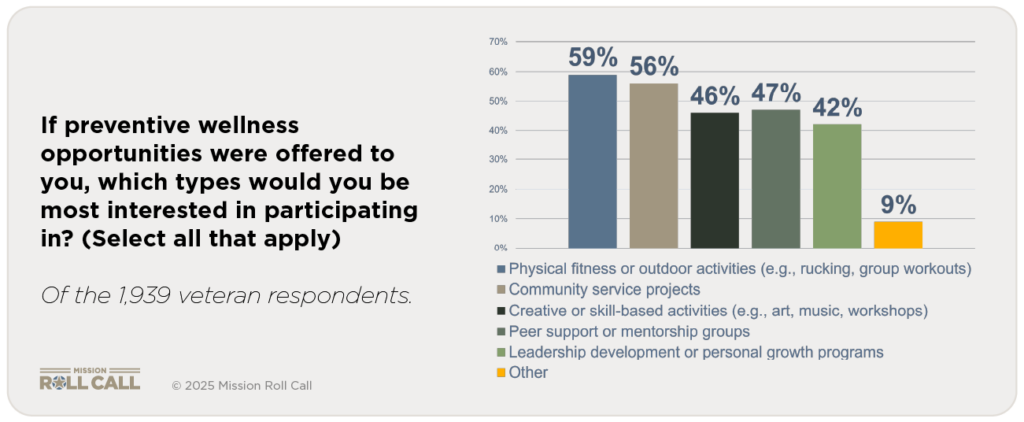
These are not exotic solutions. They are the same habits that keep people healthier across all populations: exercise, social connection, meaningful activity, and self-expression. Veterans are pointing to everyday practices that build resilience — only they want them structured, accessible, and veteran-oriented. Independent research from Frontiers in Psychology also confirms that peer- and group-oriented programs have been shown to reduce loneliness and increase purpose and engagement among veterans.
What Keeps Veterans Out
So why aren’t more already engaged in these activities? The biggest barrier, by far, was lack of awareness. More than half of respondents (53.7 percent) said they simply don’t know what programs are available. Cost came next at 18.8 percent, followed by scheduling conflicts (11.3 percent) and transportation (7.5 percent).
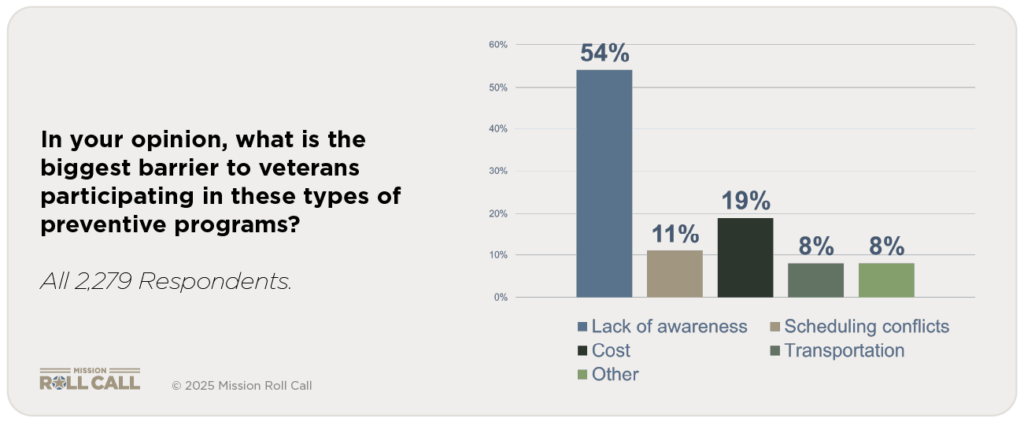
This tells us something important: veterans are not rejecting preventive wellness. Most just don’t know it exists or can’t make it fit into their lives. The problem is not demand. The problem is design. This tracks with what we’ve reported at Mission Roll Call about awareness and navigation challenges across VA systems.
What Would Tip the Balance
We also asked what would make veterans more likely to participate. The answers clustered around four practical needs: free access, local availability, peer- or veteran-led activities, and integration with VA care. These directly mirror the barriers: address cost, geography, trust, and legitimacy, and you unlock participation.
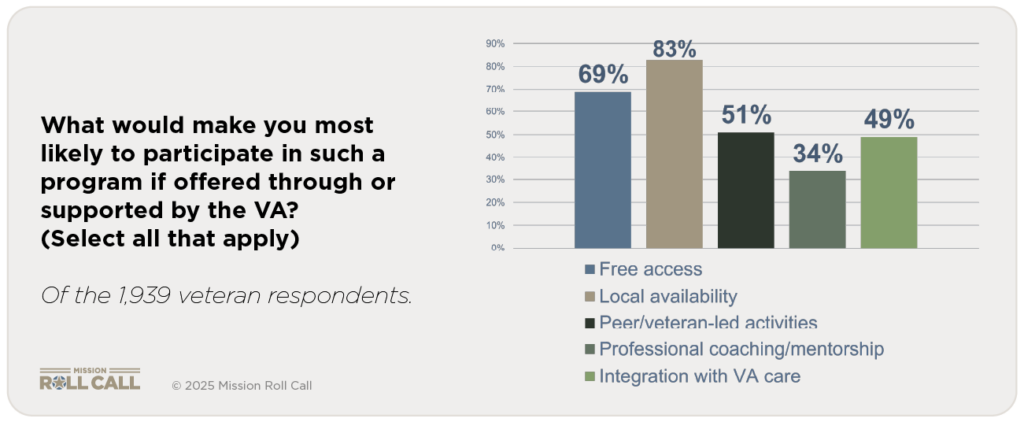
This is not about inventing something new, and it points directly to solutions. If we want preventive wellness to be real, we don’t need to invent a new model. We need to remove the obstacles veterans themselves have identified. Independent research from RAND catalogs preventive activities where peer and community strategies complement clinical care, suggesting VA endorsement and integration can multiply impact.
The Power of VA Endorsement
Finally, we asked how likely veterans would be to join preventive wellness programs if the VA supported or endorsed them. Nearly half (48.1 percent) said “very likely,” another 33.3 percent said “somewhat likely,” and only 4.7 percent said unlikely.
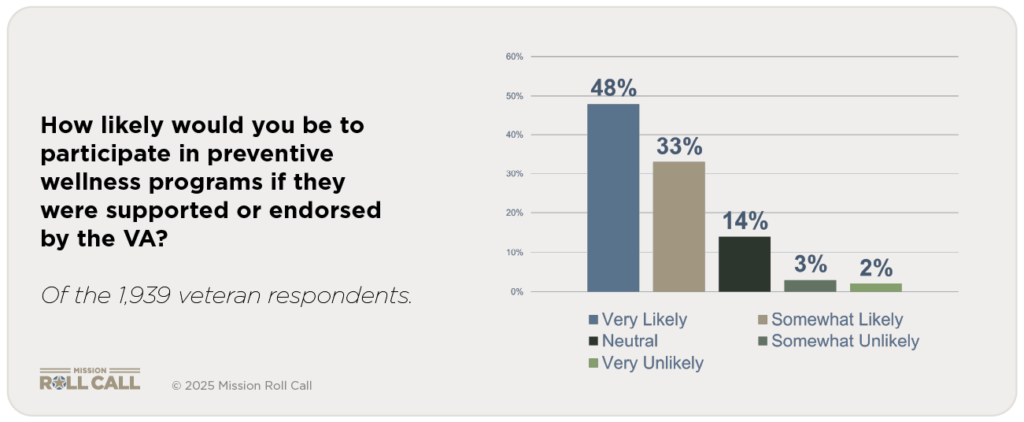
That endorsement matters. It signals credibility, safety, and legitimacy. Veterans are telling us they would proactively join preventive opportunities if those opportunities existed and if the VA put its weight behind them.
This is the essence of Left of Clinical. Veterans do not want to wait for crises. They are asking for earlier options that are cheaper, healthier, and more sustainable than endless clinical interventions. Broader research also associates routine physical activity with lower rates of mental-health problems and suicidality, underscoring why fitness-based, peer programs can be smart prevention.
Why This Matters
If half of veterans are already struggling with stress or isolation, and more than 80 percent say they would likely participate in preventive programs if endorsed by the VA, then the opportunity is enormous. We can intercept isolation and despair early. We can substitute connection and purpose for medication and symptom management.
The system has never truly invested in preventive wellness, but the message from veterans is unmistakable: they are ready. In Part Three, we turn to how the VA, Congress, and community organizations can work together to build the three-legged stool that makes preventive wellness real.
Veteran suicide rates have remained stubbornly flat for nearly two decades despite billions invested and countless initiatives. VA’s 2024 Annual Report tallied 6,407 veteran suicide deaths in 2022 (17.6 per day), underscoring how little progress the nation has made since 2001. The current model largely waits until veterans are already in crisis, and by then, the tools left are prescriptions and clinical interventions that treat symptoms but rarely restore purpose and connection. We’ve written extensively about the failure of progress in this regard, including our Suicide Prevention page, our survey addressing this topic, and our 2025 Update to our State of Veteran Suicide report. At Mission Roll Call, we believe it is time to test a different path.
In this three-part series, we explore the concept of moving “Left of Clinical”—acting earlier, while veterans are still strong and connected, rather than waiting until isolation and despair drive them to the edge. Our latest national survey of nearly 2,300 veterans and family members makes the case for preventive wellness: interventions that keep veterans engaged, purposeful, and resilient long before they ever need a prescription or diagnosis.
In Part One, we examine what veterans lose in transition and why connection matters. In Part Two, we look at what preventive interventions could actually look like in practice. And in Part Three, we map out how the VA, Congress, and community partners can work together to build a system that finally bends the curve on veteran suicide.
Part One: Veterans Value Preventive Connectedness
At Mission Roll Call, we listen to what veterans are telling us and bring those voices directly into the national conversation. In September 2025, we conducted a survey focused on a question that does not often get asked: what would it look like if the VA, and indeed our entire veteran care system, invested more heavily in preventive wellness programs that keep veterans strong and connected before they ever need medical intervention?
The message is unmistakable. Veterans are asking for a broader array of options that they can tailor to their specific needs, with greater say and influence over those decisions. But here is the harder truth: veteran suicide statistics have remained flat for nearly two decades.
Despite billions of dollars invested, the model we rely on is not moving the needle. We continue to meet veterans at the point of crisis, and too often the only tools available are prescriptions and clinical interventions that treat symptoms without addressing root causes. Preventive wellness offers a new and largely unexplored pathway — one that can help veterans stay connected, purposeful, and healthy long before they ever reach the edge of crisis.
With suicide rates unmoved and trust in current approaches strained, it’s time we begin holding serious discussions about how to achieve these aims.
What “Left of Clinical” Means
The phrase “left of clinical” comes from the same mindset that has guided military training and operations for generations. In military planning, being “left of” something means acting before the moment of crisis. In veteran health, being “left of clinical” means recognizing and addressing the challenges of transition and post-service integration into society long before they result in harmful self-talk or require a diagnosis or prescription.
Today, too many veterans only enter the care system once their struggles have reached a breaking point. Typically, by this point, isolation has taken root, stress has hardened into anxiety, and coping mechanisms have turned unhealthy. Too many veterans respond at that stage with alcohol or medication, or both, sometimes a cocktail of drugs prescribed with the best of intentions, but ultimately are not designed for prevention or long-term wellness and often create long-term dependencies and addiction. A case of the cure being worse than the disease.
Our latest survey gives weight to what many of us already know instinctively: veterans want healthier options long before they get to that point.
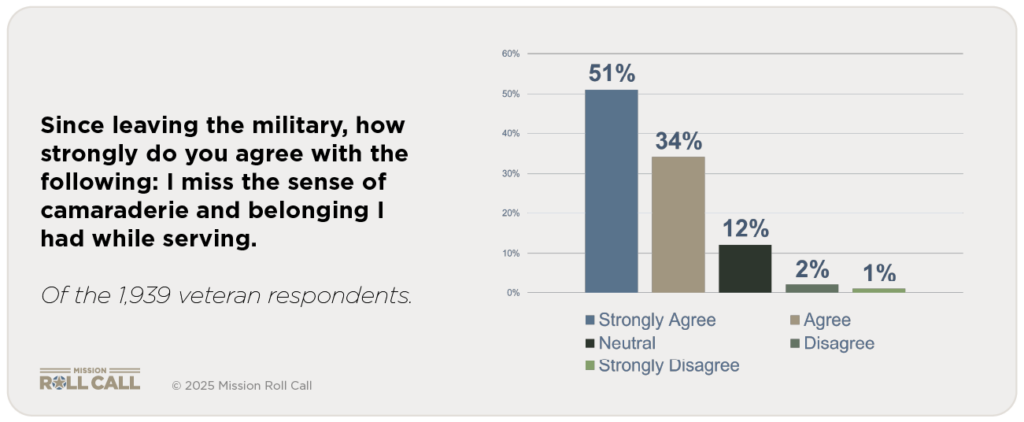
The strongest signal from our September survey is about what veterans value most after leaving the military. Almost 86 percent of respondents said they strongly agree or agree that they miss the sense of camaraderie and belonging they had while serving. Less than 3 percent disagreed. The bond of shared experience is not just a fond memory. It is the anchor that many veterans find missing in civilian life.
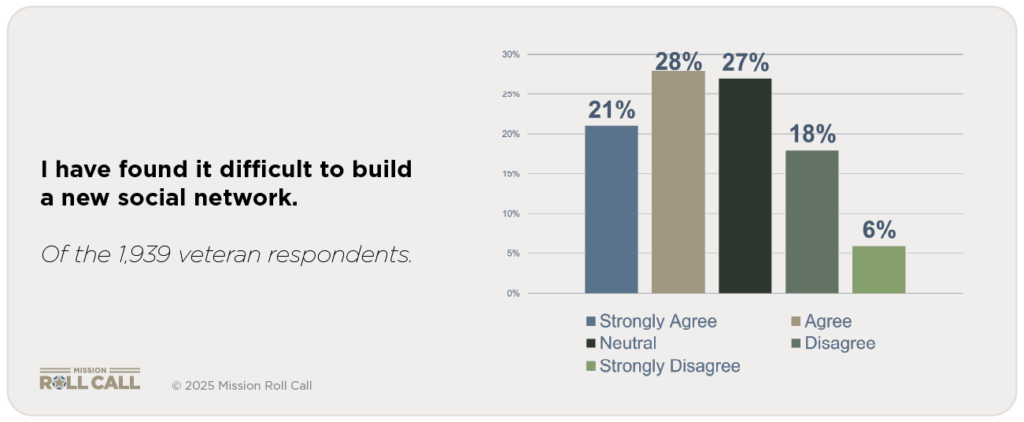
That loss has real consequences. Nearly half (49.5 percent) said they agree or strongly agree that they have found it difficult to build a new social network since leaving the military. Another 27 percent were neutral, meaning only about one in four veterans feels they have successfully rebuilt the same trust and community they once had in uniform. This is where isolation begins, and where stress compounds.
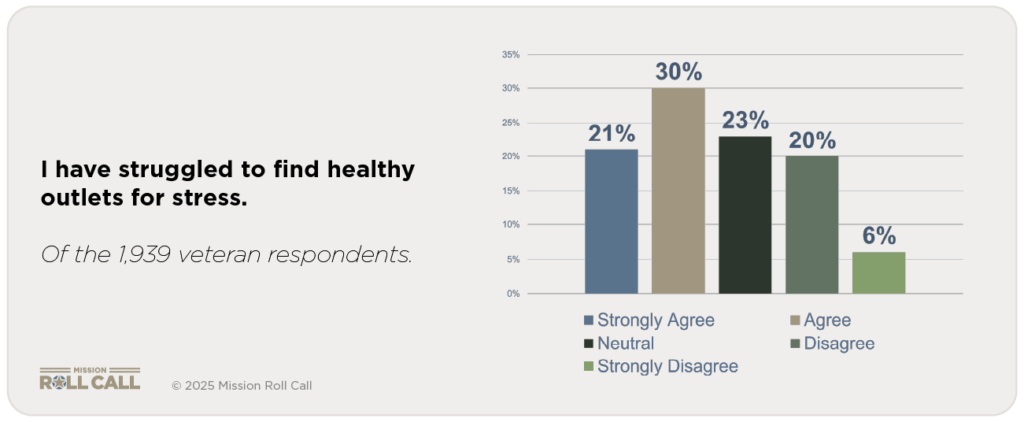
The same pattern appears when veterans talk about coping. Just over 50 percent said they have struggled to find healthy outlets for stress. A quarter were neutral, and only a quarter disagreed. Most veterans live in an environment where the old ways of managing stress—team, mission, shared purpose—are gone, and nothing equally strong has replaced them.
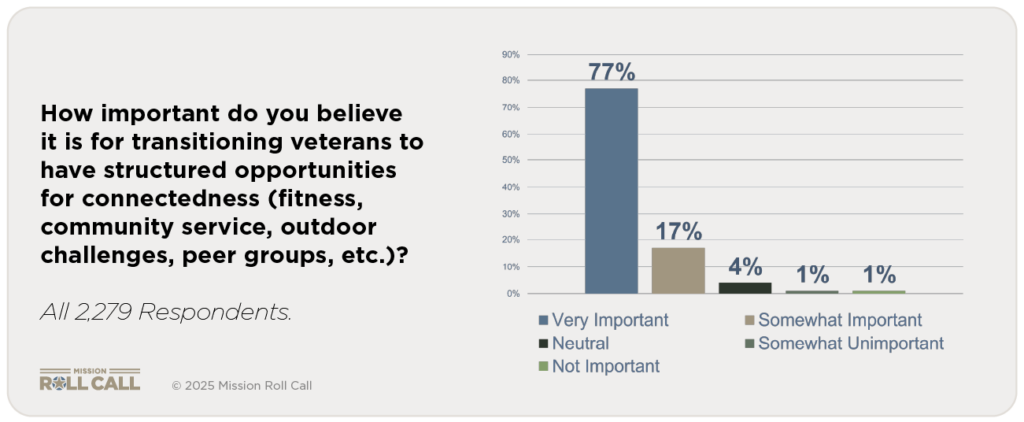
When asked directly, veterans did not hesitate about what they want instead. Over 95 percent said it is very important or somewhat important for transitioning service members to have structured opportunities for connectedness. Less than 1 percent said such opportunities are not important. In other words, nearly every veteran sees connectedness as essential to their well-being.
This matters because of where the absence of connectedness leads. Without community and purpose, isolation grows. Isolation becomes stress. Stress becomes unhealthy coping. And too often, the VA meets veterans for the first time only when they are already in crisis. At that point, the response is often medication—sometimes multiple prescriptions that dull symptoms without addressing the root cause: the loss of belonging.
Veterans are telling us they want something different. They want opportunities to connect, to be part of a team again, to build resilience before they ever need a prescription. They are asking for prevention that sits left of clinical—because they know that is where real strength is rebuilt.
The next question is obvious: what would those preventive wellness opportunities actually look like? In Part Two, we turn to the survey results that show which interventions veterans say they want most, what keeps them out of those programs today, and how the system can remove those barriers.
At Mission Roll Call, veterans consistently tell us that mental health and suicide prevention are their top priorities. These are not abstract statistics or distant issues — they are real challenges that affect real people, every single day. That’s why it is critical to hear the lived experiences of veterans and amplify their voices.
Stories like Don Legun’s not only shed light on what it feels like to live with depression but also help others recognize warning signs in themselves or their loved ones.
Meet Don Legun
Lieutenant Don Legun is no stranger to discipline, resilience, and achievement. Before his military career, he was an elite college gymnast and a respected gymnastics coach, known for bringing out the best in his athletes. He also taught high school industrial arts, investing in young people and building confidence both inside and outside the gym.
When the opportunity arose to fly, Don changed course. He went through Aviation Officer Candidate School and became a Naval Flight Officer (B/N), flying the A-6 Intruder. Over his 10-year career, he logged more than 1,000 flight hours, completed 200 carrier landings, and deployed three times. He later taught marketing and sales in the Officer Recruiting Command, and then managed flight schedules and coordinated training exercises for deployed air wings.
After leaving the Navy, Don’s entrepreneurial spirit led him to open a windsurfing and kite shop and launch an award-winning “Learn to Windsurf” school. He also volunteered in local classrooms, using kites to teach kids the principles of flight.
In the final months of Don’s service, he incurred a new battle to conquer. Due to environmental and emotional events while serving, depression entered his life. While this underlying challenge often undercuts his drive, it has also fueled a deeper purpose: to understand his own journey and share it so that others might survive theirs. As Don puts it, “It provides purpose for my pain.”
Don also writes and speaks about his experience, including in his book, My Side of Depression.
Mapping the Experience
For years, Don searched for ways to understand and manage his depression. During one particularly difficult period of medication adjustment, he began to notice a pattern. His depression didn’t simply arrive in an instant — it unfolded step by step. Small shifts were built into more consuming changes until he felt cut off entirely.
So he started keeping track. Each time his depression deepened, he wrote down what he was experiencing. Over time, he realized that his journey wasn’t random. It followed a recognizable sequence.
What he discovered has resonated with other veterans and civilians who’ve read his work. Many said they saw themselves in his description, recognizing familiar patterns in their own lives.
The Depression Progression
Depression looks different for everyone, but Don’s careful notes highlight how it can progress if left unrecognized or untreated. Here are 17 common signs (broken into 7 categories) to watch for in yourself or in someone you care about:
DISTANCING
- Lack of eye contact – avoiding meeting eyes in conversation, looking down often.
- Disengagement – no longer starting conversations; giving short, closed responses.
- Anxiety or restlessness – a tense, on-edge feeling, like the body is fighting itself.
- Seeking solitude – turning off music, withdrawing to a bedroom or quiet space.
FATIGUE
- Fatigue – feeling tired all the time, lacking energy for normal activities.
SHORT FUSE
- Irritability – snapping at others, becoming frustrated over small things.
- Frustration – nothing feels satisfying; a sense that life is working against you.
- Impatience – low tolerance for mistakes, responding with quick anger.
UNPROVOKED ANGER*
- Persistent anger – staying angry without a clear reason; feeling like a different person.
- Anger turned inward – frustration with oneself for not “being normal,” which fuels more rage.
SELF-RECOGNITION
- Loss of joy – activities, music, or hobbies that once brought happiness now feel empty or painful.
- Awareness of impact – recognizing that your mood is dragging others down but feeling powerless to change it.
DETACHMENT
- Avoidance of others – pulling away socially, feeling out of place, or being unable to connect.
- The “curtain” effect – a sense of being cut off from the world, able to see it but not engage with it.
- Isolation – ignoring calls, staying in bed, sleeping excessively, limiting interactions.
GIVING UP
- False comfort – growing used to withdrawal and convincing yourself it’s fine to be left alone.
- Suicidal thoughts – believing you are a burden, thinking of ending your life, and even planning it.
These signs don’t always appear in the same order, and not everyone will experience all of them. But being aware of the progression can make it easier to notice shifts sooner, and step in with support before things reach a crisis point. These patterns reflect broader trends in how mental health challenges affect veterans. To better understand the full scope, explore key insights into veteran mental health today.
One of the most important lessons Don learned is that support isn’t a straight line. That’s why Mission Roll Call created a Mental Health Thermometer, a companion tool that visualizes these stages and shows how different types of support can help at any point along the way.
The resources on the thermometer aren’t listed in order, because there is no single “right” way to get help. Depending on where you are in the progression, you might use one, several, or all of these options at different times:
- Friend in Confidence: Sometimes the first step is the simplest: talking to someone you trust. Opening up to a friend or loved one can help you process what’s happening before it deepens.
- Peer Groups: Shared experience matters. Connecting with others who’ve walked similar paths can reduce isolation and remind you that you’re not alone.
- Counselor: A licensed counselor can help you recognize patterns, develop coping tools, and work through underlying issues.
- Seek Professional Help: If symptoms persist or worsen, reaching out to a mental health professional, such as a psychologist or psychiatrist, can make a meaningful difference.
- Psychologist: Talk therapy is often the first step. Psychologists help you recognize patterns, develop coping tools, and work through underlying issues in a non-medical setting. They can also advise when additional treatment may be helpful.
- Psychiatrist: If medication is recommended, either by a psychologist or another doctor, a psychiatrist is the specialist best equipped to prescribe and manage mental health medications. They monitor side effects, adjust doses, and guide you through the process. Medication is not one-size-fits-all, so professional oversight is essential.
- Hospital: If you feel unsafe with your thoughts or believe you might act on them, going to the hospital is a vital and life-saving choice.
*A note on safety: If you’re experiencing intense, unprovoked anger or emotional outbursts that feel beyond your control, taking proactive steps to protect yourself and others is an act of strength, not weakness. Consider storing firearms or other weapons securely, with access managed by a trusted person who understands your situation. Depression can distort thinking and override logic, and limiting immediate access to lethal means during volatile periods can be a powerful preventive measure.
Above all, help is always available. If you or someone you know is thinking about suicide, call the Suicide & Crisis Lifeline at 988 (press 1 for the Veterans Crisis Line). This free, confidential support is available 24/7.
Why It Matters
Don’s courage in naming his stages and sharing them openly is exactly why Mission Roll Call exists. When veterans tell us that suicide prevention is a top priority, we don’t just listen. We amplify voices like Don’s to bring understanding, resources, and hope to others.
Depression can feel isolating, but as Don shows, even in the darkest stages, there is a way to recognize what is happening and reach for help.
This is just the beginning. Mission Roll Call will continue to share more articles and resources in partnership with Don and other mental health thought leaders, so together we can advance awareness, prevention, and support for every veteran and family.
If you or someone you know is struggling, call the Suicide & Crisis Lifeline at 988 (press 1 for the Veterans Crisis Line). You are not alone.
September 7–13 marks National Suicide Prevention Week, a time to raise awareness, break down stigma, and take meaningful steps toward preventing suicide in our communities. For our nation’s veterans, this week carries special urgency. The mental health crisis among those who’ve served continues to deepen, and it’s one we must face together.
Veteran Suicide Is a National Crisis
The numbers are sobering:
- According to the VA’s 2024 annual report, an estimated 17.6 veterans die by suicide every day.
- But other research suggests the true number could be significantly higher. A study by America’s Warrior Partnership, Operation Deep Dive, estimates as many as 44 veteran suicides per day when accounting for drug-related deaths and self-injury mortality.
- That means we could be losing more than 16,000 veterans each year—more than all U.S. combat deaths since Vietnam.
Behind every number is a person. A family. A story that ended too soon. For a more comprehensive look at how these numbers are evolving and what’s driving them, see our breakdown of veteran suicide trends and underlying factors.
Understanding the Risk
Transitioning out of the military can be one of the most vulnerable times in a veteran’s life. Studies show that the first two years after leaving active duty are especially high-risk due to challenges like isolation, loss of identity, and limited access to care.
There are also alarming disparities across groups:
- Male veterans are 60% more likely to die by suicide than civilian men.
- Women veterans face a 92% higher suicide rate than civilian women.
Post-traumatic stress continues to affect a significant portion of the veteran community. About 15% of Iraq and Afghanistan veterans experience PTS in any given year, and roughly 1 in 3 will experience it at some point in their lifetime.
Access to care remains a major barrier as well. Nearly 45% of veterans report long wait times or delays in receiving health care through the VA. In some areas, wait times for mental health care exceed 50 days.
Progress Is Happening — But It’s Not Enough
The recent passage of the Elizabeth Dole Act has been a step in the right direction. It expands resources for employment, disability claims, mental health care, and support for the 7.8 million caregivers who walk alongside our veterans every day.
But policy alone can’t solve this crisis. It takes all of us veterans, families, communities, and advocates working together to ensure no veteran is left behind.
Support Starts Here
If you or someone you know is struggling, please know you’re not alone.
- Veterans Crisis Line: Dial 988 then press 1
- Veterans Resource Directory
- Mission Roll Call Suicide Prevention Page
Together, we can build a future where no veteran feels that suicide is their only option.
Get Involved: Ride & Run 4 Their Lives with HBOT4Heroes
This National Suicide Prevention Week, MRC is teaming up with HBOT4Heroes to help turn awareness into action through two powerful events that support veteran suicide prevention efforts and honor those we’ve lost:
Ride 4 Their Lives with Raging Bull Harley-Davidson
Sunday, Sept. 7 | Durham, NC
Kick off National Suicide Prevention Week with a scenic group ride to the Orange County Veterans Memorial.
- Registration at 10 AM | Kickstands up at 11 AM
- Riders: $25 pre-registration | $30 day-of
- Raffle prizes, community vendors, and more
Register here: hbot4heroes.org/events/ride-4-their-lives
Run 4 Their Lives 5K
Saturday, Sept. 13 | American Tobacco Trail
Run, walk, or roll — every step you take honors the 44 veterans we lose to suicide each day and helps protect the living.
- Family-friendly and fully accessible
- All proceeds support suicide prevention outreach and treatment
Register here: hbot4heroes.org/events/5k-run4theirlives
Can’t ride or run? You can still stand with us.
- Donate.
- Spread the word.
- Volunteer.
- Share your story.
National Suicide Prevention Week reminds us that hope is real, and help is out there. We honor those we’ve lost by showing up for one another, speaking out, and standing together in the fight for life.
Let’s ride. Let’s run. Let’s rise for their lives.
Fuel Veteran Voices
A small gift powers the research and advocacy that brings veterans to the decision-making table.
Donate $5+