The Veteran Has Income — So Why Are They Still Homeless?
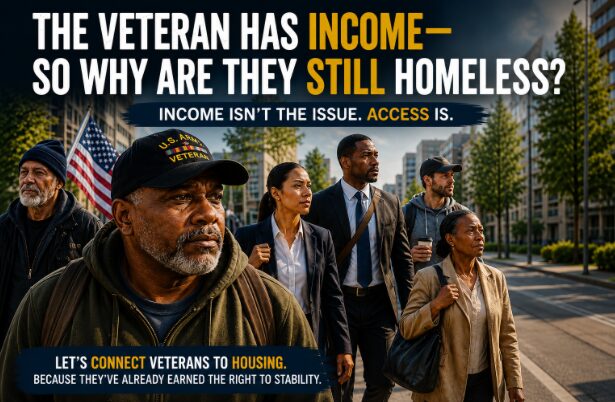
When most people picture a homeless veteran, they often assume the individual has no income, no benefits, and no support system.
But that assumption does not reflect the reality many veterans are living today.
Across this country, there are veterans experiencing homelessness who receive:
- 100% VA service-connected disability compensation
- Social Security income
- military retirement benefits
- pensions
- employment income
- or housing vouchers through programs like HUD-VASH and other subsidies for housing
Yet despite having income and support systems connected to them, many remain unhoused. Technically, HOMELESS!!
That should force us to ask a difficult question:
If a veteran has income and housing assistance available, why are they still struggling to secure housing?
The answer reveals a much larger issue within the housing system itself.
The Veteran the System Still Could Not House
One story that continues to stay with me is Sgt. Marlene Wolf.
Sgt. Wolf had income.
She had support systems connected to her.
And she HAD a two-bedroom housing voucher.
But despite having what many people assume should guarantee housing stability, she still struggled to secure permanent housing.
Eventually, her voucher was terminated because she could not find a place willing or able to work within the program requirements and housing realities she faced.
Think about that for a moment.
A veteran can qualify for housing assistance, receive approval, hold the voucher in hand — and still lose the opportunity because the housing market itself never aligned around the veteran.
That is not simply a paperwork issue.
That is a systems failure.
The Misconception About Veteran Homelessness
One of the biggest misconceptions surrounding veteran homelessness is the belief that homelessness only happens when someone has no financial resources.
That is not always true.
Many veterans living in vehicles, hotels, shelters, temporary situations, or couch surfing have some form of stable monthly income. Some receive VA disability compensation that is more reliable than traditional employment. Others are retired and receive Social Security or military retirement benefits consistently each month.
Some veterans are actively employed.
Some go to work every day while still struggling to find stable housing.
But income alone does not guarantee access to housing.
And that is the part of the conversation many communities still do not fully understand.
Homeless Does Not Mean Unemployable
Homelessness does not always look the way people expect.
Many veterans experiencing homelessness are:
- employed
- medically retired
- disabled
- enrolled in workforce programs
- or living on fixed retirement income
Yet they are still:
- sleeping in vehicles
- staying in extended stay hotels
- couch surfing
- rotating between family members
- or living in unstable temporary situations
These veterans are often overlooked because they do not fit the public image of homelessness.
But housing instability is still homelessness.
And many of these veterans are already financially housing-ready.
The system simply does not recognize them that way.
The Voucher Is Not the Housing
Programs like HUD-VASH were designed to help veterans transition out of homelessness by combining rental assistance with VA case management and supportive services.
The voucher matters.
But the voucher itself is not the housing.
Veterans still must:
- locate available units
- find landlords willing to participate
- pass screenings
- navigate inspections
- compete in tight rental markets
- and manage rising housing costs
That process can become overwhelming, especially for veterans already navigating disabilities, trauma, aging, or prolonged housing instability.
A veteran may already have the voucher in hand and still have nowhere to go.
Where SSVF and GPD Fit Into the System
Supportive Services for Veteran Families (SSVF) was created to prevent homelessness and rapidly rehouse veterans. SSVF can help with:
- deposits
- temporary financial assistance
- case management
- housing stabilization
- and prevention services
Grant and Per Diem (GPD) programs provide transitional housing and supportive services while veterans work toward permanent housing placement.
These programs are critical.
But none of them can create housing inventory where none exists.
And none of them work effectively without strong community alignment.
The Real Barrier Is Access
This is where the conversation must shift.
The issue is not always whether the veteran can pay rent.
The issue is whether the veteran can access housing.
Many veterans are overlooked not because they lack income, but because homelessness itself creates barriers.
Veterans may face:
- prior evictions
- damaged credit
- gaps in rental history
- discrimination against voucher holders
- limited affordable inventory
- rising rents
- transportation barriers
- or delayed inspections and approvals
And in many communities, landlords and Realtors still do not fully understand how veteran housing programs work.
As a result, veterans who are financially capable of sustaining housing remain trapped in instability.
Why Community Education Matters
This is why communities must better understand how programs like HUD-VASH, SSVF, and GPD actually function.
Housing stability does not happen through federal policy alone.
It requires:
- landlords
- Realtors
- housing authorities
- nonprofits
- veteran service organizations
- local government
- and community partners
all working together.
When communities understand the system, veterans move into housing faster.
When communities do not, vouchers go unused, opportunities expire, and veterans continue falling through the cracks.
A Different Way to Look at Veteran Homelessness
We must stop assuming homeless veterans are starting from zero.
Many already have:
- income
- case management
- housing vouchers
- healthcare access
- and support services
What they often do not have is a housing market prepared to receive them.
That is not a veteran failure.
That is a systems alignment issue.
Moving Forward
We cannot continue measuring success simply by approvals and program enrollment while veterans remain unhoused.
A voucher without housing is not stability.
Income without access is not security.
And support systems without community alignment will continue leaving veterans behind.
Many homeless veterans are not without income.
They are without access.
The goal should not only be to connect veterans to programs.
The goal must be to connect veterans to actual housing.
Because veterans like Sgt. Marlene Wolf should never lose housing opportunities simply because the system could not align around them in time.
To learn more about Mission Roll Call’s work uplifting veteran voices and advancing effective housing solutions, visit their homelessness initiative:
Mission Roll Call Housing & Homelessness
Mission Roll Call is committed to listening first. Veterans, families, caregivers, and community partners are encouraged to share their experiences through Mission Roll Call’s national surveys to help shape future advocacy and policy discussions: Mission Roll Call Surveys
Yvette Jones-Swanson, M.A., is a former homeless veteran, U.S. Army veteran, Realtor, and nationally recognized subject-matter expert on veteran homelessness and housing. She has spent more than 22 years helping veterans navigate the path from homelessness to housing stability and homeownership through community-based housing solutions and systems alignment.