
The past several years have brought important efforts to address veteran mental health. Congress has passed legislation such as the Hannon Act and the Staff Sergeant Parker Gordon Fox Suicide Prevention Grant Program, expanding mental health services, strengthening suicide prevention and improving access to care for veterans.
But challenges persist. Each year, nearly 250,000 service members transition to civilian life, but not all connect with VA healthcare, leaving many without access to critical resources and benefits they have earned and deserve.
That gap is dangerous, especially when it comes to mental health. An estimated 41% of veterans still need mental health services each year, with post-9/11 veterans facing particular challenges as they navigate the transition from military to civilian life. Suicide rates among veterans are also stubbornly persistent, with more than 6,000 veterans dying by suicide every year since 2001.
Veteran mental health and suicide are complicated issues with no single cause or solution. But we do know we need to be more proactive and connect veterans with care before they reach a crisis point. The Department of Veterans Affairs (VA) must strengthen its outreach and engagement strategies so that every eligible veteran knows what care and benefits are available and can access the support they need to thrive physically and mentally after service.
In this updated report, Mission Roll Call examines the most common mental health challenges facing veterans, why suicide rates remain persistently high, the legislative wins that have expanded access to care and what more can be done to connect veterans with the support they need.
What Are the Most Common Mental Health Challenges for Veterans in 2026?
Mental health issues can affect every aspect of a veteran’s life, making it harder to maintain relationships, stay focused at work, manage daily responsibilities or feel connected to family and community.
In the past year, more than 1.7 million veterans received mental health services through VA . This number does not include veterans who receive care outside of VA or those living with undiagnosed mental health conditions, which means the actual number of veterans experiencing mental health challenges is likely higher.
Some of the most common mental health challenges veterans experience include:
1. Post-Traumatic Stress Disorder (PTSD)
Post-traumatic stress disorder (PTSD) is a condition that can develop after witnessing or experiencing a tragic or traumatizing event, with symptoms including flashbacks, nightmares, avoidance, changes in behavior and physical symptoms.
PTSD affects one in 10 veterans nationwide, and of the veterans who use the VA, 23% have had PTSD at some point in their lives.
Compared to the civilian population, veterans are at a much higher risk of developing PTSD due to exposure to combat, serious injury, loss and traumatic experiences. For instance, among veterans who served in Iraq and Afghanistan, 15% experience PTSD each year, with the lifetime PTSD rates approaching 29%.
PTSD frequently occurs alongside other conditions, including substance use disorders, with some research estimating that up to 60% of veterans with PTSD also have a substance use disorder.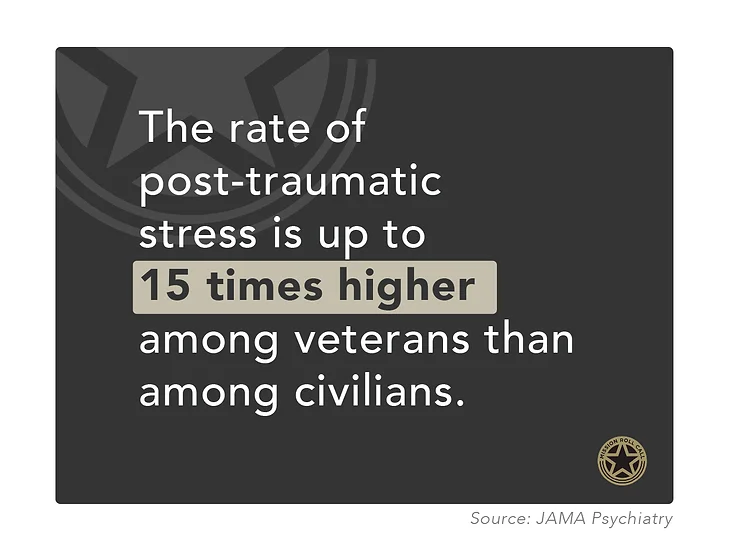
2. Traumatic Brain Injury (TBI)
Military service members and veterans can experience brain injury from explosions during combat or training exercises.
The Defense and Veterans Brain Injury Center (DVBIC) reported more than 400,000 TBIs among U.S. service members who served between 2000 and 2019, and more than 185,000 veterans who use the VA for their health care have been diagnosed with at least one TBI.
TBI can cause conditions like headaches, irritability, sleep disorders and depression, and can play a major role in veterans’ mental health.
Mission Roll Call’s 2025 TBI Care Polling underscores the challenges veterans and families face getting appropriate care. Among respondents who reported that they or a veteran in their household had been diagnosed with TBI, just 21% said their TBI-related mental health needs had been adequately addressed. Another 38% said those needs had not been adequately addressed, while 30% said they had only been partially addressed.

Figure 1. Only 21% of respondents affected by TBI said their TBI-related mental health needs had been adequately addressed. Source: Mission Roll Call, TBI Care Polling Results, August 2025; n=337 respondents reporting a TBI diagnosis for themselves or a veteran in their household.
3. Anxiety, Depression and Substance Abuse
Veterans can experience a range of mental health conditions after service, including anxiety, depression and substance use disorders. These conditions can occur on their own, but they also frequently overlap with PTSD and other mental health challenges.
Thirty percent of veterans experience anxiety, while 33.33% of veterans exhibit symptoms of depression and 12.5% have major depression. However, studies show that half of all patients experiencing depression are not correctly diagnosed by their practitioner, potentially leaving hundreds, even thousands of veterans’ symptoms unrecognized.
For some, untreated or overlapping mental health conditions can manifest in substance abuse disorders, including alcohol abuse. Some veterans use alcohol and drugs to self-medicate after trauma, with one in 10 veterans diagnosed with a substance use disorder. However, this combination can significantly elevate the risk of suicide.
4. Suicidal Ideation
The latest VA figures from 2025 show there were roughly 17.5 veteran suicides per day, or 6,398 a year. While that figure is widely cited, the real number of veteran suicides might be much higher. One Operation Deep Dive report by America’s Warrior Partnership notes that the actual number of veteran suicides per year may be 2.4 times higher than the VA reports.
Why is the Suicide Rate Higher Among Veterans?
The risk factors for veteran suicide, in some ways, look similar to the risk factors for nonveterans: financial stress, substance abuse, mental health diagnosis, problems in a romantic relationship, and unemployment. But there’s one additional critical factor among veterans – an abrupt and often overwhelming loss of community and identity.
Veterans responding to a 2025 Mission Roll Call survey pointed to that same challenge. When asked to identify the most significant barrier to preventing suicide in the veteran community, 35% identified social isolation or loss of purpose – the most common response – followed by stigma around mental health at 28%.
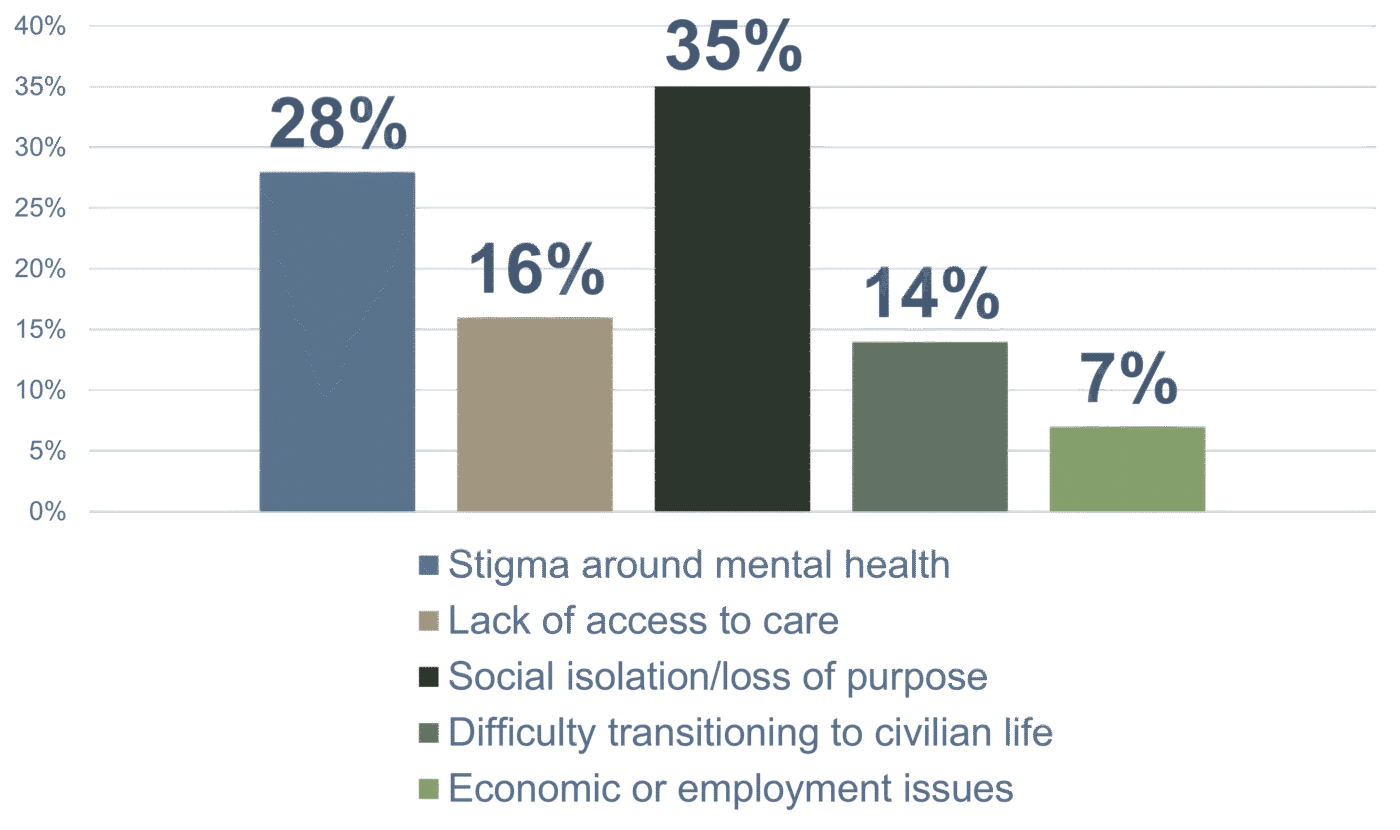
Figure 2. Veterans identified social isolation and loss of purpose as the leading barrier to preventing veteran suicide.
Source: Mission Roll Call, Veteran Suicide Polling Results, 2025; veteran respondents only.
During the first year of separation from military service, veterans face a disproportionately high risk of suicide. However, suicide risk can remain elevated for years, especially among women veterans who experience a suicide rate 92% higher than civilian women.
There is no uniform “exit strategy” for a veteran transitioning to civilian life. Many veterans are not prepared for the feelings of loss that come when they are ripped away from the only community they have known for years.
Military service touches all aspects of life, from housing to healthcare to social life. When you transition from the military, you don’t just leave your job and your salary. You often leave your house, your city, your friends and your purpose. When you add post-traumatic stress from deployment and combat, it can be a difficult transition.
The best way to combat mental health struggles that come from a loss of community is for the community to step in. This is why community organizations that understand and address veterans’ issues are so important.
Veterans surveyed by Mission Roll Call strongly supported that broader approach. Eighty percent said veteran suicide prevention should prioritize clinical treatment and community-based support equally, while 92% said including community-based organizations such as nonprofits and veteran service organizations in suicide prevention efforts was extremely or very important.
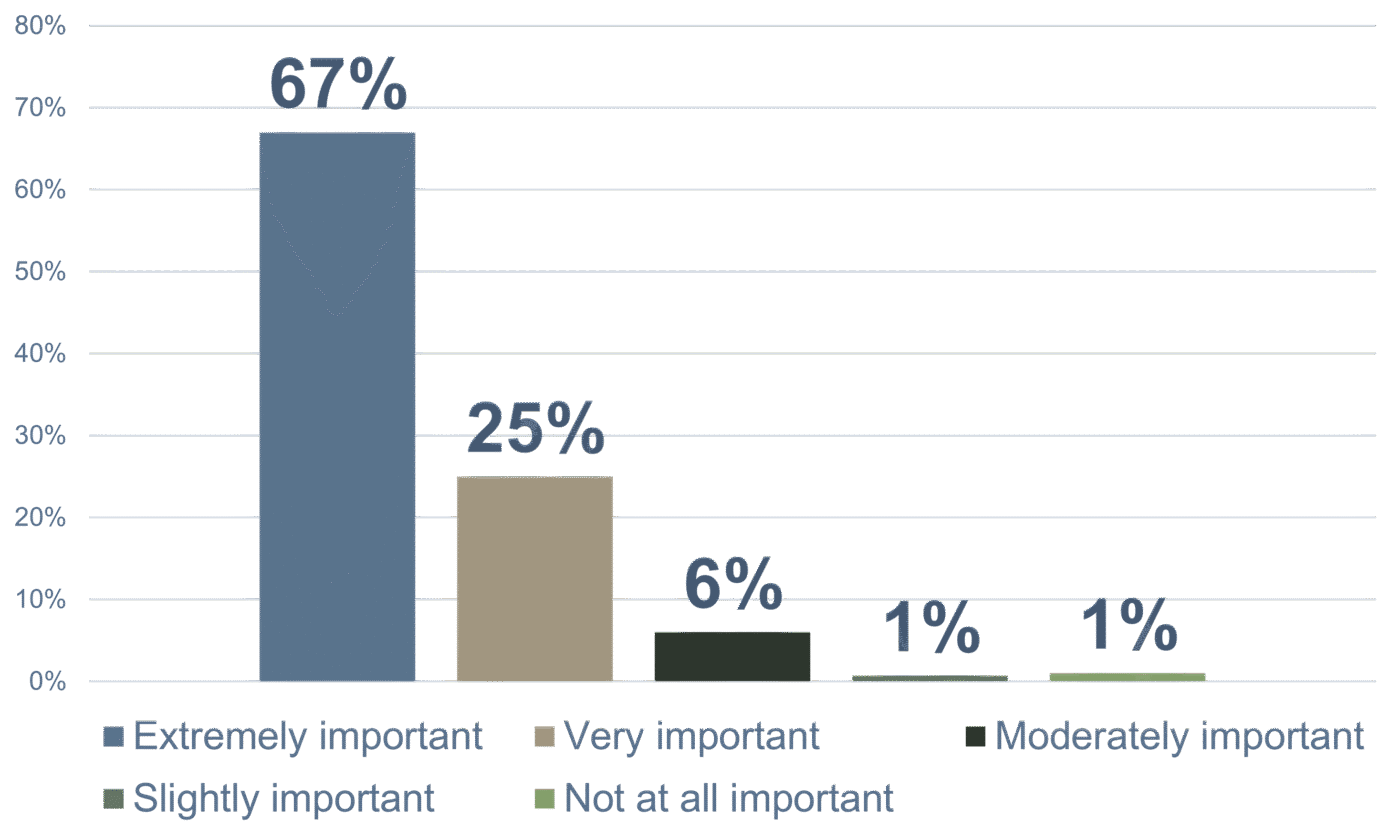
Figure 3. 92% of veteran respondents said community-based organizations are extremely or very important to veteran suicide prevention. Source: Mission Roll Call, Veteran Suicide Polling Results, 2025; veteran respondents only.
Legislative Wins and Their Impact on Veteran Mental Health
The Hannon Act
The Hannon Act was inspired by the service of Commander John Scott Hannon, who retired after a decorated 23-year career with the Navy SEALs. Commander Hannon died by suicide on February 25, 2018, at the age of 46.
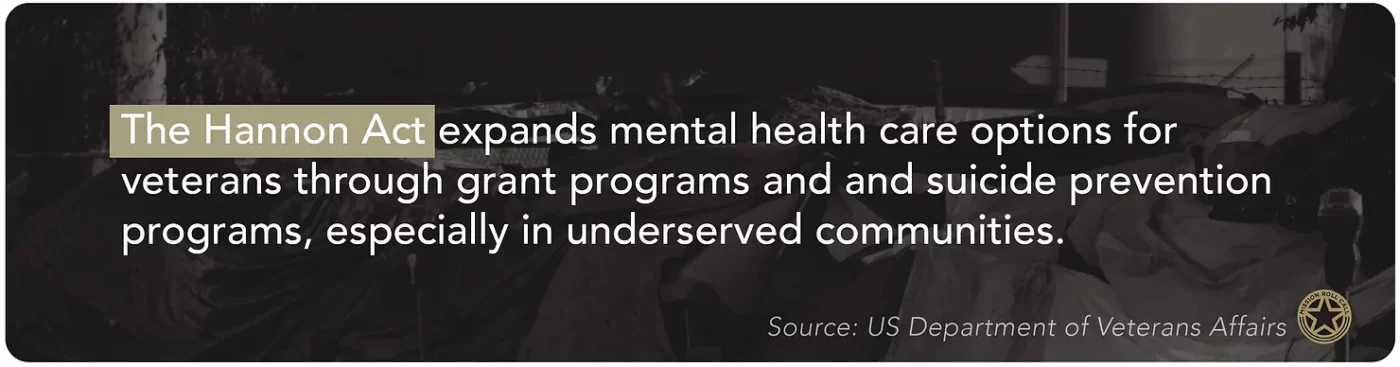
Signed into law on October 17, 2020, the Commander John Scott Hannon Veterans Mental Health Care Improvement (Hannon) Act expands mental health care options for veterans through grant programs and suicide prevention programs, especially in underserved communities.
The Hannon Act includes:
- Grants that will expand community-based suicide prevention and telehealth services to reach veterans in remote areas.
- Funding for mental health research to identify, improve, and expand treatment protocols.
- A pilot program exploring alternative mental health treatments for veterans, including animal therapy, art therapy, sports therapy, yoga, meditation, acupuncture and chiropractic care.
- The Staff Sergeant Parker Gordon Fox Suicide Prevention Grant Program, which dedicates resources toward community-based suicide prevention efforts for veterans and their families.
The Staff Sergeant Parker Gordon Fox Suicide Prevention Grant Program
The Staff Sergeant Parker Gordon Fox Suicide Prevention Grant Program, or Fox Grant, is part of the Hannon Act. The Fox Grant allocates funding for “on the ground” community organizations that offer traditional and nontraditional suicide prevention to veterans and their families.
The program has grown significantly since it launched. Since June of 2026, the Fox Grant program has awarded $210 million to 111 organizations across 46 states, U.S. territories and Tribal lands. Those organizations have made more than 24,400 referrals for suicide prevention support, including emergency service connections for 854 veterans at high risk for suicide. Meanwhile, in March 2026, the VA announced a $112 million grant opportunity for community-based organizations providing suicide prevention services to veterans.
What Else Needs to Be Done?
While the Hannon Act and Fox Grants have demonstrated the value of connecting veterans to support in their own communities and expanded the federal government’s approach to veteran mental health, implementation determines how many veterans actually benefit from these programs.
Timely access to mental health care is another spotlight priority for Mission Roll Call. An MRC review of VA appointment wait-time data found significant differences across the country. In July 2025, the state averages shown ranged from 2 to 88 days for a new mental health appointment, with an average of approximately 29 days across all 50 states.
Long wait times have helped drive efforts to expand veterans’ access to private-sector providers through VA community care. The 2018 MISSION Act gives eligible veterans additional options when VA cannot provide timely or accessible care. However, community care does not eliminate broader health care workforce and access challenges. VA also provides specialized care informed by veterans’ military experiences and unique health needs, expertise that may not always be available from civilian providers.
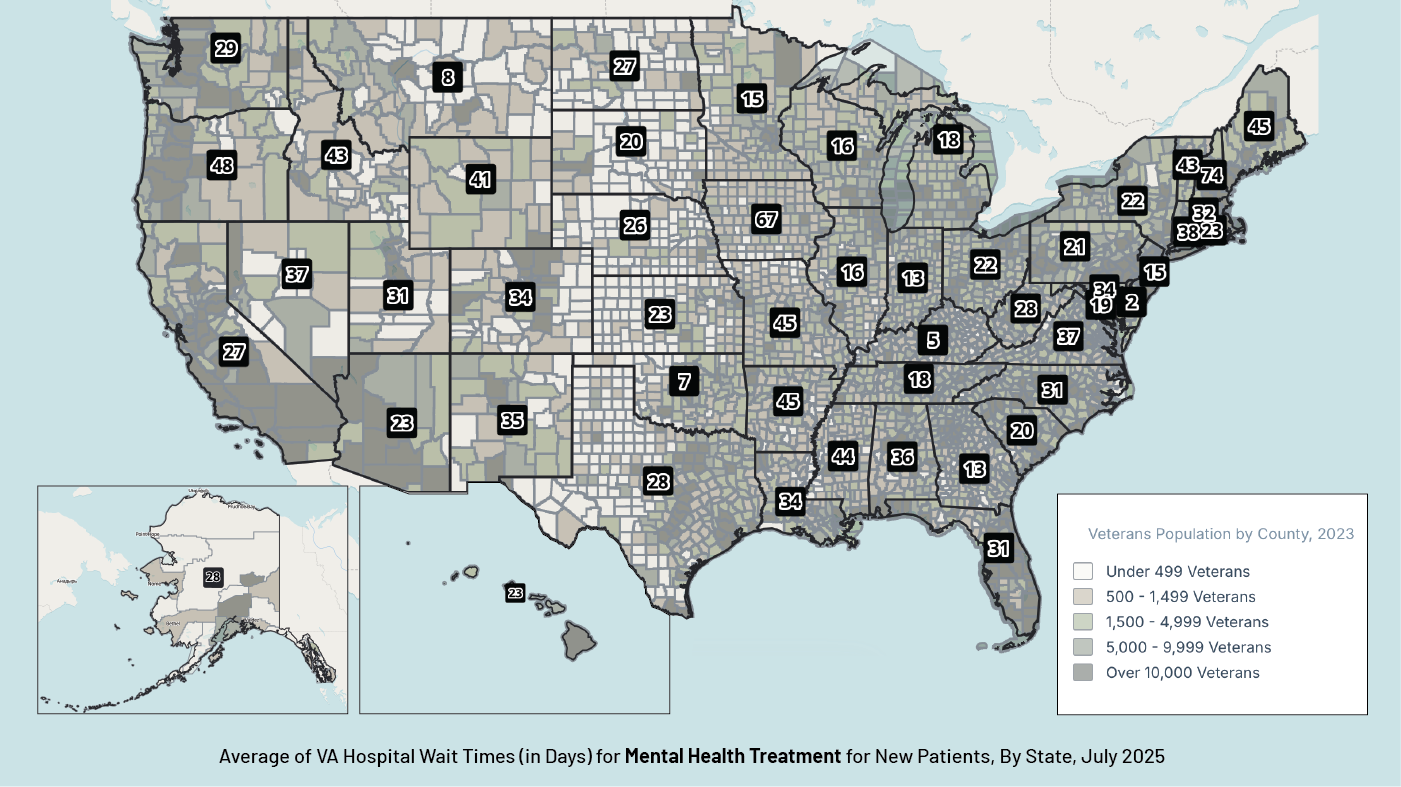
Average VA Hospital Wait Times for Mental Health Treatment for New Patients, by State, July 2025. State averages ranged from 2 to 88 days. The map also shows the veteran population by county to provide context on where veterans live. Source: Mission Roll Call analysis of U.S. Department of Veterans Affairs data, July 2025.
The VA must take an active role in getting funding for mental health programs to the right people, ensuring it’s accessible to the nonprofits, businesses and community organizations that are on the front lines of veteran care.
Sixty-one percent of veterans who died by suicide in 2023 were not receiving VA health care during the preceding year. Also, some veterans have private insurance, while others may have concerns about using the VA or simply not know what resources are available. Community organizations, particularly in rural areas, may have connections to the veteran community the VA can’t reach.
At the same time, many of the grants have gone to larger organizations. In 2022, for example, 80 Fox Grant awards went to healthcare corporations and state-level organizations. Smaller organizations often have the ability to form closer relationships with veterans and, in some cases, are more likely to know the needs of a specific area or community. Smaller organizations also typically have fewer options for securing financial support for their programming.
MRC advocates for continued and expanded funding for the program so that community organizations can reach veterans who may never connect with VA on their own.
How Can We Support Veterans’ Mental Health?
Doctor’s appointments, disability benefits and reskilling aren’t enough to tackle the mental health challenges veterans are experiencing. The Department of Defense and the VA need to fundamentally change the way they approach veteran mental health by taking a more holistic approach to the problem. This starts with being more proactive in addressing the issue.
1. Advocate for all veterans, whether or not they’re using the VA
The best way to tackle the issue of suicide and mental health among veterans is by advocating for policies that provide services to veterans, whether or not they’re engaged with VA services. That’s why policies that fund community organizations that work with veterans are so important.
Mission Roll Call shares veteran narratives and news about policies that directly affect the veteran community. We also take the views, experiences and insights shared by our veterans and deliver them directly to our leaders to speak unfiltered, accurate truth and enact positive change.
If you are a veteran, active duty service member or family member, make your voice heard by participating in our monthly polls and surveys.
2. Increase collaboration between government and military branches
Preventing veteran suicide requires more collaboration among the VA, various branches of the military and the Department of Defense. They still have a lot of joint work to do on meaningful transition assistance and things like electronic health record management to make reintegration into civilian life as seamless as possible.
Veteran suicide should be the top priority for the VA. One way this can be achieved is for the Office of Suicide Prevention to be a direct report to the U.S. Secretary of Veterans Affairs, and not housed under the Office of Mental Health.
3. Support meaningful, local connections
The more we empower community organizations to find veterans and work with them, the more we can replace connections lost after they transitioned out of the military.
Every year, Mission Roll Call visits geographically diverse, veteran-heavy communities across the country. Before each visit, we poll veterans to understand how they view the resources and organizations serving them. When we compared communities like Dallas, which had higher approval ratings, with places like Los Angeles, which had lower ratings, we found a common thread in communities where veterans felt better served. VA officials, nonprofits and for-profit companies regularly engaged with veterans outside their facilities. They had established local networks of people who knew their communities, understood where veterans could turn for help and could connect them with the right resources.
We can’t wait for veterans to ask for help. Veteran support organizations need to proactively engage with and get to know veterans to address small struggles before they become big ones.
4. Spread the word
Small but effective organizations may not be aware of grant opportunities that exist. The VA needs to invest resources in targeted awareness of these grant opportunities, especially to the communities that their notice claims to prioritize.
Ensuring the application window is long enough for organizations to sustainably and effectively complete all requirements – and that the organizations have an awareness of these kinds of opportunities – will help promote parity among applicants and put necessary funding into diverse veteran communities in need.
Reach out to your representative in Congress and encourage them to advocate for the veterans in your area.
5. Reach out to veterans
Even though, according to a Mission Roll Call survey, only 35% of American civilians know a veteran, and 13% know someone currently in the military, members of the community have a vital role to play in supporting veteran mental health.

Building those connections doesn’t have to be complicated. Volunteering with a local veteran organization, attending community events, offering professional support or simply taking the time to get to know veterans in your community can help expand the network around them.
For instance, Mission Roll Call has had the privilege of sitting down with many veteran nonprofit organizations, including America’s Warrior Partnership, Black Ops Rescue, Boulder Crest Foundation, Honor Flight Network and more.
Get to know the veterans in your community.
There are a number of ways to volunteer with veterans in your community and become part of the support network veterans need. Find an organization you can help (through donations, advocacy or volunteering) on Mission Roll Call’s Veteran Nonprofit’s list. You never know how much of a difference your support can make in a veteran’s life.
What’s Next?
Congress and the VA have made strides in the right direction toward preventing veteran suicide, but the job is not done until every veteran has access to the resources they need to save their lives.
Not all wounds are visible. Military personnel can be exposed to an array of potentially traumatizing experiences that can impact them for years and decades in the future. With millions of veterans experiencing mental health challenges every day, we need proactive government and community involvement to heal our veterans.
Mission Roll Call will continue to advocate for meaningful legislation, not just so that all veterans have access to quality care, but that this care actually reaches them.
Veterans in need of emergency counseling can reach the Veterans Crisis Line by dialing 988 or 1-800-273-8255 and selecting option 1.