Why Suicide Prevention Must Reach Beyond the VA
The latest national suicide report presents a challenge that cannot be solved inside the VA alone. In 2024, 6,488 veterans died by suicide, averaging 17.7 deaths each day. About 62 percent had not received VA health care during the year they died or the preceding year. For Mission Roll Call, that finding reinforces the need to reach veterans earlier, in the communities where they live, before their difficulties become an emergency.
About 62 percent of veterans who died by suicide had not received VA health care during the year they died or the preceding year.
The VA released its 2026 National Veteran Suicide Prevention Annual Report on September 30, with data through 2024. The absence of recent VA care does not establish that these veterans received no health care anywhere. Some may have used private providers or other services. It does show why prevention must extend beyond the people who appear in VA examination rooms. A national strategy needs a way to reach veterans who are absent from those settings.
Connection before crisis
Mission Roll Call describes earlier support as working left of clinical. That means addressing isolation, financial strain, difficulties adjusting to civilian life and other challenges before they escalate. Clinical care remains essential for veterans who need treatment. Earlier community support should complement that care and make it easier to seek help. A veteran should have opportunities to rebuild a support network without first having to identify as someone experiencing a mental health crisis.
Our September 2025 wellness survey illustrates the need for those opportunities. In the published MRC chart below, 21 percent of veteran respondents strongly agreed and 28 percent agreed that they had found it difficult to build a new social network. Those responses describe a practical challenge after service. They do not establish that a particular respondent is at risk of suicide, but they identify an area where earlier support could matter.
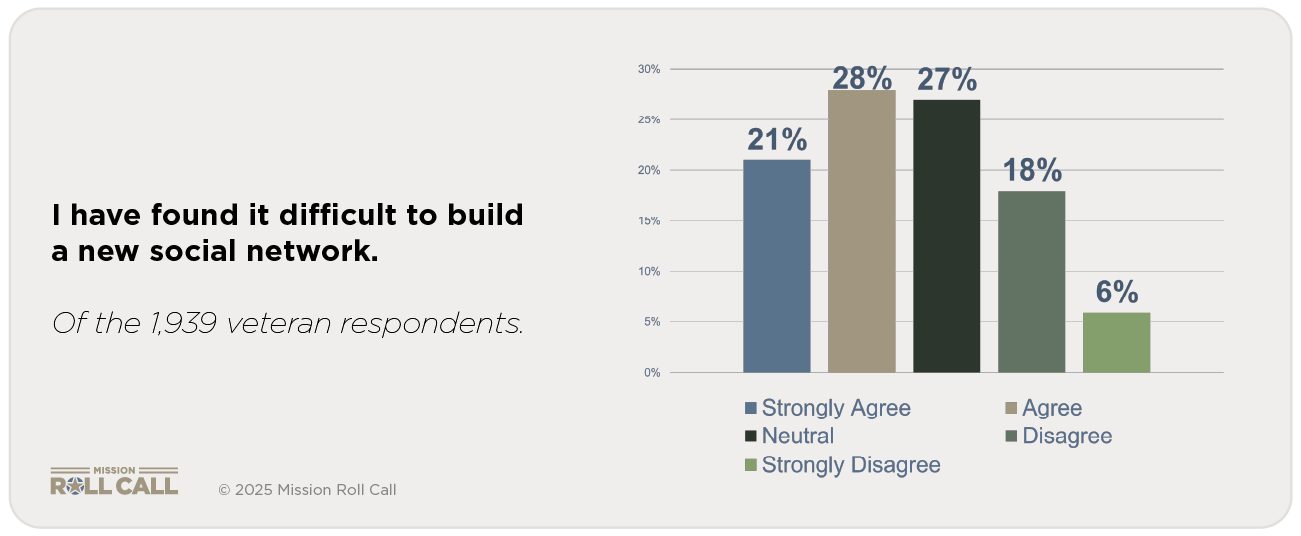
Building a new social network after service. Original MRC chart. Veteran respondents, n = 1,939.
Community organizations can create places where veterans are known and welcomed. A volunteer project, peer group or regular outdoor activity can offer an entry point for someone who would never begin by asking for counseling. Over time, those relationships may also make it easier to discuss a missed rent payment, a relationship breakdown or an unmet health need. The goal should be a dependable connection with someone who can help the veteran take the next step.
Programs must be easy to find
Availability alone is insufficient. MRC’s published survey chart identifies lack of awareness as the leading perceived barrier to preventive programs, selected by 54 percent of respondents. Cost was selected by 19 percent. These findings suggest that an effective outreach strategy needs clear information, affordable options and people who can explain what participation actually involves. Publishing another resource list will accomplish little if veterans still cannot identify a suitable local program.
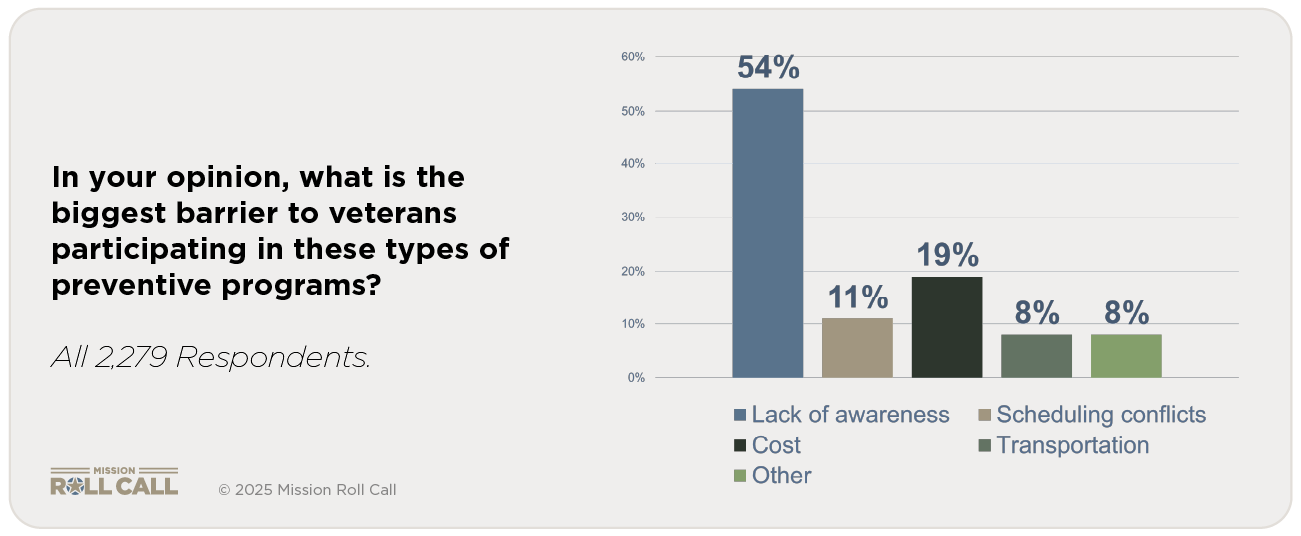
Perceived barriers to preventive programs. Original MRC chart. All respondents, n = 2,279.
Local organizations should also make referrals easier to complete. With a veteran’s consent, a staff member could introduce the veteran directly to a partner, help arrange transportation and check whether assistance arrived. Families should have clear ways to ask where support is available. These are practical proposals for closing gaps between organizations, rather than assuming that handing someone a telephone number completes the work.
Lack of awareness was the leading perceived barrier to preventive programs, selected by 54 percent of respondents.
A role for community grants
The Staff Sergeant Parker Gordon Fox Suicide Prevention Grants Program provides an existing route for supporting community organizations. In a May 1, 2025 statement about the program, Senator John Boozman described “a dire need” to improve community resources addressing veteran suicide. His comment preceded the latest annual report, but the emphasis on local access remains relevant to the population the report identifies.
The VA’s September release reported that Fox grantees served about 17,000 veterans, service members and families in 2025. That demonstrates program reach, although participation figures alone cannot establish how many deaths a program prevented. Community investments should be evaluated for whom they reach, whether veterans receive the assistance they need and whether improvements persist. Programs reaching veterans outside recent VA care deserve particular attention.
Civilian health providers, employers and local veteran offices could help widen that reach by asking about military service and offering appropriate referrals with consent. Organizations should make clear who qualifies, whether a diagnosis is required and what a veteran can expect at a first visit. Straightforward explanations can make asking for practical help less intimidating and reduce the burden of navigating unfamiliar services alone.
For Congress, the VA and community partners, the next task is to make earlier help a routine part of veteran support. That requires accessible programs, dependable referral relationships and follow through when a veteran asks for assistance. MRC’s Resource Directory offers a place to begin finding support, while our surveys give veterans and families a way to describe gaps that remain. Prevention should reach a veteran through several possible doors, with each one leading to meaningful help. The latest report makes clear how much that broader reach matters.
Chart note: MRC survey responses describe participants’ experiences and preferences. They are separate from the VA national mortality data and do not establish program effectiveness. Percentages in the text follow the rounded labels in the original charts.