Twenty Three Years of Data and Thousands of Lives Lost
What Must Change in Veteran Suicide Prevention
The VA’s latest National Veteran Suicide Prevention Annual Report should prompt a serious discussion about how the country measures progress. The report examines 2001 through 2024, a span of 23 years covering 24 calendar years of data. In 2024, 6,488 veterans died by suicide. Mission Roll Call believes the response must include clearer accountability for whether prevention programs improve veterans’ lives and reach people who otherwise would remain without support.
There was a meaningful improvement in the latest year: the report recorded 174 fewer veteran suicide deaths than in 2023. That decline deserves recognition. It also leaves thousands of families grieving and an urgent need to understand which approaches are helping. A single annual change cannot establish the effectiveness of an entire prevention system, especially when programs serve different populations and operate over different periods.
In 2024, 6,488 veterans died by suicide.
Measure what happens after outreach
Screenings, referrals and outreach contacts help describe the work being performed. They do not, by themselves, explain what happened afterward. Did a veteran obtain an appointment? Did someone help resolve an immediate housing problem? Was support still available several months later? Congress should expect agencies and grantees to answer those questions alongside their activity totals. Otherwise, a program can appear productive while veterans continue to encounter the same unresolved barriers.
Accountability should include the needs veterans identify before a crisis occurs. In MRC’s published September 2025 survey chart, 21 percent of veteran respondents strongly agreed and 30 percent agreed that they had struggled to find healthy outlets for stress. That finding points toward a useful area for evaluation: whether preventive programs help participants develop dependable ways to manage stress and seek assistance. It is an expression of respondents’ experiences, rather than evidence that a particular intervention prevents suicide.
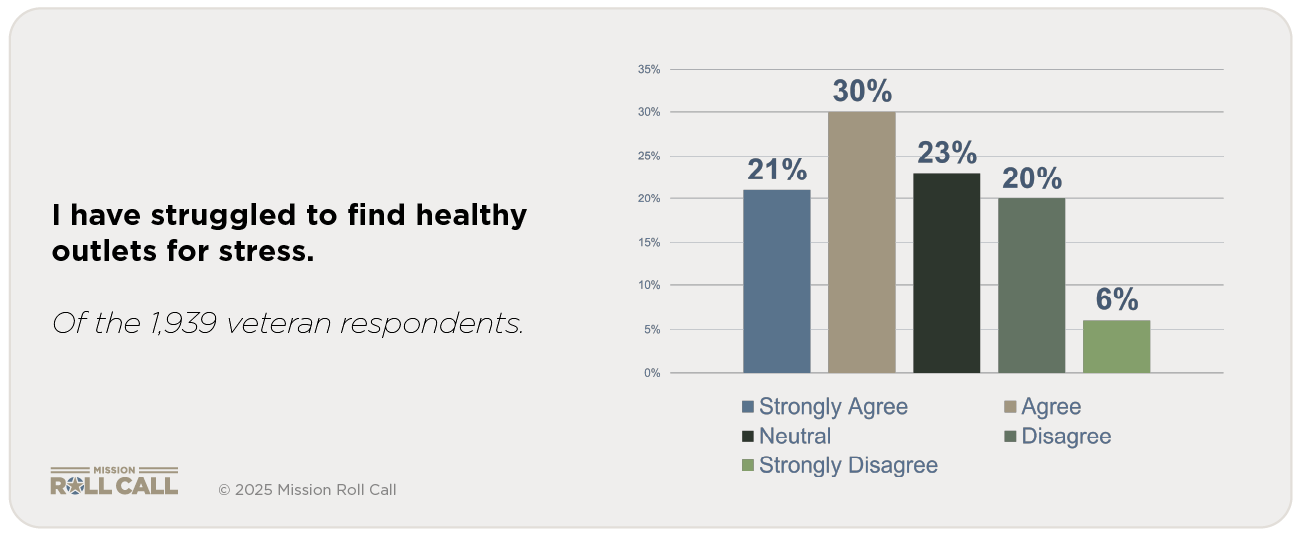
Veterans report difficulty finding healthy outlets for stress. Original MRC chart. Veteran respondents, n = 1,939.
A stronger evaluation could follow participants over time, ask consistent questions about isolation and wellbeing, and document whether referrals led to services. Where feasible, independent researchers should compare outcomes with those of similar veterans receiving other support. Programs should report who stops participating and why. Those details would help policymakers distinguish an ineffective approach from one that works but remains difficult to access or sustain.
Apply the same standards to earlier prevention
MRC’s left of clinical approach calls for support before challenges escalate into a crisis. That approach also needs evidence. Community connection, peer support and practical assistance should be assessed with the same seriousness applied to clinical programs. Veterans deserve confidence that public investments respond to their needs. Promising ideas should have room to develop, with clear expectations for learning, transparent reporting and changes when results fall short.
Veterans and families have expressed strong support for preventive partnerships. In the original MRC chart below, 77 percent of all respondents strongly agreed and 18 percent agreed that the VA should fund or partner with preventive wellness programs as part of suicide prevention. That support establishes a reason to test and evaluate such partnerships. It does not replace the need to demonstrate results or determine which programs serve particular veterans effectively.
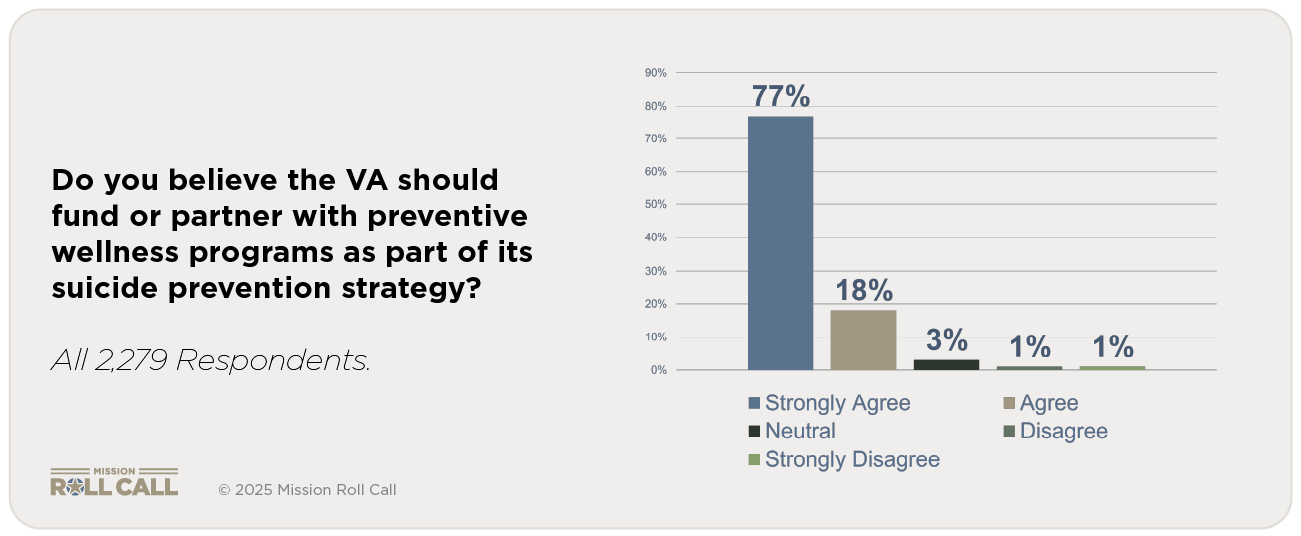
Support for VA partnerships in preventive wellness. Original MRC chart. All respondents, n = 2,279.
Congress has an opportunity to clarify outcomes
There is already bipartisan interest in a more coordinated approach. When Senators Jerry Moran and Richard Blumenthal introduced the National Veterans Strategy Act on January 29, 2026, Moran said the proposal would “clarify the outcomes they are intended to achieve.” The announcement described standardized measures of veteran outcomes and coordination across government and other organizations. That is a useful principle for suicide prevention oversight, regardless of the legislative vehicle Congress ultimately uses.
Reporting should distinguish veterans recently using VA care from those who are not, and show differences by age, sex and geography where the data support reliable comparisons. Congress should also examine how much support reaches veterans before an emergency. Because the latest mortality data end in 2024, they cannot demonstrate the impact of initiatives introduced in 2025 or 2026. Evaluations must match program dates with appropriate follow up periods.
Financial reporting should make it possible to connect spending with the services veterans actually receive. Congress could ask programs to explain the cost of reaching a participant, completing a referral and maintaining support over time. Those comparisons require care because intensive assistance costs more than a brief contact. Used responsibly, they could help identify where additional resources would improve access and where administrative requirements consume time without improving care.
Success should mean that more veterans receive timely, useful support and fewer families lose someone they love.
Funding decisions should follow that evidence. Effective services need stability, while programs with weak results need improvement or reconsideration. Providers should not be encouraged to avoid veterans with complex needs simply to improve performance figures. Fair evaluation must account for the challenges participants face. After more than two decades of data, veterans deserve a prevention system that learns from its results and explains its decisions. Success should mean that more veterans receive timely, useful support and fewer families lose someone they love.
Chart note: MRC survey responses describe participants’ experiences and preferences. They are separate from the VA national mortality data and do not establish program effectiveness. Percentages in the text follow the rounded labels in the original charts.