The Work Is Not Finished: The 120th Congress and Veteran Advocacy
The next Congress will inherit a veterans policy landscape already crowded with major questions about health care, benefits, transition, mental health, staffing and the long-term cost of caring for those who served. Whether Congress passes the Take Care of America’s Veterans Act (TCAVA) before the end of the current 119th session or not, those challenges will not disappear. Some legislation can make important changes to the system, but no single bill can settle the larger questions facing veterans and their families.
How quickly can a veteran get an appointment? Is the VA equipped to provide care directly while also managing an increasingly large community care system? Are veterans receiving help before a financial, employment or mental health problem becomes a crisis? Can the VA process a rapidly growing volume of disability claims accurately and efficiently? Are programs created decades ago still providing enough support for today’s severely disabled veterans, caregivers and survivors? Those are likely to remain central questions when the 120th Congress convenes in January 2027.
The VA Is Getting Bigger, and So Is the Responsibility
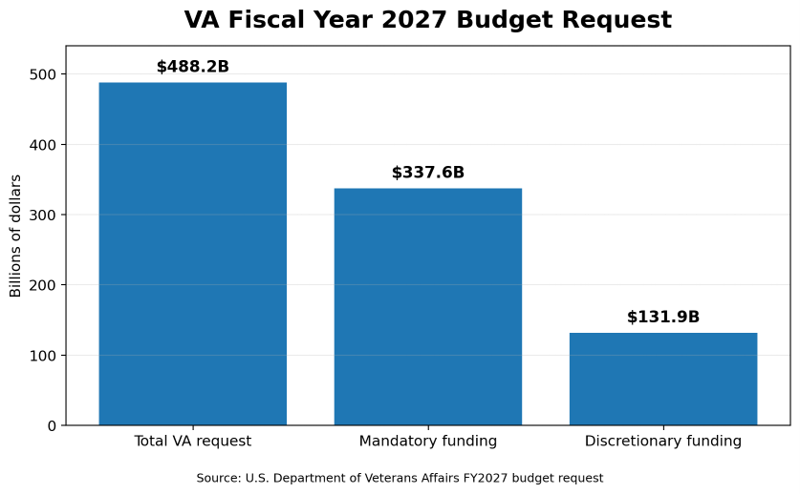
The Department of Veterans Affairs is requesting $488.2 billion for fiscal year 2027. To put that figure in perspective, the VA’s $488.2 billion request is roughly one-third the size of the Administration’s total FY2027 defense funding proposal.
The comparison is imperfect because the two departments have very different missions and funding structures, but it illustrates the extraordinary scale of the federal government’s financial commitment to veterans. The scale of that request reflects the size of the federal commitment to veterans, but it also raises a basic question for Congress: what outcomes are veterans receiving for that investment?
The question for the next Congress will not simply be how much money the VA receives. Lawmakers will also have to decide where that money should go and whether existing programs are producing measurable improvements in veterans’ lives. That debate reaches nearly every part of the system, from direct medical care and community care to claims processing, information technology, mental health programs and long-term services.
Access to Care Will Remain a Front-Line Issue
For veterans, the size of the VA budget matters far less than whether they can obtain care when they need it. The VA now operates a system in which veterans may receive treatment directly from the VA or from private providers through the Veterans Community Care Program. The VA has reported that a substantial share of care is now delivered through community providers, which has expanded options for many veterans while also creating new demands for scheduling, referrals, medical records and follow up care.
The practical question for the next Congress is not simply whether care is delivered inside or outside the VA. It is whether the system works from the veteran’s perspective. Can the veteran get an appointment? Can the VA find an appropriate provider? Can medical records follow the veteran? Can the VA ensure follow up care occurs? Can veterans move between the VA and community providers without becoming responsible for coordinating a complicated health care system themselves? These questions will remain important regardless of what legislation passes this year.
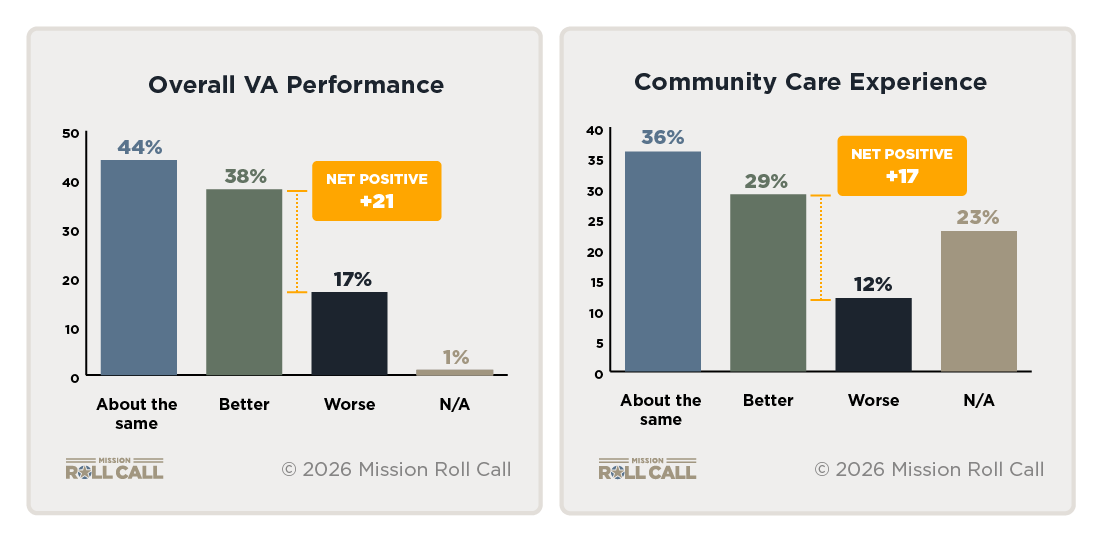
Mission Roll Call’s own polling shows why Congress should focus on outcomes rather than simply the structure of care. In February 2026, MRC surveyed more than 2,200 veterans, 73 percent of whom relied on the VA as their primary source of health care. Thirty-eight percent said overall VA performance had improved over the previous year, compared with 17 percent who said it had worsened. Community care showed a similar pattern, with 29 percent reporting improvement and 12 percent reporting deterioration. Staffing and continuity, however, remained much closer: 28 percent said conditions had improved while 22 percent said they had worsened.
The Workforce Behind the System Matters
Access cannot improve without people. The VA depends on physicians, nurses, mental health professionals, schedulers, claims processors, social workers and thousands of other employees. Staffing gaps can therefore affect everything from appointment availability to community care referrals and the speed of disability decisions. The next Congress will have to examine recruitment, retention, burnout, geographic shortages and the distribution of employees across VA facilities, not simply the total number of authorized positions.
For veterans, the effect is much simpler. An unfilled position can mean another delay. That makes workforce policy an access issue, a quality issue and, in some cases, a prevention issue as well.
Suicide Prevention Must Reach Veterans Before Crisis
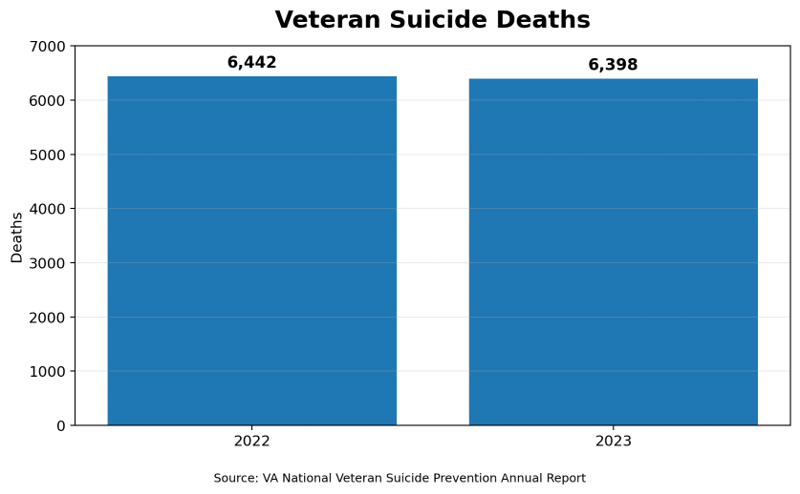
Few issues illustrate the unfinished work more clearly than veteran suicide. The VA’s most recent national report identified 6,398 veteran suicide deaths in 2023, compared with 6,442 in 2022. That is a slight decline, but the scale of the loss remains profound and continues to demand sustained attention from Congress, the VA, communities and veteran serving organizations.
But that is not all. One of the most important lessons in the national data is that many veterans who die by suicide are not actively receiving health care through the VA before their deaths. That reality reinforces a point Mission Roll Call has emphasized repeatedly: suicide prevention cannot begin only when a veteran arrives at a hospital in crisis. Transition, employment, financial stress, housing, family relationships, social isolation, substance use, chronic pain and connection to community can all affect risk long before a clinical emergency develops.
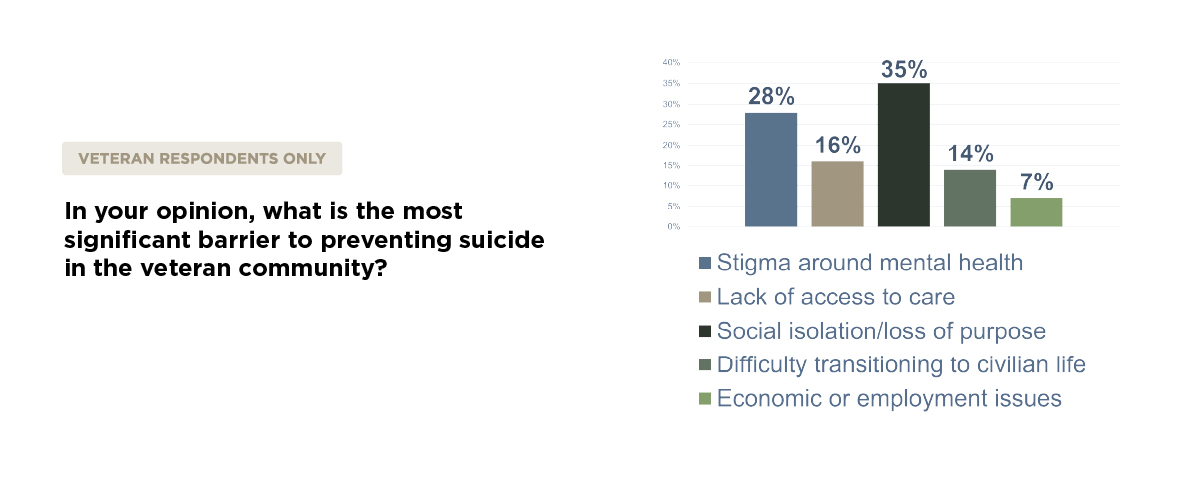
Mission Roll Call’s polling suggests veterans see the problem in similarly broad terms. In MRC’s survey on veteran suicide prevention, 35 percent of respondents identified social isolation and loss of purpose as the most significant barrier to preventing veteran suicide, followed by stigma surrounding mental health at 28 percent. When asked whether suicide prevention should prioritize clinical treatment or community-based support, 80 percent said both should be prioritized equally. Ninety-two percent also said including community-based organizations such as nonprofits and veterans service organizations in suicide prevention efforts was very or extremely important.
The next Congress will therefore have to consider how veteran suicide prevention can move further left of clinical. The question is not only how the VA responds to veterans in crisis, but how government, communities and veteran organizations can identify risk earlier and strengthen the conditions that help veterans remain stable before a crisis occurs.
Younger Veterans Need a Better Transition
The transition from military service remains another area where participation alone cannot be the measure of success. Veterans may complete Transition Assistance Program requirements and still encounter difficulty finding meaningful employment, navigating benefits available through the VA, adapting to civilian workplaces or managing the financial and family pressures that come with leaving military service.
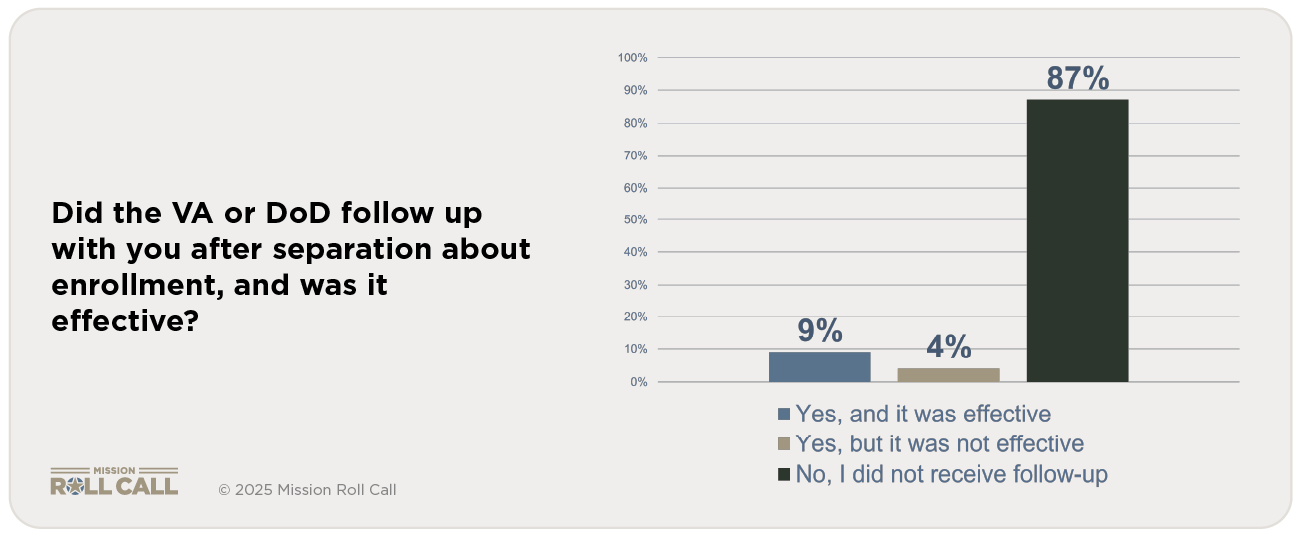
Mission Roll Call’s transition polling illustrates the gap between completing a transition process and achieving a successful transition. Among 1,581 respondents, 1,378 said they received no follow-up from either the VA or DoD after separation regarding enrollment, while only 142 reported receiving follow-up they considered effective. The employment findings were similarly revealing: 544 respondents said they took the first civilian job available because they needed immediate income, compared with 244 who entered a job aligned with their skills and goals that had been arranged before separation.
The next Congress has an opportunity to ask a different set of questions. Did the veteran find sustainable employment six months or a year after separation? Was the veteran financially stable? Did the veteran understand benefits available through the VA? Was the family prepared for transition? Did the veteran become connected to health care and community support? Did outcomes differ by age, service branch, rank, geographic location or family status? Better age disaggregated and outcome focused data would give Congress a clearer picture of whether transition programs are working for younger veterans and their families.
The PACT Act Has Changed the Scale of the Benefits System
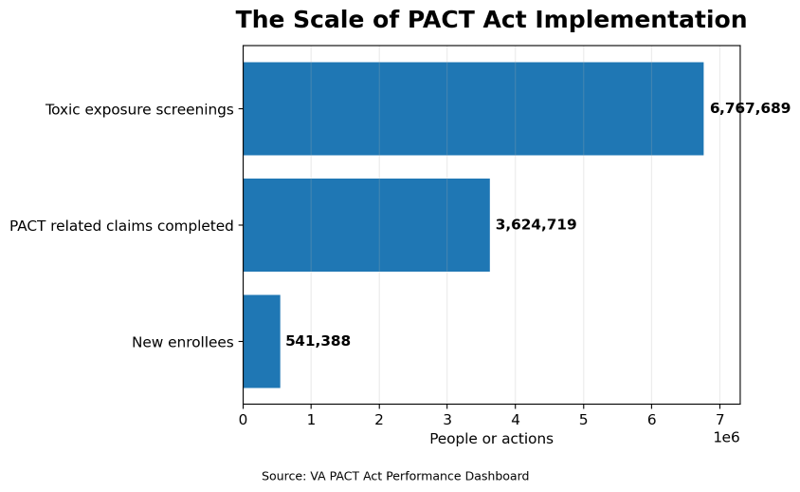
The PACT Act dramatically expanded eligibility for health care and benefits related to toxic exposure. The next phase is implementation. By the middle of 2026, the VA reported millions of toxic exposure screenings and PACT related claims, along with hundreds of thousands of new enrollees. Those numbers demonstrate both expanded access and a much larger administrative responsibility for the VA.
The next Congress will continue examining whether the VA can process that workload quickly and accurately, whether additional toxic exposures should be recognized and whether veterans can understand and navigate an increasingly complex benefits system. Volume alone cannot become the definition of success. For veterans, the important questions are whether the decision is correct, whether it arrives in a reasonable amount of time, whether communication is clear and whether veterans know what to do next.
Severely Injured Veterans, Caregivers and Survivors Cannot Be an Afterthought
Another issue likely to remain before Congress is the adequacy of support for veterans living with catastrophic injuries and the families caring for them. This population is smaller than the overall veteran population, but the consequences of policy decisions can be enormous. A severely injured veteran may require decades of personal care, adaptive housing, specialized transportation and medical treatment. A spouse or family member may leave the workforce to become a caregiver. A surviving family may suddenly lose not only a loved one but income and long-term financial security.
Those realities raise a fundamental question for lawmakers: have benefit programs created years or even decades ago kept pace with the actual cost of living with catastrophic disability or losing a veteran to a service-connected condition? The next Congress will continue confronting questions involving caregiver assistance, survivor compensation, specially adapted housing, long term care and financial support for the most seriously disabled veterans. For Mission Roll Call, this is also an area where veterans and caregivers themselves can provide Congress with information that administrative data cannot.
Housing and Financial Stability Remain Part of the Picture
Veteran homelessness has improved in important ways, but the issue is not solved. Housing instability is also an example of why Congress increasingly needs to focus upstream. The objective should not only be finding housing after a veteran becomes homeless. It should also include identifying the employment problems, financial shocks, disability issues, family disruption and mental health challenges that can place a veteran at risk of losing housing in the first place.
That same principle applies across veterans’ policy. Intervening earlier is usually better than waiting for a crisis, whether the issue is mental health, housing, employment, transition or family stability.
The Question Facing the 120th Congress
The veteran policy debate entering 2027 may therefore be less about identifying new problems than determining whether the nation is solving the ones it already recognizes. Congress has enacted major veterans’ legislation in recent years. The VA is operating with historically large resources. Millions of claims are being processed. Millions of toxic exposure screenings have occurred. Community care has expanded. More veterans are gaining access to health care. Those are significant developments, but the measure that matters most is what veterans experience.
That distinction between government activity and veteran outcomes is also why direct feedback from veterans matters. Across Mission Roll Call’s recent surveys on VA performance, transition, suicide prevention, community care and benefits, a consistent theme emerges: veterans judge these systems less by how much government spends or how many programs exist than by whether they can obtain care, understand their benefits, successfully transition to civilian life and receive help before problems become crises.
A veteran waiting for an appointment does not experience a budget number. A veteran struggling through transition does not experience a program participation statistic. A caregiver who has left the workforce does not experience a legislative authorization. A veteran approaching a mental health crisis does not experience the distinction between a program operated by the VA and a community program. They experience whether the system works.
That is why, regardless of TCAVA’s fate, the 120th Congress will still have substantial work ahead. The priorities are increasingly clear: improve access to care, strengthen the workforce that delivers it, move suicide prevention further left of clinical, improve transition outcomes for younger veterans and their families, modernize the benefits system, protect severely injured veterans and survivors, and demand meaningful outcomes from the enormous public investment being made on behalf of America’s veterans.
The laws may change from one Congress to the next. The obligation does not.
Sources
U.S. Department of Veterans Affairs, Fiscal Year 2027 Budget Submission.
U.S. Department of Veterans Affairs, National Veteran Suicide Prevention Annual Report.
U.S. Department of Veterans Affairs, PACT Act Performance Dashboard.
U.S. Government Accountability Office, reports and testimony on the VA’s community care, workforce capacity and access to care.