Five Years to a Front Door: A Marine Veteran’s Journey to Homeownership—and the Wife Who Didn’t Live to See It
Sometimes the call doesn’t come from a system.
It comes from a community that sees something isn’t right.
In this case, it was a local village that reached out—alerting that there was a homeless veteran family in their community.
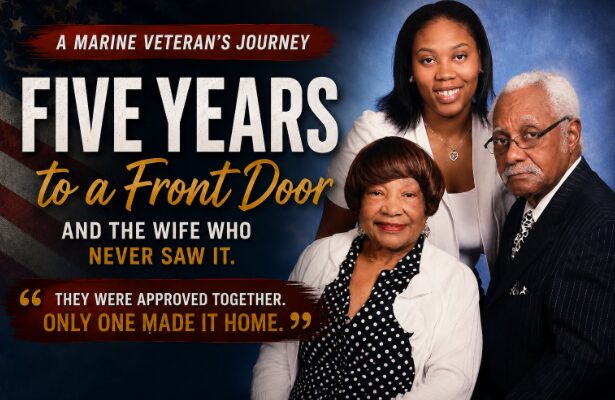
Marine veteran Philip Baldwin, his wife Miss Mary, and their daughter had been displaced due to a family situation. What began as a place to stay quickly became unstable. And like so many veterans, their situation wasn’t always visible—but it was real.
This is how homelessness often shows up.
Not always on the street.
But in displacement.
In uncertainty.
In families trying to hold things together while figuring out what comes next.
That call mattered—because it led to action.
I was able to place the family into a rental home—creating immediate stability after they had been displaced. What could have become a deeper crisis was stabilized through housing.
And for the next five years, that rental home became their foundation.
But stability did not mean security.
Over time, the condition of the home began to fall apart, and the owner attempted to force the family into purchasing a property that was not safe, not sustainable, and not aligned with what they deserved.
That moment could have set them back.
Instead, it became a turning point.
We made a decision—not to settle, but to move forward with intention.
We got to work to get Mr. Baldwin and Miss Mary preapproved for a new home. Together, they were approved—after everything they had endured—for a home that was structurally sound, stable, and truly their own.
Because after everything they had experienced, they deserved more than temporary solutions.
They deserved permanence.
Mr. Baldwin and Miss Mary had built a life together as a married couple for over 40 years. A lifetime of commitment, partnership, and resilience—only to be displaced later in life by circumstances beyond their control.
He had served this country.
He served well.
He was proud to be a Marine.
And like many veterans, he carried that pride even after facing adversities during his time in service.
At 83 years old, Mr. Baldwin purchased a home.
Let that sit for a moment.
After five years in a rental…
After displacement…
After navigating a system that often takes too long…
He became a homeowner.
But this story is not just about the milestone.
It’s about who was beside him on that journey.
Miss Mary.
She was there through the displacement.
Through the uncertainty.
Through five years of rebuilding stability.
She was there when they were approved to buy their home.
But she passed away before she was able to move in.
That matters.
Because when we talk about outcomes, we often focus on the closing.
We celebrate the keys.
We highlight the success.
But we don’t always acknowledge the time it took to get there—or what was lost along the way.
Five years is not just a timeline.
It’s a measure of how long stability can take to restore.
In 2026, we celebrated Mr. Baldwin’s 89th birthday.
A homeowner.
A Marine veteran.
A man who, despite every obstacle placed in front of him, made it to the other side of instability.
But his story raises a larger question:
Why does it take five years?
Because the reality is, veterans like Mr. Baldwin often move through multiple systems—temporary housing, referrals, program requirements, and delays—before everything aligns.
The resources exist.
The programs exist.
But alignment takes time.
And sometimes, too much time.
What worked here was connection—when the right people, the right resources, and the right timing finally came together.
But success should not depend on timing or chance.
It should be built into the system.
Mr. Baldwin’s journey shows us both sides of the truth:
That homeownership is possible—even after homelessness.
And that delays in the process have real human costs.
Not just for veterans—but for their families.
In honor of Miss Mary—who stood beside her husband for over 40 years, who endured displacement and rebuilding, and who was part of the approval that made homeownership possible—her legacy lives within the home, even if she never had the chance to step inside.
To learn more about Mission Roll Call’s work uplifting veteran voices and advancing effective housing solutions, visit our Homelessness page:
https://missionrollcall.org/spotlight-priorities/housing-and-homelessness/
Mission Roll Call is committed to listening first. If you are a veteran, family member, caregiver, or community partner, we invite you to share your story with us. Your experiences guide our advocacy and help us push for the changes veterans say matter most.
Your voice matters here. We encourage veterans, families, caregivers, and supporters to share their experiences through Mission Roll Call’s national surveys. Your stories help shape policy, raise awareness, and ensure veterans are seen and heard:
https://missionrollcall.org/surveys/
Understanding the truth brings us one step closer to ensuring every veteran has what they deserve: stability, dignity, and a place to call home.
Yvette Jones-Swanson, M.A., is a subject-matter expert on veteran homelessness and housing. A U.S. Army veteran and survivor of MST, she brings more than 22 years of frontline experience helping thousands of veterans secure stable housing.