Still Waiting: Hidden Homelessness and the Long-Term Struggles Facing Navy Veteran Kristy Barnes
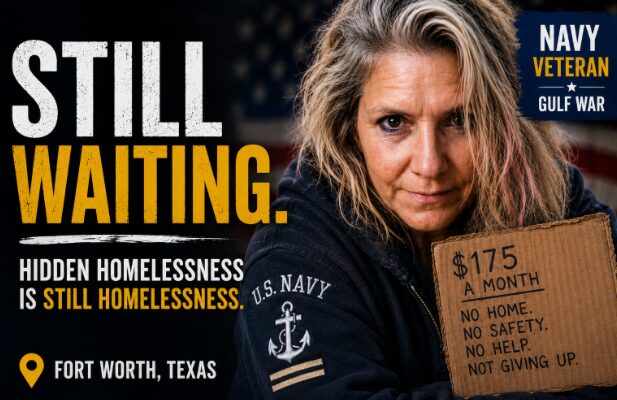
Kristy Barnes served her country honorably as a U.S. Navy veteran during the Gulf War.
Today, decades after her military service ended, she is still fighting for stability.
Not on a battlefield — but through years of hidden homelessness, financial instability, abuse, transportation barriers, and systems she says never fully connected to the reality of what she was experiencing.
Kristy currently lives in the Fort Worth, Texas area and survives on approximately $175 a month connected to a 10% VA disability rating. While she technically has a roof over her head, she describes living in an environment marked by long-term financial and emotional control.
That distinction matters.
Many veterans experiencing housing instability do not fit the public image of homelessness. They may still reside inside a home, but they lack safety, financial independence, reliable transportation, and long-term stability.
Kristy’s story reflects what many frontline advocates now describe as “hidden homelessness” — situations where veterans remain housed on paper while living in deeply unstable or unsafe conditions.
For years, Kristy has attempted to navigate benefits systems, housing resources, legal barriers, and community programs while also managing severe financial hardship and emotional exhaustion.
Without reliable transportation, even routine survival tasks became difficult:
• Attending VA appointments
• Accessing mental health services
• Applying for assistance
• Seeking employment opportunities
• Resolving legal and financial issues
At one point, repeated vehicle registration and insurance problems resulted in mounting tickets and an impounded vehicle she could not afford to recover.
The instability compounded.
Stories like Kristy’s highlight how transportation insecurity can directly affect healthcare access, employment opportunities, benefits navigation, and long-term housing stability for veterans already living in crisis.
Kristy also openly described the emotional toll years of instability have taken on her mental health.
After prolonged stress, isolation, abuse, and financial hardship, she disclosed experiencing intrusive thoughts of death — not from a desire to die, but from exhaustion and hopelessness tied to years of survival without meaningful relief.
That reality reflects a growing issue many veteran advocates continue to raise: mental health deterioration often cannot be separated from prolonged housing instability, trauma exposure, poverty, and chronic survival stress.
Kristy’s situation also reflects broader challenges affecting women veterans nationwide.
Many veteran housing and homelessness systems were historically structured around male veteran populations, leaving significant gaps for women veterans navigating:
• Domestic violence
• Financial control
• Caregiving burdens
• Trauma recovery
• Transportation instability
• Hidden homelessness
As a result, many women veterans do not receive meaningful intervention until their situations become visibly catastrophic.
By then, years of instability have already compounded into crisis.
One of the clearest realities in Kristy’s story is fragmentation.
Housing systems address housing.
Mental health systems address mental health.
Benefits offices address disability claims.
Legal aid handles legal issues.
But veterans do not experience these struggles separately.
Everything overlaps.
Kristy repeatedly asked for coordinated support:
• Crisis mental health intervention
• Housing stabilization assistance
• Benefits advocacy
• Transportation support
• Legal guidance
• A dedicated case manager willing to help coordinate across systems
In one of the most revealing parts of her statement, she wrote:
“I am overwhelmed and may have difficulty telling the full story in one call. Please accept this summary & help triage next steps.”
That statement reflects something many veterans quietly experience: exhaustion from repeatedly having to explain trauma and instability simply to access help.
As reflected throughout ongoing frontline housing advocacy and system analysis, many breakdowns occur not because resources do not exist, but because systems fail to align around the full reality veterans are experiencing.
Kristy Barnes’ story is not simply about one veteran struggling financially.
It reflects what can happen when hidden homelessness, delayed intervention, military-connected struggles, domestic abuse, transportation barriers, and fragmented systems collide over time.
And it raises an important question:
Are current systems truly designed to stabilize veterans before crisis escalates—or are they primarily responding once conditions become impossible to ignore?
Kristy Barnes is still here.
Still fighting.
Still surviving.
Still waiting for the kind of coordinated support that could change the trajectory of her life.
Her story is a reminder that some of the most serious veteran housing crises are not always visible from the outside.
To learn more about Mission Roll Call’s work uplifting veteran voices and advancing effective housing solutions, visit our Homelessness page:
https://missionrollcall.org/spotlight-priorities/housing-and-homelessness/
Mission Roll Call is committed to listening first. If you are a veteran, family member, caregiver, or community partner, we invite you to share your story with us. Your experiences guide our advocacy and help us push for the changes veterans say matter most.
Your voice matters here. We encourage veterans, families, caregivers, and supporters to share their experiences through Mission Roll Call’s national surveys. Your stories help shape policy, raise awareness, and ensure veterans are seen and heard:
https://missionrollcall.org/surveys/
Understanding the truth brings us one step closer to ensuring every veteran has what they deserve: stability, dignity, and a place to call home.
Yvette Jones-Swanson, M.A., is a former homeless veteran, U.S. Army veteran, Realtor, and nationally recognized subject-matter expert on veteran homelessness and housing. She has spent more than 22 years helping veterans navigate the path from homelessness to housing stability and homeownership through community-based housing solutions and systems alignment.