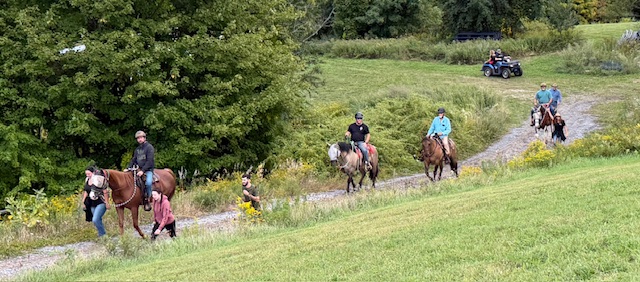
The trail winds through the trees on a property in New Hampshire that Rick and Renee, two generous people who want to share their stables, their horses, and their land with those who serve, have opened up to this work.
A veteran is on a horse. Eyes closed. One hand resting over their heart.
And somewhere in the quiet between the trees and the hooves and the Autumn air, they are saying something out loud that they have never quite been able to say before.
“I am worthy of love. I deserve to be carried.”
For someone who spent a career carrying everyone else, those are the hardest words they have ever been asked to say.
Six Months Later
When Mission Roll Call published its three-part series on the mental health side of military transition earlier this year, Shawn Batien, Brandon Rudder, and Gina Wright each shared something real about what it means to leave the military and figure out who you are on the other side. The series met three people where they were, found the people who needed it, and then life kept moving.
Six months after Shawn retired from 25 years of Army service, he got on a plane to New Hampshire.
He did not fully know what he was walking into. He had never spent significant time with horses. He was still in the middle of figuring out who Civilian Shawn was, working through the Honor Foundation’s transition program for veterans from the special operations community and the early stages of a doctorate degree, carrying questions he had not yet found the right space to answer.
Brandon Rudder, the Command Sergeant Major who retired in February 2026 after 23 years and 15 deployments, was navigating a job transition of his own. The position he had stepped into after leaving the Army had not worked out, and he was in the thick of networking, interviewing, and figuring out what came next professionally while also still sorting out the larger question of who Brandon was outside of the rank. Outside of being the stop gap, the person who solved what everyone else considered unsolvable. That identity does not just hand itself over quietly.
Gina Wright, a licensed clinical social worker who spent more than 18 years on active duty and anchored the third part of the original series, had made a phone call to both Brandon and Shawn that fall. Each of them she knows from different roles while serving. She thought Shawn was in the right headspace for this kind of therapy. Brandon had experienced equine work with Gina before, and she thought he could use more of it. She asked both of them, carefully and with full transparency about her dual role, whether it would be okay for her to be there.
They both said yes.
What happened over those two days at Blue Sky Farms is the kind of thing that is hard to explain to someone who was not there, but what they kept coming back to was the horses.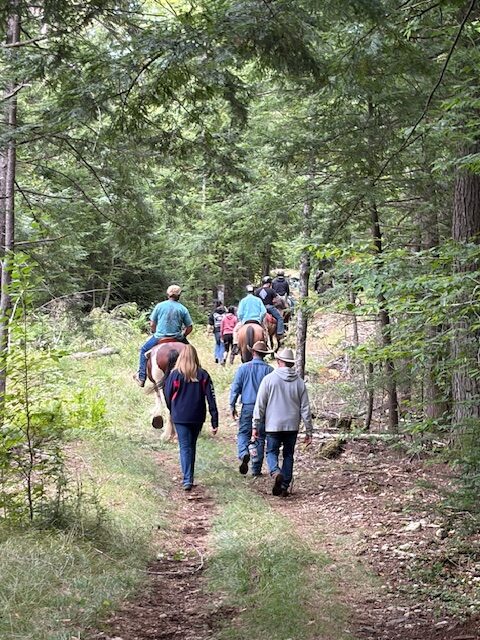
What the Horse Already Knows
Gina has been part of the Equine Immersion Project for four years, first joining as a second licensed clinician when it became clear that one therapist was not enough to hold space for eight to ten veterans carrying everything they carry.
She is careful and specific when she explains why the horses work.
“Horses are extremely intuitive,” she said. “They can feel your heartbeat about ten feet away. They know if you’re carrying a load. And they’re going to mirror or respond or react to what you’re feeling.”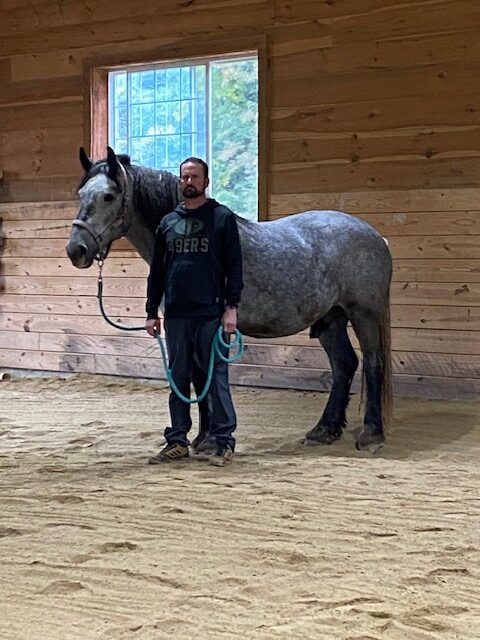
An anxious person may notice the horse turn away from them. A sad or burdened individual may experience the horse approaching, moving close in a way that feels almost deliberate. As the connection between the horse and the veteran changes, the horse’s posture and mannerisms will change with the activities throughout the program.
“The horses are doing what we want people to do with people,” Gina said. “We want humans to connect with each other. And a lot of times when we’ve experienced trauma or we’re going through things, we isolate. If you can’t connect with people, the horse is an opportunity for you to learn how to connect with something. And then hopefully you can start transferring that over to humans.”
For veterans who have spent years, sometimes decades, trained to push through, to not ask for help, to keep their guard up, being read honestly by a thousand-pound animal is a disarming experience. You cannot perform for a horse. You cannot manage your image. The horse already knows.
The Choice, the Brush, the Box
The Equine Immersion Project was founded by Tara, a licensed therapist and horse expert who built the program from the ground up and runs it as its day-to-day architect. She screens every participant before they arrive, interviewing each person Gina or another clinician refers to make sure the fit is right and the timing makes sense. The weekend does not happen without her.
When participants arrive at Blue Sky Farms, the first thing that happens is a safety brief. Tara runs it in military language because that is the language most of the participants know. The Army is all about safety, Gina said with a smile, and so is this.
Then something different happens.
All the horses are brought into the arena. And unlike almost every experience these veterans have had in uniform, they are given a choice. Walk around. See which horse you feel pulled toward. Take your time.
“In the Army, you get told what to do and you don’t get choices,” Gina said. “So we give them this choice.”
Therapists and horse handlers watch quietly, ready to redirect a pairing that is not quite right without the participant ever knowing it happened.
From there, participants groom their horse. They brush it, pick dirt from its hooves, and then they are asked to do something that stops most of them cold — they are asked to pull the horse’s tail.
“You hear, don’t stand behind a horse, you’re gonna get kicked,” Gina said. “So we’re getting them to feel anxious. They complete the task, they feel confident. Because when you’re anxious, you either push through it and then it goes away, or you avoid it. And we don’t want them to avoid. When you have an anxiety disorder, when you avoid things, they don’t get better.”
The tail pull becomes a conversation. Did you feel anxious? You waited, went still, pulled the tail, and you were confident. What else in your life are you avoiding instead of working through?
Later comes what Gina calls the box exercise. Objects are placed in the middle of the arena. A fire extinguisher. A chain. A weight. A chair. A ladder. Whatever is available. Participants are asked to choose one or two items that speak to their story, and then to tell that story, out loud, with their horse beside them.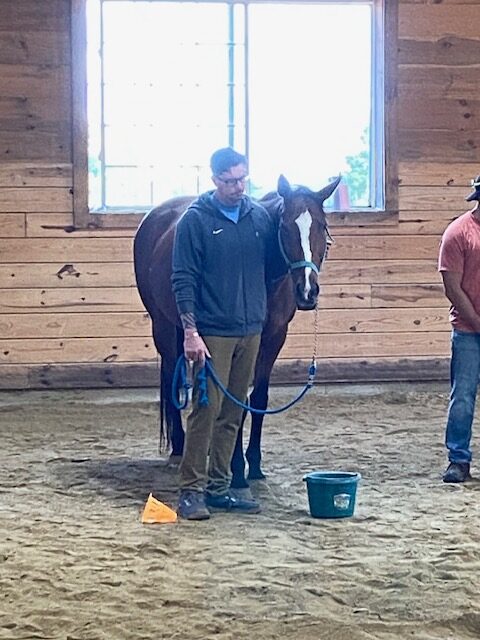
Say a participant chooses a chain. Tara and Gina observe where they place it, where they and the horse stand while they tell their story to the group, and where the horse moves during the telling. The horse stepping behind the veteran, placing them between the horse and the group, means something different than the horse stepping between the veteran and everyone else. The horse could be protecting the person, or showing them they belong.
“We find a way to take what the horse is doing, tie it into the story, and make sense of it,” Gina said. “Sometimes the horse will step behind the person and kind of push them toward the people. And we’re like, look, the horse wants you to know that you have us. We’re here.”
She paused.
“It’s very powerful. You never know what’s gonna happen. You never know how the horse is gonna respond to what the person is saying and how they’re feeling.”
Shawn and Brandon
For Shawn, the weekend did something specific that he had not been able to do from home. It gave him distance.
“The equine immersion project for me was a really good way to separate myself geographically from home, and even where I’ve been for the last quarter of a century,” he said. “To focus and try to find some clarity on what all of that truly means.”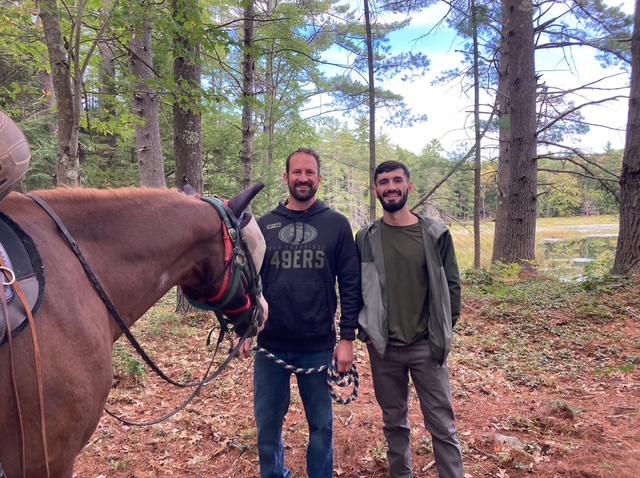
He brought what he found back to his VA therapist, and said the conversations they had afterward were some of the best they had ever had. Getting clear on his values, who he is as a person, the direction he wants to go.
“It almost culminated there in a way that allowed me to bring it all back,” he said. “Let’s figure out what that means and then create a goal and plan forward.”
Six months post-retirement, he is finding his footing.
Brandon Rudder was there too. Unlike Shawn, Brandon was not coming to equine therapy for the first time. The previous October, when the Equine Immersion Project came to Fort Stewart for its twice-yearly day program, Brandon had been one of the soldiers who participated. Soldiers arrive at nine and leave at three. It is surface level by design, an introduction, a window into something bigger.
Gina had watched him go through it. She knew what he carried. And she knew he needed more than a day.
So she invited him to New Hampshire for the full weekend, the version that builds over days rather than hours. Brandon knew what he was walking into. He said yes anyway.
Healing is not linear. It does not happen on a schedule, and it does not always arrive at a tidy place where a person is ready to put words to it. What matters is that Brandon showed up. That all three of them did. That after everything the series asked them to share publicly, when the invitation came to go somewhere quiet and do some of the harder, quieter work, they said yes.
The Trail
The trail ride is where everything that has been building over the weekend arrives at something.
Participants mount their horses, the animals they have spent time grooming, brushing, learning and being honest in front of, and they ride out into the trees. Then at some point on that trail, they are asked to close their eyes. To put one hand over their heart and say something out loud.
I am worthy of love. I deserve to be carried.
“As service members, you are caring for other people,” Gina said. “You are carrying this load. So you’ve built this trust, this relationship with this horse. And now this horse is saying, I got you.”
For some of the participants, that sentence comes easily. For others, I deserve to be carried is the hardest thing they have said in years. Maybe ever.
Because the military does not train people to be carried. It trains people to carry. To push through, show up, hold the line, take care of the person to their left and their right. The idea that you might deserve to rest that weight on something else, that something else might be willing and able to hold it, is not a thought that comes naturally after years of being trained out of it.
But the horse does not know any of that. The horse just knows you are on its back and it keeps carrying you.
What It Is Building
The Equine Immersion Project is still growing. The Fort Stewart day program, which runs twice a year for five days each iteration, giving soldiers a surface-level introduction to the work, will expand to a full week in March. It will be held at a farm owned by a veteran who went through the program himself, got out of the Army, and opened his land to other veterans.
Gina sees it as part of something larger, a growing recognition that healing for veterans does not always look like a waiting room or a prescription. Sometimes it looks like a field. A horse that goes still when you get to the hard part of your story. A group of people who showed up as strangers and left with each other’s phone numbers.
“The end goal is for them to walk away feeling loved and supported,” she said, “and having more individuals to help them through whatever they’re gonna have to navigate in their lives.”
By the end of the weekend at Blue Sky Farms, Rick and Renee, the couple who donated their land and their time and their home, stay after everyone leaves and debrief with Tara and Gina. They talk about what they witnessed. They say things like, I felt so privileged and I am so grateful they shared that with me.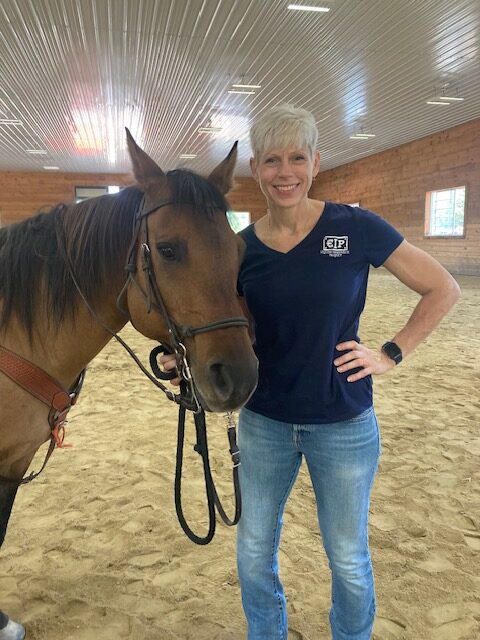
The horses go back to their stalls.
And somewhere on the drive home, or on the plane, or maybe not until weeks later when a therapist asks the right question, a veteran who spent a career learning to carry everything finds out what it felt like to be carried.
And holds onto that.
Coming Soon
Behind every weekend at Blue Sky Farms is Tara — the licensed therapist and horse expert who built this program, runs every detail of it, and has spent years watching veterans say things out loud they have never said before. Her story is coming soon to Mission Roll Call.
To learn more about the Equine Immersion Project or to inquire about participating in a program, visit equineimmersionproject.com.
Mission Roll Call’s Veteran Resource Directory is a free, searchable database of organizations supporting veterans across the country. Visit missionrollcall.org to find resources near you.
If you or someone you know is struggling, the Veterans Crisis Line is available 24 hours a day, 7 days a week. Call 988 and press 1, text 838255, or chat online at veteranscrisisline.net.