The Programs Exist. So Why Is She Still Fighting Alone?
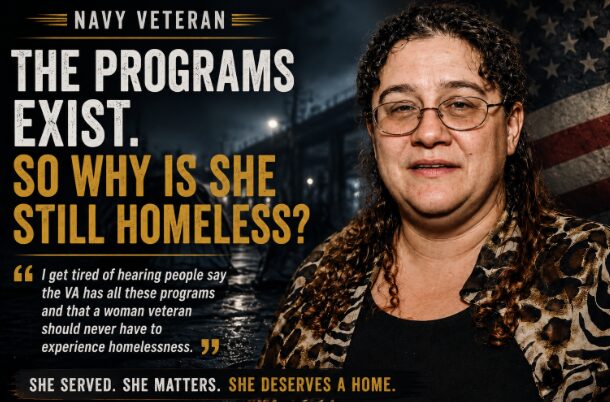
A Navy Veteran’s Battle for Care, Stability, and Survival
Navy Veteran Kristina Marie is not disconnected from the system.
She has reached out for help.
She has followed procedures.
She has connected with services.
She has continued advocating for herself while battling serious illness, housing instability, and emotional exhaustion.
And yet today, she is still fighting for something no veteran should ever have to beg for:
Care.
Relief.
Stability.
Dignity.
Right now, Kristina is in Boston trying to receive treatment for a serious medical condition.
Not simply requesting healthcare.
Begging for it.
“I’m in Boston trying to beg to get treatment for my disease… and for my pain.”
Those are not words any veteran should have to say after serving this country honorably.
Especially not a veteran already navigating homelessness, chronic illness, and declining physical health.
Kristina describes feeling physically depleted and emotionally overwhelmed by systems that seem to require veterans to prove their suffering repeatedly before receiving meaningful help.
“I’m tired of being so sick and so depressed, but I just got done trying to beg to get an evaluation.”
That statement reflects something happening quietly across the country.
Many veterans are no longer just fighting medical conditions.
They are fighting exhaustion from navigating disconnected systems:
- Endless referrals
- Delayed evaluations
- Fragmented healthcare
- Housing instability
- And the emotional burden of constantly advocating for themselves while already in crisis
What makes Kristina’s story even more significant is that she is not only carrying her own struggles.
She is also a caregiver.
She has two adult children facing behavioral health challenges, and much of that responsibility falls on her shoulders—even while she battles serious illness and homelessness herself.
And despite all of this, she continues moving forward.
Kristina is currently pursuing her master’s degree at the University of Washington in Public Health and Public Policy.
That matters.
Because her story directly challenges one of the most harmful myths surrounding homelessness:
That homeless veterans are not trying.
Kristina is trying.
She is educated.
She is engaged.
She is connected to services.
She is advocating for herself.
She is pursuing higher education.
She is caring for her family.
And still, she is struggling to secure coordinated healthcare and stable housing.
Her experience exposes a painful contradiction within the national conversation surrounding veteran homelessness.
The public is often told:
- The programs exist
- The resources are available
- Women veterans should never experience homelessness
Yet veterans like Kristina continue living a very different reality.
Not because resources do not exist.
But because systems are not aligned in ways that make those resources realistically accessible for medically vulnerable veterans.
Kristina also speaks openly about something many women veterans quietly carry:
The emotional exhaustion of constantly hearing that help exists while continuing to experience barriers firsthand.
“I get tired of hearing people say the VA has all these programs and that a woman veteran should never have to experience homelessness.”
That statement is not rooted in anger.
It is rooted in fatigue.
The fatigue that comes from surviving inside systems that often feel harder to navigate the sicker you become.
Kristina’s story is about far more than homelessness.
It is about what happens when medically vulnerable veterans become trapped between disconnected systems:
- Hospitals discharge without continuity of care
- Specialty evaluations remain delayed or inaccessible
- Housing options fail to account for medical realities
- Veterans are forced to repeatedly explain and prove their suffering just to receive support
Eventually, exhaustion becomes part of daily life.
Not because veterans stop fighting.
But because they have been fighting for too long.
There is another truth embedded in Kristina’s story that deserves national attention:
Homelessness among veterans is not always visible.
Sometimes it looks like:
- A veteran coordinating medical care across multiple states
- A woman veteran pursuing graduate school while struggling with housing instability
- A caregiver carrying emotional burdens while battling serious illness herself
- A veteran sleeping in temporary spaces while trying to secure healthcare access
These stories rarely fit the public stereotype of homelessness.
But they are real.
And they are happening every day.
Kristina’s experience forces us to ask difficult but necessary questions.
If a veteran can:
- Be medically fragile
- Connected to services
- Pursuing higher education
- Acting as a caregiver
- Actively seeking help
—and still remain unstable—
then where exactly is the breakdown happening?
Because this should not be normal.
Kristina’s story reflects broader systemic gaps affecting medically vulnerable veterans across the country:
- Fragmented healthcare coordination
- Delayed specialty care access
- Housing systems disconnected from medical realities
- Emotional exhaustion caused by endless system navigation
- Limited coordination between medical providers, housing systems, and veteran services
The issue is no longer whether programs exist.
The issue is whether veterans can realistically access those programs before crisis deepens.
And still, despite everything, Kristina continues.
Continuing to advocate.
Continuing to pursue education.
Continuing to care for her family.
Continuing to survive.
That is resilience.
But resilience should never be mistaken for proof that the system is working.
Veterans should not have to beg for evaluations.
They should not have to fight through disconnected systems while seriously ill.
And no veteran—especially one carrying medical, emotional, educational, and caregiving burdens simultaneously—should feel forgotten while trying to access help.
Kristina’s story reminds us that awareness alone is not enough.
Coordination matters.
Access matters.
Listening matters.
Action matters.
Because behind every statistic is a veteran still fighting to survive.
To learn more about Mission Roll Call’s work uplifting veteran voices and advancing effective housing solutions, visit our Homelessness page:
https://missionrollcall.org/spotlight-priorities/housing-and-homelessness/
Mission Roll Call is committed to listening first. If you are a veteran, family member, caregiver, or community partner, we invite you to share your story with us. Your experiences guide our advocacy and help us push for the changes veterans say matter most.
Your voice matters here. We encourage veterans, families, caregivers, and supporters to share their experiences through Mission Roll Call’s national surveys. Your stories help shape policy, raise awareness, and ensure veterans are seen and heard:
https://missionrollcall.org/surveys/
Understanding the truth brings us one step closer to ensuring every veteran has what they deserve: stability, dignity, and a place to call home.
Yvette Jones-Swanson, M.A., is a former homeless veteran, U.S. Army veteran, Realtor, and nationally recognized subject-matter expert on veteran homelessness and housing. She has spent more than 22 years helping veterans navigate the path from homelessness to housing stability and homeownership through community-based housing solutions and systems alignment.