The Transition Gap, Part I: What Veterans and Their Families Told Us About Leaving the Military
Every year, more than 200,000 men and women transition from military service to civilian life. Although policymakers frequently emphasize the goal of a “seamless transition,” the lived experience of veterans suggests that this goal remains unmet. Their families and loved ones often absorb the resulting challenges, providing support where existing systems fall short.
In October 2025, Mission Roll Call conducted a nationwide survey examining the transition process. More than 1,500 veterans and family members participated, offering frank assessments of current programs and support structures. Their responses reveal consistent themes: veterans do not feel thoroughly prepared for civilian life; they lack clear guidance on navigating VA benefits, and the broader system does not sufficiently address the needs of their families.
Our survey identifies four key areas in which the transition process falls short, leaving veterans and their families insufficiently prepared for life after service:
- Limited preparedness for civilian life: Half of veterans’ report feeling unprepared for the challenges of civilian life.
- Complex and unclear VA enrollment: The process of enrolling in VA benefits is often opaque, inconsistent, and more complicated than other aspects of transition.
- Low trust in DOD and VA guidance: Veterans frequently place low trust in official sources, instead relying on peers for guidance on transition-related tasks.
- Inadequate family inclusion and support: Families are often under-informed and excluded from the transition process.
Veterans often feel unprepared for life after service, face confusing and inconsistent VA enrollment, lack confidence in official guidance, and experience limited support for their families. We must address these gaps to ensure veterans and their loved ones receive the guidance and support they need for a successful transition.
Preparation for Civilian Life
We asked veterans how well their military service prepared them for civilian employment, education, and community life. The responses show that half of all veterans felt insufficiently prepared for life after service.

One veteran wrote in our survey, “I was trained to do my job, not to navigate civilian life.” Another said, “I did not know how to translate my skills into something employers understood.”
These comments align with the data. Veterans arrive in civilian life with strong, marketable skills developed through military service but receive too little guidance on how to translate those skills into civilian credentials, language, and career pathways. The impact is not abstract. When veterans cannot clearly articulate their experience to employers, they are more likely to be underemployed or unemployed, even when jobs are available. That underemployment often leads to financial strain, loss of identity and purpose, and growing frustration with systems that promised a seamless transition but did not deliver.
Over time, these pressures compound. Difficulty securing stable, meaningful work is a well-documented risk factor for housing instability and homelessness, particularly for younger veterans and those leaving the service without a strong civilian network. Prolonged economic stress and a sense of failure or invisibility can also deepen mental health challenges, increasing the risk of depression, substance use, and suicide. In this way, inadequate skills translation is not just a workforce issue; it is a public health and public safety issue.
Because many of the most at-risk veterans entered service so young, many had little experience managing personal finances, navigating healthcare, or making major life decisions before joining. The military’s structured environment provides housing, healthcare, and a clear professional pathway. Once separated, veterans are suddenly responsible for decisions previously handled by their chain of command.
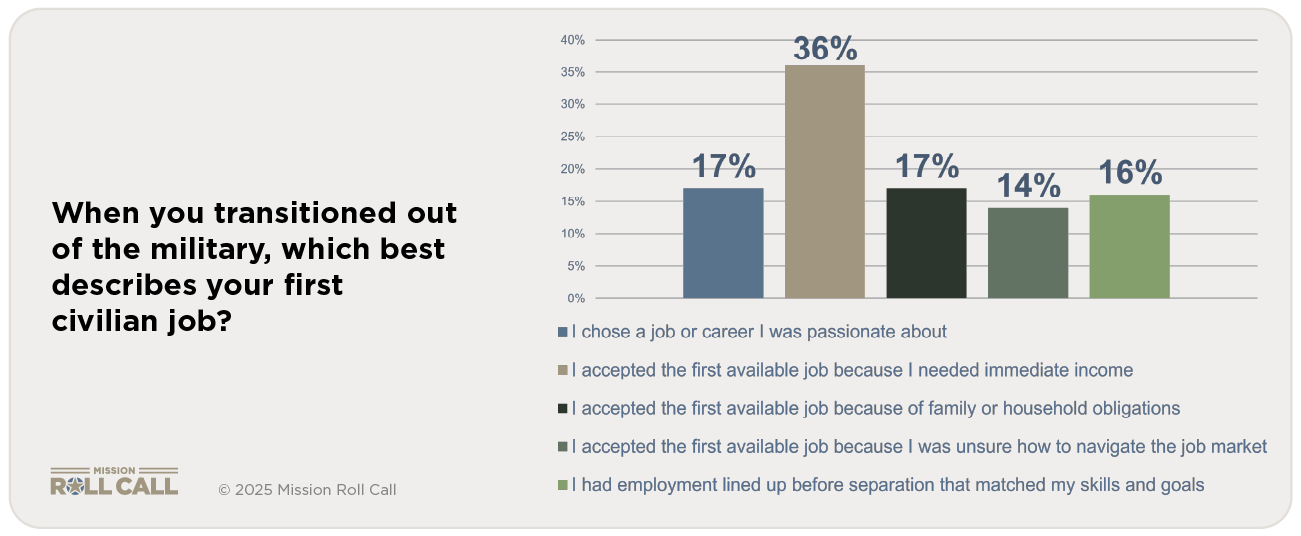
This pressure shows clearly in the job market. When asked which statement best describes their first civilian job, many respondents said they took the first job they could get. Perhaps more concerning, 67 percent of respondents did not choose a job based on fit, interest, or long-term career goals. They simply needed work or lacked guidance to make a more informed decision.
Unlike many older veterans who transition with more life experience, younger veterans often leave the military without strong community ties outside the service. The loss of camaraderie, routine, and purpose can create feelings of isolation or disorientation. These young service members often stepped into uniform at a time when their civilian peers were developing foundational life skills, pursuing education, and gaining early work experience.
As a result, many separate from the military without a college degree, without a professional network, and without the civilian work history employers expect. For some, the transition is not just a career shift but the end of the only adult life they have ever known. In the most serious cases, these pressures intersect with mental health challenges and increase risk for crisis or suicide.
These findings point to multiple areas of concern deserving of more focused solutions. Younger veterans require targeted and intensive support to successfully navigate the transition from military to civilian life. This includes:
- stronger communication about benefits
- more accessible and effective transition education
- financial guidance
- mentorship and career coaching
- community building and focused programs alongside veterans that replicates the cohesion they lose after separation
- By understanding where the gaps exist, we can ensure veterans enter civilian life with clarity, confidence, and connection instead of uncertainty and risk.
Complex and unclear VA enrollment
The process of enrolling in Department of Veterans Affairs benefits is often opaque, inconsistent, and more complicated than other aspects of the transition to civilian life. Compounding this challenge, our survey found that the Transition Assistance Program is frequently viewed as unhelpful or, in some cases, counterproductive. Even among veterans who did participate in TAP, only a small share reported that it meaningfully prepared them for what came next.

Veterans’ comments consistently point to problems with timing, delivery, and relevance. Many cited the speed at which information was presented, the lack of follow up, and content that felt disconnected from their immediate needs. One veteran described TAP as “information, not preparation.” Another noted that it “came at the end, when my attention was split between out processing tasks.”
Together, these responses reveal two critical gaps. First, a significant number of servicemembers never meaningfully engage with TAP at all. Second, for those who do, the program is often experienced as brief, generic, and easy to forget rather than as a sustained bridge to civilian life. These gaps leave veterans navigating complex benefit systems on their own at precisely the moment when clear guidance and continuity matter most.
Others described how the process competed with immediate financial and family pressures. “I was trying to find a job, move my family, and figure out health care all at once,” one veteran wrote. “VA enrollment just became another full-time job.”

For some veterans, the complexity and opacity of the VA enrollment process are so discouraging that they disengage entirely, particularly when faced with lengthy, repetitive, and confusing paperwork. Even minor errors can trigger significant delays, with forms often requiring repeated submissions across offices that do not communicate with one another. Veterans describe this experience as overwhelming, and as a result, some forego benefits entirely, delaying or losing access to healthcare, education programs, and financial support.
Low trust in DOD and VA guidance
Veterans consistently describe required forms as lengthy and difficult to understand, with unclear instructions and little support for completing them correctly. Many report being caught in cycles of submission and correction that erode confidence and momentum. One veteran stated, “After being sent in circles so many times, I just stopped trying.” Another explained, “I filled out the paperwork the best I could, only to be told months later that something was missing or wrong.”
Even small errors can trigger significant delays. As one respondent shared, “One mistake on a form meant everything was kicked back, and no one could tell me how to fix it.” Others described having to provide the same information repeatedly across different offices that do not communicate with one another. “I felt like I was doing the same paperwork over and over,” one veteran wrote, “but every time it was for a different system.”

These administrative barriers have real consequences. Delays in completing or correcting paperwork can postpone access to health care, education benefits, and income support for months or longer. Rather than serving as a stabilizing force during transition, unclear and burdensome paperwork often becomes an added source of stress and discouragement. For veterans already balancing employment, family responsibilities, and the emotional challenges of leaving military service, paperwork difficulties can be the tipping point that leads them to disengage entirely, leaving critical benefits unused.
At the same time, many veterans report low trust in official sources of transition information and instead rely on peers for guidance. Official briefings, websites, and help lines are frequently described as confusing, inconsistent, or disconnected from lived experience. One veteran explained, “I trusted other veterans more than anything I was told in a briefing.” Another shared, “The official information sounded good, but it did not match what actually happened once I got out.”
Peer networks are viewed as more credible because they offer practical, experience-based advice. Veterans commonly turn to friends who have already separated, informal online groups, or fellow servicemembers slightly ahead of them in the process. “I learned more from talking to other veterans than I did from any official program,” one respondent noted. Another added, “Other vets told me what paperwork actually mattered and what mistakes to avoid. That was never clear from the VA or TAP.”
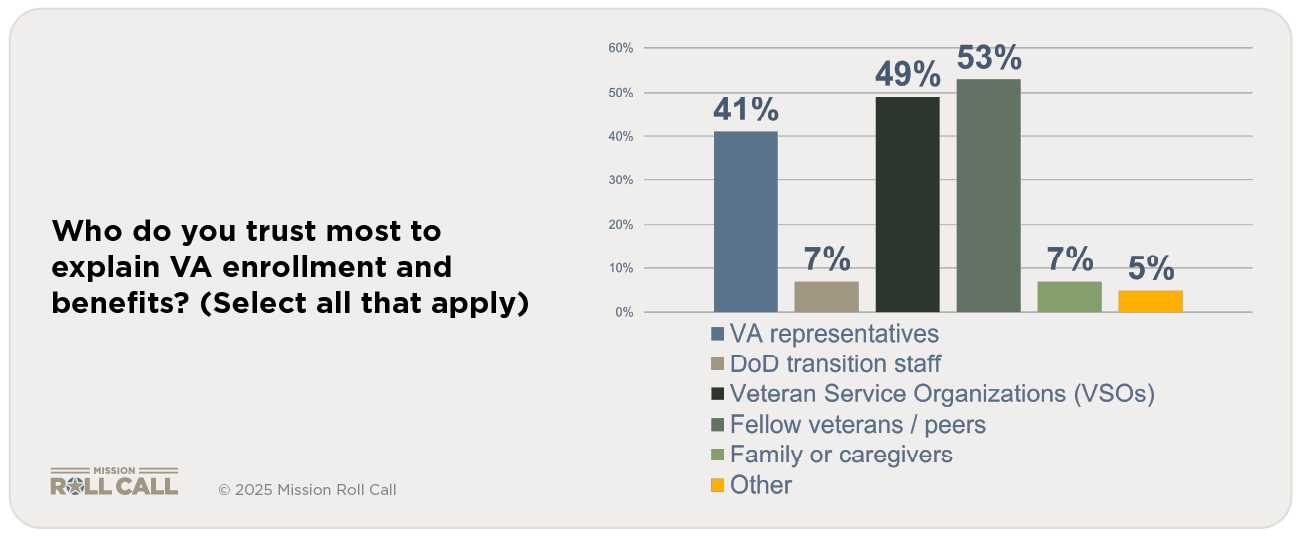
This reliance on informal networks reflects a deeper breakdown in institutional trust. Veterans described receiving different answers depending on who they contacted, leading many to stop seeking official guidance altogether. As one veteran put it, “Every office gave me a different answer, so I just listened to people who had already been through it.” As a result, veterans often navigate one of the most complex transitions of their lives through word of mouth rather than through clear, reliable, and accountable support systems.