The Transition Gap, Part II: What Veterans and Their Families Told Us About Leaving the Military
Inadequate family inclusion and support
Families and loved ones are often the first to recognize when a veteran begins to struggle physically, mentally, or emotionally, and their early awareness can make a world of difference for a veteran. Long before a challenge becomes a crisis, it is the spouse who notices the sudden withdrawal, the parent who hears something different in a phone call, or the sibling who sees a shift in routine. Yet during one of the most important periods in a veteran’s life, the transition out of the military, these same loved ones are often left on the sidelines. Because the separation process is fast paced, stressful, and packed with dense information, many veterans walk away without fully understanding the benefits they have earned or how to access them.
In our recent survey, 87 percent of respondents said they did not receive any follow-up from the VA or DoD after their separation. A percentage this high, combined with the veteran frustration outlined above, makes clear that a family member or trusted loved one should be involved in the discharge process. Families usually notice subtle changes in a veteran’s well-being long before a crisis occurs. If trusted family members also understand the benefits, enrollment steps, and programs available, they can help ensure nothing is missed.

Strategies Moving Forward
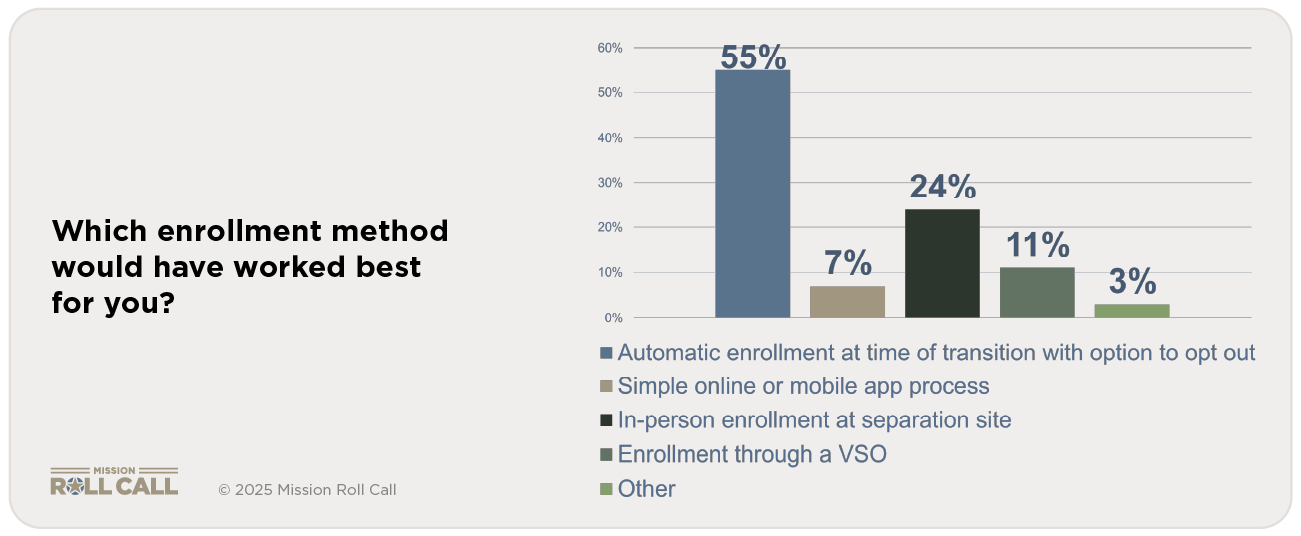
Recommendation #1: Automatic enrollment in VA at time of separation, with an option to opt out.
We asked veterans and their family members how they would prefer to be enrolled in the VA, and one answer stood out: automatic enrollment at the time of transition*, with the option to opt out. One way to ensure that all eligible servicemembers have access to the care provided by the VA is to automatically enroll them at the time of first eligibility, which is the moment they are separated from active duty with any discharge other than dishonorable.
*Some VA-related programs can be used before separation, such as the VA Home Loan Certificate of Eligibility, the Transition Assistance Program, and Pre-Discharge Disability Claims.
This option will guarantee that veterans have coverage and will make the transition easier. If a veteran does not want to take advantage of VA benefits, they will be able to easily opt out of coverage if they choose to do so.
Recommendation #2: Involve immediate family members or caregivers at critical moments during transition
Ensuring a family member or trusted advocate is present during VA enrollment and TAP instruction helps solidify understanding, spreads the burden of information retention, reduces the mental overload on the veteran, recruits the veteran’s own support network, and increases follow-through. A recent Mission Roll Call survey indicated that 69 percent of 595 family members/caregivers felt they were excluded in servicemember’s transition planning or enrollment discussion. Providing clearer, streamlined information that is delivered to servicemembers and their families can reduce confusion that occurs during an already stressful time.

Sharing information about VA programs, caregiver resources, and support services helps families prepare and advocate effectively. When families understand VA services before they are needed, veterans are more likely to connect with care early and maintain long-term engagement, reducing the burden on the veteran and their families.

This lack of clarity is compounded by the fact that many veterans were unsure whether they were ever clearly offered the opportunity to enroll in VA health care or benefits during transition.

This gap in communication and understanding leaves veterans, and especially younger veterans, navigating complex systems such as health care, education benefits, and disability compensation without the guidance or confidence needed to access what they have earned.
Moving Forward
Despite the programs and resources designed to support transitioning service members, many veterans leave the military feeling unprepared for civilian life. They encounter complex and confusing VA enrollment processes, often struggle to understand official guidance, and experience limited support from their families due to gaps in inclusion and communication. These challenges are particularly acute for younger veterans, who may enter service with little civilian experience, no professional networks, and few of the life skills necessary to navigate employment, healthcare, and financial responsibilities. Without targeted support, these veterans are at greater risk of underemployment, financial strain, housing instability, and mental health challenges, including depression and suicidal ideation.
Addressing these gaps requires a multi-pronged approach. Targeted transition support and mentorship can help veterans translate military skills into civilian credentials and career pathways. Clear, consistent communication from the Department of Defense and the VA, coupled with streamlined enrollment processes, can reduce confusion and delays in accessing benefits. Actively involving families in transition planning ensures that veterans have a support network that understands available resources and can intervene early when challenges arise. By implementing these measures, we can not only ensure veterans access the benefits they have earned, but also help them build stable, healthy, and fulfilling post-service lives, strengthening both individual outcomes and the broader community that relies on their contributions.