In a year full of uncertainty, policy debates, and shifting headlines, one thing often gets overlooked: the many pillars of veteran support that didn’t change.
While the national conversation tends to focus on what’s new, it’s equally important to recognize the stability, protections, and systems that held firm — and continued to deliver for millions of veterans, families, and survivors.
Here’s what stayed strong this year, and why it matters more than ever.
1. The PACT Act Is Still Delivering Life-Changing Benefits
The PACT Act, one of the largest expansions of veteran care in decades, kept doing exactly what it was designed to do: get veterans the care and compensation they earned.
What didn’t change:
- VA continued processing and approving record numbers of PACT Act claims.
- Dozens of new presumptive conditions remained in place.
- Survivors of deceased veterans continued to qualify for expanded benefits.
The bottom line: the PACT Act’s protections are still firmly in effect, and they’re helping millions.
2. Veterans Service Organizations (VSOs) Kept Showing Up Every Day
From DAV and VFW to Team RWB, Team Rubicon, Blue Star Families, Boulder Crest Foundation, Hire Heroes USA, America’s Warrior Partnership, and hundreds more VSOs never paused their mission.
What didn’t change:
- Free benefits navigation and claims assistance remained widely available.
- Community-building programs, volunteer events, and wellness activities continued to thrive.
- Emergency aid, mental health support, and connection-focused services stayed accessible nationwide.
This ecosystem of support continues to be one of the strongest safety nets in America.
3. Military Families Continued Carrying the Torch of Service
No election, policy debate, or budget fight changed the essential truth: military families remain the backbone of the veteran community.
What didn’t change:
- Families continued serving quietly alongside their service members.
- Caregivers still provided essential emotional, logistical, and medical support.
- Their resilience remained a foundation for successful transitions back to civilian life.
Their steadfastness continues to anchor every branch of the veteran community.
4. Access to Community Care Remained Protected
Despite ongoing discussions about future legislation, the core structure of VA Community Care stayed stable.
What didn’t change:
- Veterans could still receive care outside the VA system under established access standards.
- The MISSION Act framework remained intact, giving veterans flexibility in choosing their providers.
In a time of policy uncertainty, the continuity of community-care pathways offered real reassurance.
5. Education, Home Loan, and Employment Benefits Stayed Strong
Some of the most impactful tools for upward mobility in the veteran community stayed rock-solid this year.
What didn’t change:
- Post-9/11 GI Bill benefits, including monthly housing allowance, remained fully intact.
- VA home loans continued to offer no-down-payment mortgages and competitive rates.
- VR&E programs kept helping veterans retrain and build new careers.
For many veterans, these benefits are lifelines to stability, growth, and new opportunities.
6. Progress and Innovation Within the VA Kept Moving Forward
Even amid challenges, the VA continued advancing key priorities.
What didn’t change:
- Telehealth and mental health access continued expanding.
- Suicide prevention remained a top VA priority.
- Modernization of digital systems and claims processing kept moving forward.
These steady gains add up, improving the experience and outcomes for millions of veterans.
7. The Veteran Community Itself is Still One of America’s Greatest Forces for Good
Above all, one constant stands out: veterans continued showing up for each other and for their communities.
What didn’t change:
- Veterans supported veterans — everywhere, every day.
- Peer groups, platoons, meetups, and online communities continued to grow.
- Acts of service, from disaster response to community rebuilding, remained a core part of veteran culture.
The strongest force in the veteran ecosystem has always been veterans themselves — and that didn’t change this year. If you haven’t yet participated in our Veteran Voices survey, now’s your chance. Your experience matters, and your voice remains the fuel for change. Join us and be part of the movement.
Why This All Matters
Stability may not grab headlines, but it changes lives.
In a year defined by uncertainty, these unshaken foundations ensured that veterans, caregivers, and families continued receiving the care, community, and opportunities they deserve.
Not everything changed and that’s exactly the point.
Every year, Mission Roll Call (MRC) connects directly with America’s veterans through polls, surveys, and open discussions to better understand their experiences and priorities. In 2025, thousands of veterans across the country shared their thoughts on healthcare, access, family well-being, and the systems designed to serve them.
Their insights reveal not only what veterans need, but what they teach all of us about resilience, leadership, and the importance of being heard.
Here are ten things veterans taught us in 2025.
1. Choice and Flexibility in Care Matter.
A May 2025 poll on the ACCESS Act of 2025 found that 67% of respondents believe the legislation will improve healthcare outcomes, and 71% of rural veterans said it would enhance timely access.
Lesson: Veterans taught us that empowering individuals with options matters, and one size does not fit all when it comes to care. Whether it’s choosing a provider, accessing services locally, or finding the right treatment, flexibility leads to better outcomes.
2. Innovation Is Essential for Wellness.
In a 2025 poll, 74% of veterans said they would use an online portal to schedule and track their care if one were available.
Lesson: Veterans showed us that innovation and convenience in healthcare aren’t luxuries; they’re expectations. As technology continues to transform the medical landscape, digital tools can bridge gaps, reduce wait times, and help veterans take charge of their health.
3. Transparency Builds Trust.
A March/April 2025 MRC survey found that 64% of veterans said they were concerned or strongly concerned that staffing reductions at the VA would affect their care.
Lesson: Veterans taught us the importance of transparency and stability. When systems change, people feel the impact. Open communication and accountability are critical to maintaining trust with those who’ve served.
4. Inclusion Strengthens Community.
In a November 2025 MRC survey on veteran community and belonging, many respondents reported feeling only “somewhat connected” or “neutral” to the broader veteran community, underscoring the importance of inclusive and generational recognition. The survey is still open, and veterans are encouraged to share their own experiences and perspectives at MissionRollCall.org/Veteran-Voices-Survey.
Lesson: Veterans reminded us that respect spans generations and service eras. From World War II to Iraq and Afghanistan, every story counts, and every veteran deserves recognition.
5. Food Security Is Still a Battle.
In an October 2025 poll, many veterans said they or someone they know had relied on food assistance such as SNAP or local food banks. In a separate Mission Roll Call poll during the federal government shutdown, 91% of veterans said they were concerned about losing access to food assistance, with SNAP benefits set to run dry on November 1.
Lesson: Behind the uniform are real lives, and veterans told us that meeting basic needs like food security is essential. Supporting programs that address hunger among veterans and their families must remain a national priority.
6. Staffing and Resources Shape Real Experiences.
A Mission Roll Call poll found that 44% of veterans were “very concerned” about the impact of recent VA staffing cuts, and 20% were “concerned.” Another 19% were not concerned at all, highlighting the varied experiences across the veteran community.
Lesson: Veterans showed us that staffing and resource changes are more than budget decisions; they directly affect the quality and timeliness of care. Sustainable investment in people and infrastructure matters.
7. Vigilance Protects Those Who Served.
In a July 2025 MRC poll, a significant number of veterans reported having been targeted by financial scams or fraud, highlighting the heightened vulnerability of those who’ve served.
Lesson: Veterans taught us the importance of vigilance and protection. Strong safeguards, education, and awareness are essential to preventing exploitation.
Lesson: Veterans taught us the importance of vigilance and protection. We must continue advocating for stronger safeguards, education, and awareness to prevent financial abuse among those who’ve served.
8. Voices Drive Change.
The ACCESS Act poll reached 1,292 respondents across all 50 states, 85% of whom identified as veterans.
Lesson: Veterans showed us that when they speak, leaders pay attention. Policies grounded in lived experience lead to more meaningful change.
9. Access Means Freedom of Choice.
In the same ACCESS Act poll, 60% of veterans said they were comfortable receiving mental health care from non-VA providers, and 79% said allowing veterans and families to seek care in the community without a VA referral would improve access.
Lesson: Veterans remind us that access isn’t just about eligibility; it’s about proximity, convenience, and the freedom to choose what works best for them and their families.
10. Systems Should Meet Veterans Where They Are.
Across polls and conversations, veterans expressed a common desire for systems that are “user-friendly, efficient, and meet them where they are.”
Lesson: Veterans remind us to design systems around people and not to force people to adapt to systems. When we prioritize accessibility, simplicity, and respect, everyone benefits.
Looking Ahead
This year’s insights show that veterans are not just asking for help; they are offering wisdom. Their opinions, based on our 2025 polls, taught us to lead with compassion, prioritize flexibility, and hold systems accountable to serve the people they were created to support. At Mission Roll Call, we are proud to amplify these voices because when veterans speak, America listens.
Join the Mission. Share Your Voice. Shape the Future.
Mission Roll Call’s 2026 polls are coming, and your voice matters. By participating, you help ensure that every veteran’s perspective is heard by the people who make decisions that affect your life and community.
Join Mission Roll Call today at MissionRollCall.org and be part of the conversation shaping the future for all who served.
Veteran suicide rates have remained stubbornly flat for nearly two decades despite billions invested and countless initiatives. The current model largely waits until veterans are already in crisis, and by then, the tools left are prescriptions and clinical interventions that treat symptoms but rarely restore purpose and connection. At Mission Roll Call, we believe it is time to test a different path.
In Part One of this series, we saw the cost of lost camaraderie. Veterans told us they miss the team, struggle to build new networks, and often lack healthy outlets for stress. Nearly all agreed that structured opportunities for connectedness are essential. Without them, isolation grows, stress compounds, and too many veterans arrive at the VA only when a crisis is at their doorstep.
Part Two asks the next question: what would it look like to act Left of Clinical—to create preventive opportunities for connection, service, and purpose before the prescription pad comes out? Our survey results outline what veterans want, what keeps them from joining today, and what would make participation possible. The answers are clear, practical, and veteran-led.
Part Two: Designing Interventions Left of Clinical
Veterans told us exactly the kinds of interventions they would choose. When asked what preventive wellness opportunities mattered most, the top answers were physical fitness and outdoor activities, community service projects, peer mentorship groups, and creative or skill-based workshops.
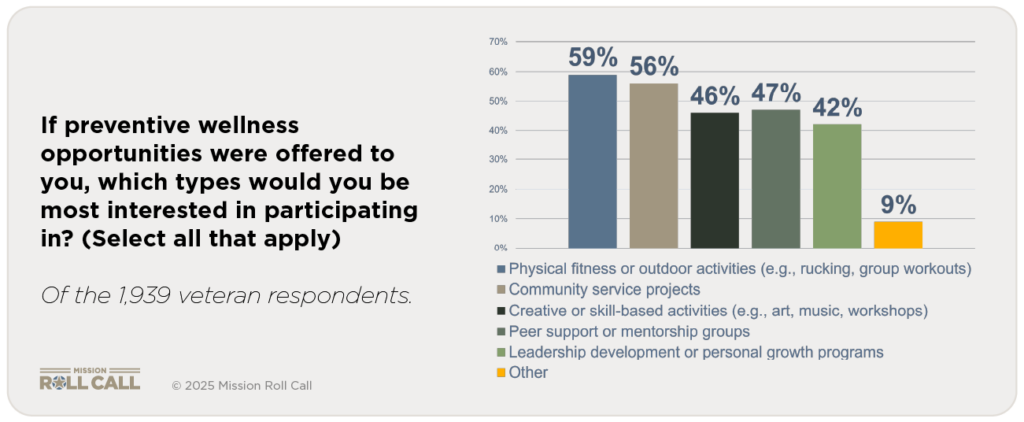
These are not exotic solutions. They are the same habits that keep people healthier across all populations: exercise, social connection, meaningful activity, and self-expression. Veterans are pointing to everyday practices that build resilience — only they want them structured, accessible, and veteran-oriented. Independent research from Frontiers in Psychology also confirms that peer- and group-oriented programs have been shown to reduce loneliness and increase purpose and engagement among veterans.
What Keeps Veterans Out
So why aren’t more already engaged in these activities? The biggest barrier, by far, was lack of awareness. More than half of respondents (53.7 percent) said they simply don’t know what programs are available. Cost came next at 18.8 percent, followed by scheduling conflicts (11.3 percent) and transportation (7.5 percent).
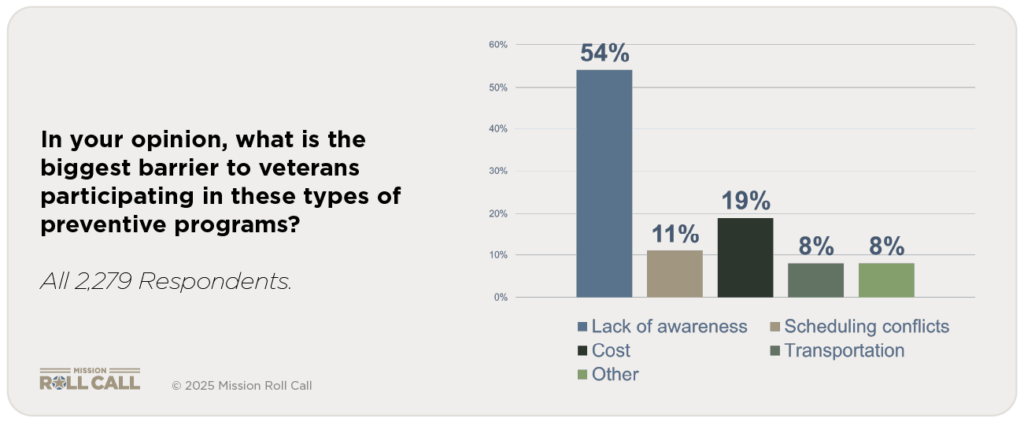
This tells us something important: veterans are not rejecting preventive wellness. Most just don’t know it exists or can’t make it fit into their lives. The problem is not demand. The problem is design. This tracks with what we’ve reported at Mission Roll Call about awareness and navigation challenges across VA systems.
What Would Tip the Balance
We also asked what would make veterans more likely to participate. The answers clustered around four practical needs: free access, local availability, peer- or veteran-led activities, and integration with VA care. These directly mirror the barriers: address cost, geography, trust, and legitimacy, and you unlock participation.
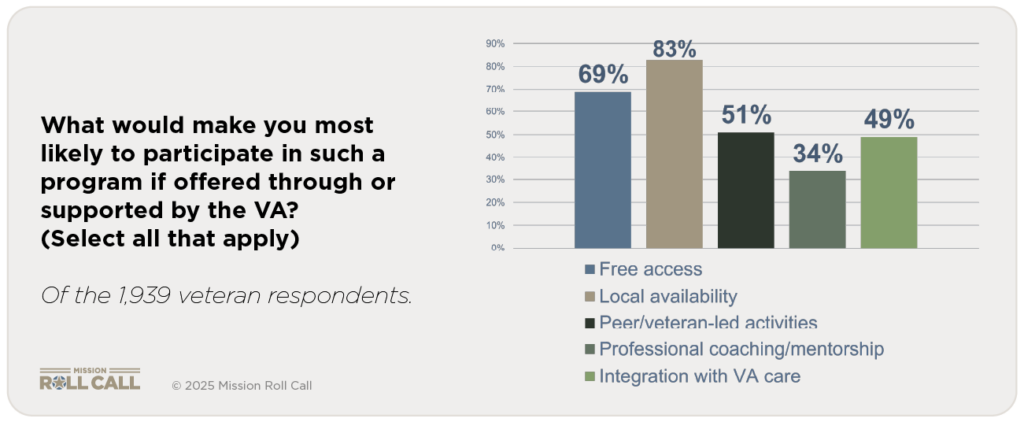
This is not about inventing something new, and it points directly to solutions. If we want preventive wellness to be real, we don’t need to invent a new model. We need to remove the obstacles veterans themselves have identified. Independent research from RAND catalogs preventive activities where peer and community strategies complement clinical care, suggesting VA endorsement and integration can multiply impact.
The Power of VA Endorsement
Finally, we asked how likely veterans would be to join preventive wellness programs if the VA supported or endorsed them. Nearly half (48.1 percent) said “very likely,” another 33.3 percent said “somewhat likely,” and only 4.7 percent said unlikely.
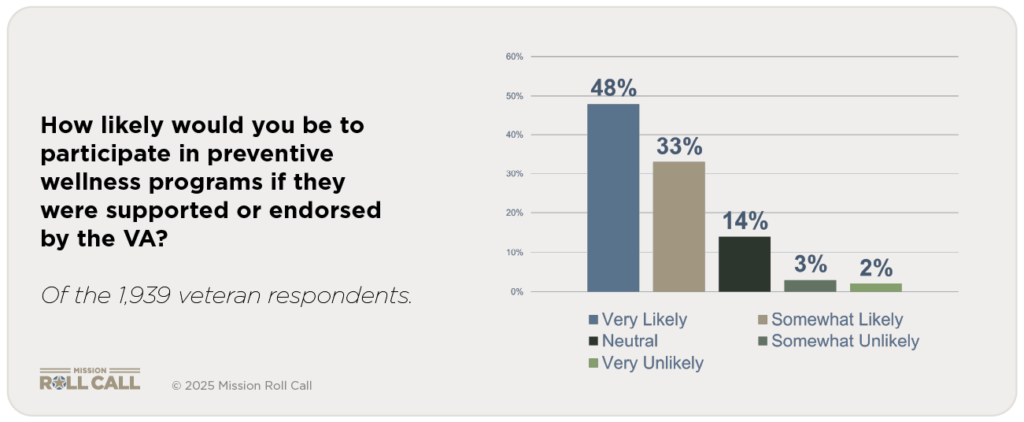
That endorsement matters. It signals credibility, safety, and legitimacy. Veterans are telling us they would proactively join preventive opportunities if those opportunities existed and if the VA put its weight behind them.
This is the essence of Left of Clinical. Veterans do not want to wait for crises. They are asking for earlier options that are cheaper, healthier, and more sustainable than endless clinical interventions. Broader research also associates routine physical activity with lower rates of mental-health problems and suicidality, underscoring why fitness-based, peer programs can be smart prevention.
Why This Matters
If half of veterans are already struggling with stress or isolation, and more than 80 percent say they would likely participate in preventive programs if endorsed by the VA, then the opportunity is enormous. We can intercept isolation and despair early. We can substitute connection and purpose for medication and symptom management.
The system has never truly invested in preventive wellness, but the message from veterans is unmistakable: they are ready. In Part Three, we turn to how the VA, Congress, and community organizations can work together to build the three-legged stool that makes preventive wellness real.
Women have served in the U.S. Armed Forces with courage, commitment, and professionalism across generations. Today, women veterans represent one of the fastest-growing populations in the military community. As they transition from military to civilian life, many face distinct challenges in areas such as employment, housing, identity, and health care.
Recognizing and understanding these unique transition challenges is essential for building more inclusive and supportive systems that help all veterans succeed after service.
Employment
Finding meaningful employment after military service is one of the most important steps in a veteran’s transition journey. While many veterans benefit from federal and state-level employment programs, women veterans often face different barriers when reentering the civilian workforce.
Veteran Employment Statistics
In 2024, the overall veteran unemployment rate was 3.0%, with women veterans experiencing a slightly higher rate of 3.5%, compared to 2.9% for male veterans, according to the U.S. Bureau of Labor Statistics (BLS).
Common Employment Challenges
- Translating military experience: Many women serve in roles such as administration, logistics, healthcare, or communications; positions that may be undervalued or misunderstood by civilian employers.
- Workplace bias: Women veterans sometimes face gender-based discrimination or skepticism about their military service, especially in male-dominated industries.
- Caregiving responsibilities: Upon leaving the military, women often resume or continue caregiving duties for children or family members. This can limit access to full-time roles or positions with inflexible hours.
Helpful Resources
Programs like Hire Heroes USA, VA’s Women Veterans Program, and the Department of Labor’s VETS program offer tailored career counseling, resume assistance, and employer outreach for women transitioning to civilian employment.
Housing and Stability
Stable housing is a critical foundation for successful reintegration. While many services exist for homeless veterans, recent data shows that housing insecurity among women veterans is a growing concern.
Housing Statistics
- From 2020 to 2023, homelessness among women veterans rose by 24%, from 3,126 to 3,980.
- Unsheltered homelessness (living in vehicles, on the streets, or in unsafe conditions) increased by 48%, from 1,464 to 2,165 in the same period.
- In FY2024, more than 27,444 women veterans were served through VA homeless programs.
Contributing Factors
- Military Sexual Trauma (MST) and domestic violence histories may impact housing stability.
- Limited access to family-friendly shelters makes it harder for women with children to find transitional housing.
- Underreporting: Women experiencing homelessness are more likely to stay with friends or family than enter shelters, making them less visible to service providers.
Supportive Solutions
Initiatives such as Supportive Services for Veteran Families (SSVF) help provide rent assistance, case management, and long-term housing solutions for women veterans.
Identity and Belonging
A less visible but equally important challenge is the issue of identity and recognition. Many women veterans report feeling unseen or excluded within both military and civilian spheres.
Common Identity Challenges
- Public perception still largely associates military service with men, leading to misconceptions about who qualifies as a veteran.
- Underrepresentation in veteran imagery, leadership, and outreach efforts can cause women to question whether they belong in veteran spaces.
- Women who mention their service may be assumed to be a spouse or family member of a veteran, rather than a veteran themselves.
Rebuilding Identity
Organizations like Women Veterans Alliance, Service Women’s Action Network (SWAN) and Mission Roll Call are working to elevate the voices of women veterans and foster a stronger sense of identity and belonging within the veteran community.
Health Care
Health care remains one of the most critical components of a successful transition. While the Department of Veterans Affairs (VA) continues to expand care options for women, understanding the specific health needs of women veterans is essential to ensuring quality and access.
Key Health Insights
- Military Sexual Trauma (MST) affects about 1 in 3 women veterans using VA services, according to the National Center for PTSD.
- Post-Traumatic Stress Disorder (PTSD) may present differently in women and can go underdiagnosed or misdiagnosed.
- Reproductive health care access is improving, but gaps remain in access to OB/GYN services across some VA locations.
- Suicide risk: Women veterans using VA care are nearly twice as likely to attempt suicide as their male counterparts, per a DAV mental health report.
Resources for Women Veterans
- VA Women’s Health Clinics offer specialized care for reproductive health, mental health, and MST recovery.
- Whole Health programs provide personalized wellness support for veterans.
Strategies and Recommendations
Transitioning from military to civilian life is not a one-size-fits-all experience. For women veterans, it’s essential that transition programs, support systems, and outreach efforts reflect their unique journeys. Listed below are strategies and recommendations we could all advocate for to better support women veterans in the workplace, at home, and in the world.
- Tailor transition programming: Expand content in the Transition Assistance Program (TAP) to address caregiving needs, civilian workforce reentry, and gender-specific challenges.
- Support women-focused housing solutions: Increase access to safe, trauma-informed, and child-friendly transitional housing options for women veterans.
- Strengthen women’s health care access: Ensure all VA facilities have properly staffed women’s clinics, and offer MST-trained providers with same-gender care options when requested.
- Promote visibility and leadership: Highlight women veteran leaders in national campaigns and ensure representation across VA boards and advisory councils.
- Expand outreach and benefit education: Utilize community-based partnerships (e.g., women’s shelters, clinics, colleges) to reach women veterans who may not engage with traditional channels.
Conclusion
At Mission Roll Call, we believe that every veteran’s voice deserves to be heard, and that includes the voices of women who have worn the uniform with pride. As the population of female veterans continues to grow, so too must our commitment to supporting their transition to civilian life, ensuring they have the tools, recognition, and resources they need to thrive. You can help by amplifying women veterans’ stories, hiring those who have served, or supporting organizations dedicated to their success.
By working together — across government, community, and industry — we can build a future where women veterans are not just supported but celebrated.
You’ve served. You’ve sacrificed. Now, as you transition or have transitioned out of uniform, there is another kind of readiness that matters: financial readiness. It’s not just about making ends meet. It’s about understanding the tools available, building confidence in financial decisions, and securing long-term stability. With the right financial understanding, small steps become strong foundations. All veterans deserve that peace of mind.
Why Financial Readiness and Literacy Matter
Financial pressure is something many veterans quietly carry, especially during and after the transition to civilian life. Rising costs of living, unexpected medical bills, and navigating unfamiliar financial systems outside the military can quickly become overwhelming. In fact, a survey by Wounded Warrior Project found that 64 percent of their participants said they did not always have enough money to meet their basic expenses in the past year. This clearly shows many veterans are living under financial strain with limited room for error.
That strain does more than affect bank accounts. It weighs on mental health, too. Financial stress can increase anxiety, depression, and feelings of helplessness, especially when combined with other post-service challenges. While grants and assistance can offer short-term relief, true financial readiness comes from something deeper: literacy.
Understanding how to budget, build credit, invest wisely, and protect yourself financially gives veterans long-term tools, not just temporary fixes. It is that knowledge and the confidence that comes with it that can help transform instability into security.
What Financial Readiness Looks Like
Here are the core pieces that add up to true readiness:
- Know your benefits, inside and out
- Benefits from the VA, educational benefits, service-related support, insurance, and housing programs all matter. Sometimes benefits overlap. Sometimes, the details like eligibility, tax implications, and documentation matter more than people realize.
- Budgeting and cash flow management
- Track every dollar: income, obligations, discretionary spending
- Build a buffer: even a small emergency fund helps reduce the risk of a financial crisis
- Adjust as life changes: deployment, family additions, separation, or civilian jobs
- Credit, debt, and loans
- Understand what affects your credit score and work to keep it healthy (on-time payments, low credit card balances)
- Be cautious with high-interest lenders
- Know your student loan or GI Bill options and repayment plans, if applicable
- Investing and long-term planning
- Retirement savings (for example, TSP or IRAs) are tools for growth, even if contributions are modest at first
- Diversify when possible, based on your risk tolerance and timeline
- Understand basic stock market principles so you can evaluate opportunities and avoid pitfalls
- Planning and protection
- Estate planning: wills, power of attorney, beneficiary designations
- Insurance: health, life, disability — know what is covered and what is not
- Fraud prevention: identity theft, scam awareness, and understanding your rights, especially when dealing with VA or contracting organizations
Spotlight: Effective Programs and Resources
These programs and tools can help veterans build financial literacy and readiness:
- Mission Roll Call’s “How the Stock Market REALLY Works”, a friendly, beginner-oriented video to help veterans make sense of investing
- Veteran Benefits Overview in 2024 breaks down benefit programs and eligibility clearly
- FINVET (National Veterans Financial Resource Center) helps veterans find trusted financial tools, learn best practices, and navigate their financial path
- Wounded Warrior Project’s Financial Readiness Program offers one-on-one counseling, budget planning, and tools for managing unexpected costs
- Office of Financial Readiness (FINRED) offers courses, resource libraries, and materials for all stages of military and post-military life
Practical Steps You Can Take Now
You don’t have to overhaul everything at once. Here are simple actions you can take today:
- Start small with budgeting: For one month, write down everything you spend. You’ll often spot easy areas to cut, such as unused subscriptions, banking fees, or impulse buys
- Automate what you can: If possible, have a portion of your income go directly into savings or investments
- Set clear, achievable goals: Examples: “Save $500 emergency fund in 3 months,” or “Reduce credit card debt by 25 percent in 6 months,” or “Watch one video per week to learn investing basics”
- Seek trustworthy mentorship or counseling: Use vetted resources that understand military and veteran needs
- Educate before big decisions: Whether buying a house, switching jobs, investing, or taking out loans, take time to research, compare options, and ask questions
- Protect yourself: Monitor credit reports, guard your identity, and understand what you are signing before entering any agreement. Know your rights under VA programs and military law, such as the Servicemembers Civil Relief Act
Empowering Your Financial Journey
Start with Mission Roll Call University. Watch the video How the Stock Market REALLY Works to build a solid and approachable foundation in investing. Then explore the Veteran Benefits Overview for 2024 to fully understand what benefits are available to you and how to access them.
Reach out to organizations like the Wounded Warrior Project, VeteransPlus, or FINVET to schedule a free or low-cost counseling session, or browse the resources in MRC’s Veteran Resource Directory. Choose one financial goal, whether it’s saving, paying off debt, or building credit, and take that first step toward achieving it.
Conclusion
Financial readiness is not about having a lot of money. It’s about having the right knowledge, healthy financial habits, support systems, and the mindset to stay steady through challenges. It’s about being able to breathe easier, sleep better, and face the unexpected with confidence. You earned that.
You may use grants and benefits, and those matter. But it is financial literacy that turns short-term relief into long-term security. The tools are out there. So are the people who understand what you’re navigating. Taking that first step may feel small, but it can lead to something steady and strong.
Subscribe to Mission Roll Call University (MRCU) to explore Mission Roll Call’s financial resources today and take the next step toward financial peace of mind.
In July, we celebrated two major themes—the legacy of American military service and the power of veteran independence. From commemorating 250 years of commitment and courage to highlighting modern-day stories of resilience, we focused on the tools, support, and spirit that allow veterans to thrive on their terms.
Through storytelling, research, interviews, and accessible resources, we continued our mission to elevate veteran voices, support autonomy, and honor every path forward after service.
Here’s what you might have missed:
We marked the 250th anniversary of the U.S. military by reflecting on the legacy of service that defines our country, and by exploring what independence looks like for today’s veterans.
– Countdown to 250: Honoring the Legacy of American Independence
– Taylor Morris: How a Quadruple Amputee Rebuilt His Life and Redefined Independence
– 7 Key Areas of Support for Veterans with Service-Connected Disabilities
– Need to Modify Your Home? These VA Grants Can Help
– Spotlight on Paralyzed Veterans of America
– Hyperbaric Oxygen Therapy and Veterans: A Breath of Fresh Air for Healing
The Lasting Mission Podcast
In July, The Lasting Mission featured powerful voices from two impactful organizations—Operation Honor: Rural Salute and the Wounded Warrior Project—highlighting both rural veteran challenges and the future of recovery for those with combat injuries.
– Operation Honor: Rural Salute – Part 1
– Operation Honor: Rural Salute – Part 2
– From Battlefield to Breakthrough – WWP: Part 1
– WWP CEO Walter Piatt: ‘We Owe Them More Than Thanks’ – Part 2
Mission Roll Call University (MRCU)
MRCU continued to deliver straightforward, practical content to help veterans and families navigate benefits and build stability. This month’s videos included guidance on adaptive housing grants, VA facility access, login systems, and even life insurance options many may not realize they qualify for.
– Make Your House a HOME With an Adaptive Housing Grant
– Find Your Veteran Affairs Facility – Fast & Easy
– Life Insurance: The Hidden Financial Superpower
– The Great Login Service Debate: Which One Is Right for You?
Veteran Town Hall: Your Voice in Real Time
Our July Town Hall brought together veterans from across the country to discuss pressing issues like healthcare access, disability support, and post-service independence. These live events are a powerful reminder that when veterans speak up, leaders listen.
– Watch the July Veteran Town Hall
From the Blog: Advocacy in Action
These articles gave readers the latest insights and policy perspectives rooted in our research and veteran polling.
– Prioritizing Veteran Healthcare in 2025 and Beyond
– Veterans Are Speaking Clearly on Suicide Prevention. It’s Time for a New Strategy.
– Want Alternate Healthcare Options? This Program Could Help Veterans and Their Families
MRC in the Media
Our message reached new audiences in July, with national and local coverage that emphasized our mission: to elevate veteran voices, push for smarter policy, and highlight solutions that work.
– Why Your Business Should Hire Veterans – Inc.
– Mission Roll Call Applauds Bipartisan Passage of VA Home Loan Program Reform Act
Speak Up: Your Voice Matters
Veterans and their families shape our advocacy—and we want to hear from you. Help guide our work by participating in our active polls and surveys.
– Take the Veteran Voices Survey
– Make Your Voice Heard in Our Open Polls
Looking Ahead: Employment, Transition & Opportunity
In August, we’ll focus on life after service—what it takes to transition well, build meaningful careers, and continue to find purpose in the civilian world. Stay tuned for powerful new content, real stories, and more updates from veterans like you.
If you’re a veteran, family member, or caregiver who’s used My HealtheVet or DS Logon to manage VA health care or benefits, there are some important changes coming. My HealtheVet has officially been retired, and DS Logon will no longer be available after September 30, 2025.
In our latest episode of Mission Roll Call University (MRCU), we explain what these changes mean, how to switch to a secure new login, and how to get support along the way.
Here’s what you need to know:
My HealtheVet is no longer available.
DS Logon will sunset on September 30, 2025.
To access VA.gov and other VA online services, you’ll now need to sign in with Login.gov or ID.me. Both options meet federal security standards and are free to use.
You can use either one—or even both—but here’s how to decide:
Choose Login.gov if you:
- Live in the U.S.
- Have a Social Security number
- Have a valid state-issued ID
- Already use government websites like USAJOBS or Social Security
Choose ID.me if you:
- Live outside the U.S.
- Don’t have a Social Security number
- Don’t have a valid ID or a phone in your name
- Need flexible identity verification options (like video calls or in-person appointments)
Setting up Login.gov:
- Go to VA.gov and click “Sign In”
- Select Login.gov and choose “Create an account”
- Confirm your email within 24 hours
- Set up a password and multi-factor authentication
- Upload ID photos or verify your identity in person at a post office
Setting up ID.me:
- Start at VA.gov and choose ID.me
- Create an account with your email and password
- Verify your identity with one of three methods:
- Self-service (photo ID, SSN, and a phone in your name)
- Video call with three forms of ID
- In-person appointment with three forms of ID
Need help getting started?
Support is available every step of the way.
- Visit Login.gov or ID.me for troubleshooting and FAQs
- Call VA Support at 877-327-0022 for help with sign-in and account setup
- Watch our full MRCU episode for step-by-step walkthroughs and practical tips
Haven’t made the switch yet? Don’t worry. You can still manage your care and benefits the way you always have—by phone, mail, or in person. Call 800-698-2411 or visit your local VA regional office for support.
For caregivers and guardians:
- Court-appointed guardians can call 877-327-0022 to explore temporary access options while a long-term solution is being developed
- Family caregivers should continue using the veteran’s own login credentials, just as before
Want to see exactly how to set up your account? Watch the full episode of MRCU to follow along with demos, tips, and help links to make the process simple.
Watch now:
For more how-to guides and helpful veteran-focused resources, explore our full video library on the MRCU YouTube channel.
In this special two-part episode of The Lasting Mission podcast, Mission Roll Call CEO Jim Whaley sits down with longtime friend and fellow veteran Walt Piatt, retired Lieutenant General and the new CEO of the Wounded Warrior Project.
Their conversation covers a lot of ground—from their early days in Panama to leading two major veteran organizations—but the message is clear: we need to do more to support the men and women who served.
Part One: Finding Purpose After Service
In Part One, Walt shares his journey from enlisted infantryman to Army general, and now to CEO of the Wounded Warrior Project. He talks about the challenges many veterans face after leaving the military—losing their sense of identity, struggling to reconnect, and carrying the invisible wounds of war.
Wounded Warrior Project helps veterans find their way back through mental health support, programs like Project Odyssey, and simply reminding them they’re not alone.
“Healing begins with movement,” Walt says. “And we walk with veterans every step of the way.”
Watch Part One:
Part Two: Advocacy, Transition & Family Support
Part Two focuses on what’s next for the Wounded Warrior Project and for the veterans and families they serve.
Walt explains how WWP is working to improve access to care, support veteran families, and make sure lawmakers hear directly from warriors themselves. He also opens up about how writing poetry helped him process his experiences, and how important it is for all veterans to find their outlet for healing.
“You can’t just leave the military and expect everything to fall into place,” Walt says. “We have to meet veterans where they are—and keep showing up.”
Watch Part Two:
Why This Matters
- 1 in 3 post-9/11 veterans face challenges with PTS, brain injury, or trauma.
- More than 50% of veterans aren’t connected to the VA or a support organization.
- Connection saves lives—and that starts with all of us.
If you’re a veteran, a caregiver, or someone who wants to help, visit woundedwarriorproject.org to get involved, or check out missionrollcall.org to see how we’re working together to make sure no one is left behind.
Fuel Veteran Voices
A small gift powers the research and advocacy that brings veterans to the decision-making table.
Donate $5+