When the System is the Barrier: One Veteran’s Search for Help
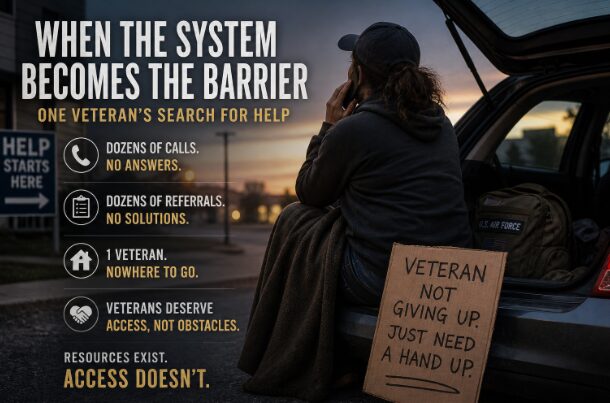
On April 2, at 5:55 a.m., a U.S. Air Force veteran who asked not to be identified began calling for help.
By the end of the day—after dozens of calls—she was still without housing.
Not because resources don’t exist.
But because access failed her.
A System Built on Referrals, Not Outcomes
What she encountered was not a lack of resources—it was a system structured around referrals instead of resolution.
Over time, she was given more than 60 phone numbers, websites, and applications to navigate.
What she found was not access—but delay:
- Voicemails with no response
- Applications requiring days or weeks for follow-up
- Programs limited to weekday business hours
- Organizations that provided additional referrals instead of direct assistance
Even the most recognized pathways led to the same result—another list.
In moments of housing instability, time is not a luxury. It is the difference between stability and crisis.
From Stability to Survival
On March 20, 2026, following a lapse in income tied to contract work ending, she made the difficult decision to leave her home in Clermont, Florida.
Like many veterans, she did not have immediate family support to rely on.
She followed the process:
She reached out.
She applied.
She made the calls.
And still—she found herself without stable housing.
Sleeping in and out of her car, she navigated a system that required her to advocate for herself at every step—while already in crisis.
When “Available Resources” Aren’t Accessible
Programs designed to prevent and resolve homelessness were presented as options.
But access came with barriers:
- First-come, first-served housing availability
- Lengthy intake and approval timelines
- Limited openings that did not align with urgent need
Temporary shared housing was offered—but not always viable.
For this veteran, asthma, anxiety, and the need for a safe and controlled environment made traditional shelter settings unsafe. She also has pets and personal belongings to consider—real-life factors often excluded from program design.
These are not exceptions.
They are everyday realities that systems are not consistently built to accommodate.
Where the Breakdown Happened
- No real-time access to assistance during crisis
- Referral loops with no clear resolution
- Delayed response times for urgent needs
- Housing options that did not meet health or safety requirements
This is not a resource issue.
It is an access and alignment issue.
The Gap Between Policy and Reality
Nationally, tens of thousands of veterans experience homelessness each year.
Yet stories like this make one thing clear: the challenge is not just availability—it is accessibility.
Even the VA hotline—widely promoted as a direct entry point—did not result in contact with a social worker. A formal complaint received no response.
The system exists.
But connection is inconsistent.
The Increased Risk for Women Veterans
For women veterans, the risks are even higher.
Safety, privacy, and health considerations are not preferences—they are requirements.
Yet many emergency housing options fail to account for those needs, leaving women veterans with limited safe alternatives during crisis.
What Veterans Are Telling Us
This experience reflects a broader pattern:
- Veterans are handed lists instead of solutions
- Access points are unclear and inconsistent
- Timing does not match urgency
- Individual circumstances are not fully considered
A system that requires veterans to navigate complexity alone is not functioning as intended.
Where She Is Now
She continues to move forward.
She has secured employment beginning May 18.
But like many veterans in similar situations, the immediate need remains:
Safe, stable, private housing to bridge the gap.
Because without stability, everything else—employment, health, long-term progress—is at risk.
Moving Forward
We do not have a resource awareness problem.
We have an access and alignment problem.
Because a system that requires a veteran to make dozens of calls while sleeping in a car is not under-resourced.
It is misaligned.
If we are serious about ending veteran homelessness, we must measure success by outcomes—not referrals.
To learn more about Mission Roll Call’s work uplifting veteran voices and advancing effective housing solutions, visit our Homelessness page:
https://missionrollcall.org/spotlight-priorities/housing-and-homelessness/
Mission Roll Call is committed to listening first. If you are a veteran, family member, caregiver, or community partner, we invite you to share your story with us. Your experiences guide our advocacy and help us push for the changes veterans say matter most.
Your voice matters here. We encourage veterans, families, caregivers, and supporters to share their experiences through Mission Roll Call’s national surveys. Your stories help shape policy, raise awareness, and ensure veterans are seen and heard:
https://missionrollcall.org/surveys/
Understanding the truth brings us one step closer to ensuring every veteran has what they deserve: stability, dignity, and a place to call home.
Yvette Jones-Swanson, M.A., is a subject-matter expert on veteran homelessness and housing. A U.S. Army veteran and survivor of MST, she brings more than 22 years of frontline experience helping thousands of veterans secure stable housing.