The System Says Yes but the Door Stays Closed: The Ongoing Fight of Sgt. Marlene Wolf
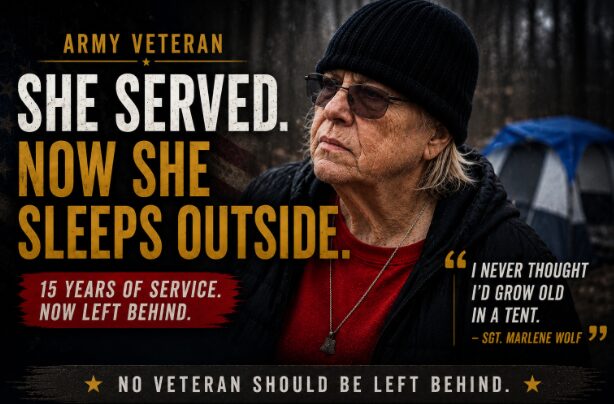
Richmond, Va. — Sgt. Marlene Wolf followed every step the system required.
She served her country. She qualified for assistance. She was issued a U.S. Department of Housing and Urban Development-VA Supportive Housing (HUD-VASH) voucher—the very tool designed to end veteran homelessness.
And today, she is still homeless.
Not hidden. Not “at risk.” Not in transition.
Homeless—living in a broken-down SUV alongside her caregiver, right here in Richmond.
A Promise That Led to Displacement—Not Housing
Sgt. Marlene Wolf is a senior, medically fragile Army veteran. Her HUD-VASH voucher was approved for a two-bedroom unit to support both her and her caregiver—an essential part of her care and survival.
After being denied housing in Charlottesville, she was told to relocate to Richmond, Virginia, where she would receive a new voucher and have a better opportunity for placement.
So she moved.
She trusted the system.
She started over.
And today, she remains without housing.
Denied for the Very Reasons HUD-VASH Exists
Before her relocation, Sgt. Marlene Wolf’s voucher was terminated in November 2025.
Not because she refused housing.
Not because she failed the program.
But because she could not find a landlord willing to accept it.
The reasons she was denied are the same barriers HUD-VASH was designed to remove:
- Credit impacted by homelessness
- Gaps in employment
- Lack of recent rental history
- Non-criminal background concerns
Let’s be clear:
These are not valid reasons to deny a HUD-VASH veteran.
These are the realities of homelessness—and federal policy explicitly requires they not be used as barriers.
Federal Law Is Clear—So Why Is This Still Happening?
There is no shortage of federal protections meant to prevent exactly this situation:
- Title 38 U.S.C. §§ 2002 & 2041 mandate housing support for vulnerable veterans
- HUD Housing Choice Voucher regulations (24 CFR 982) prohibit denial based on credit, rental history, or homelessness-related instability
- HUD-VASH program requirements mandate barrier removal and expedited placement
- Fair Housing Act, ADA, and Section 504 prohibit discrimination and require reasonable accommodations
These are enforceable obligations—not optional guidelines.
And yet, a veteran sits unhoused in Richmond with nowhere to go.
The Reality on the Ground in Richmond

Sgt. Marlene Wolf has gone from living in a tent near a creek… to living in a broken-down SUV.
She relocated for access to housing—and instead found the same barriers in a different city.
This is not a lack of resources.
This is a failure in execution.
You can see her current situation here:
https://youtube.com/live/gSouWFL7x2U
The Veteran’s Voice—Without Saying a Word
What does it say when a veteran is told:
“You’re approved.”
“You qualify.”
“Help is available.”
And still has nowhere to sleep?
It says the system is not working the way it claims to.
For Sgt. Marlene Wolf, this is not about paperwork or process—it’s about survival, dignity, and the basic expectation that a promise made will be honored.
The Advocate’s Voice: Richmond Must Answer
This is where accountability begins.
If a veteran relocates to Richmond based on the promise of housing support, then the question becomes:
Who is responsible for ensuring that promise is fulfilled?
- Where is the local HUD-VASH coordination?
- Where is Public Housing Authority intervention when a veteran is repeatedly denied?
- Where is enforcement when landlords apply prohibited screening practices?
This is no longer just a federal issue.
This is a local accountability issue in Richmond.
Because right now, a veteran is still unhoused—and the system is still saying nothing.
What Happens Next Matters
This case has been escalated to:
- VA HUD-VASH leadership
- HUD’s Office of Fair Housing and Equal Opportunity
- HUD Voucher Oversight Division
- Congressional offices
- National veteran advocacy organizations
- Civil rights and legal partners
But escalation is not the outcome.
Action is.
And Richmond has an opportunity—right now—to be part of the solution instead of part of the pattern.
Call to Action: Richmond, This Is the Moment
Let’s stop pretending this is complicated.
A veteran with a HUD-VASH voucher should not be homeless.
A veteran who relocates for help should not be left without it.
And a system designed to end homelessness should not be contributing to it.
So here is the ask:
- Housing providers in Richmond: Align your screening practices with federal law
- Local housing authorities: Intervene when veterans are denied unlawfully
- VA and HUD partners: Ensure this case results in placement—not delay
- Community leaders: Do not look away from what is happening in your own city
Because right now, the question is simple:
How is a veteran still homeless in Richmond with federal housing support behind her?
Until that question is answered with action, the system is not working.
To learn more about Mission Roll Call’s work uplifting veteran voices and advancing effective housing solutions, visit our Homelessness page:
https://missionrollcall.org/spotlight-priorities/housing-and-homelessness/
Mission Roll Call is committed to listening first. If you are a veteran, family member, caregiver, or community partner, we invite you to share your story with us. Your experiences guide our advocacy and help us push for the changes veterans say matter most.
Your voice matters here. We encourage veterans, families, caregivers, and supporters to share their experiences through Mission Roll Call’s national surveys. Your stories help shape policy, raise awareness, and ensure veterans are seen and heard:
https://missionrollcall.org/surveys/
Understanding the truth brings us one step closer to ensuring every veteran has what they deserve: stability, dignity, and a place to call home.
Yvette Jones-Swanson is a subject-matter expert on veteran homelessness and housing. A U.S. Army veteran and survivor of MST, she brings more than 22 years of frontline experience helping thousands of veterans secure stable housing.