What My Therapist Wished I’d Known Before I Left the Service Part Three: From the Other Side of the Desk
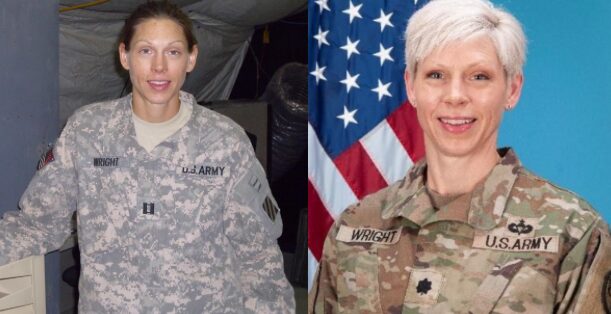
LTC Gina M. Wright Joined the Army Because She Could Not Watch Veterans Struggle Alone Anymore. Eighteen Years Later, She Still Has Not Stopped Trying to Help.
LTC Gina M. Wright became a social worker before she ever put on a uniform.
She was already a licensed clinician, already doing the work, when the early years of the Iraq War started sending veterans back to the mental health facility where she was employed in Indiana. National Guard and Reserve units had been activated, deployed, and returned. And then, almost without ceremony, they were expected to pick up their civilian lives exactly where they had left them. Many of them could not.
“They trained, they drilled, they sent them to war,” Gina said, “and then they said, all right, you’re back to regular life. And they couldn’t adjust.”
She watched it happen. She tried to help from where she was. And eventually she asked herself a question that changed the direction of her life. Can I help in a different capacity?
So in 2008, at 32 years old, with a clinical career already behind her and a life already built, Gina joined the United States Army. She has been helping ever since.
Learning Everything Else on the Job
Gina will tell you she did it backwards. She became a clinician first and a soldier second, which meant she arrived in uniform already knowing how to sit with someone in pain, already knowing how to ask the right questions, already knowing what it looks like when someone has been managing something alone for too long. What she did not know was anything about the military.
“I was 32 and I knew nothing about the military,” she said, with the kind of laugh that comes from having made peace with something. “I learned everything about wearing that uniform on the job.”
What the Army gave her in return was something her clinical training had not fully prepared her for: a window into a culture that is unlike anything in civilian life. The structure. The language. The bonds forged under pressure. The deep, complicated pride. And the equally deep, complicated difficulty of walking away from all of it.
Eighteen years later, Gina oversees the Department of Behavioral Health at a military hospital. She does more administrative and consulting work now, the way things tend to shift as you move up in any organization. But the years she spent embedded in units, working directly with soldiers, working with people like Shawn and Brandon, are the years that shaped everything she knows.
She has a lot to say. And she says it with the warmth of someone who has spent two decades genuinely caring about the people on the other side of her desk.
The Thing Nobody Normalizes
When Gina thinks about what is missing from the way the military prepares people for transition, she keeps coming back to one word: Normalization.
When a soldier comes back from a traumatic event, clinicians are trained to normalize their reaction. To tell them: it is normal to not sleep well after this. It is normal to feel anxious, to be hypervigilant, to have thoughts that circle back. Naming that does not make it worse. It actually makes it more manageable, because it tells the person that they are not broken. Gina believes transition deserves the same treatment.
“We should normalize some of the stressors with transition,” she said. “Hey, it’s normal to be worried and anxious and not feel settled. Because then people are like, okay. Nothing’s wrong with me. I’m just like everybody else who’s stressing out about this.”
Right now, she said, the transition process is almost entirely administrative. Classes, paperwork, briefings. The psychological experience of leaving, the identity shift, the grief, the disorientation of trading structure for open sky, gets no dedicated space.
What she wants is not a therapy group or a vulnerability exercise. She wants something educational. Something that treats the emotional experience of leaving the military as a normal thing that requires preparation, the same way a PCS move or a deployment does.
The Fast-Moving Train
One of the hardest patterns Gina sees among senior leaders is the tendency to wait too long. Not because they do not know transition is coming, but because they feel essential. Because the mission is still moving and they are still a part of it and stepping back to take care of themselves feels, at best, premature, and at worst, like abandoning the people who need them.
“The Army is a fast-moving train,” she said. “If I get off this train, it’s still going to keep going forward. I’m important. But I’m not that important.”
The veterans who struggle most with transition, she has found, are the ones who have so fully merged their identity with the institution that separating the two feels like a kind of loss that has no name. They think the Army needs them. They think they need the Army. Both things feel true. Untangling them takes time, honesty, and often a relationship with someone who can help.
The Army allows service members to begin transition services two years before separation. In Gina’s experience, most senior leaders who would benefit most from that window do not use it. They keep working. They keep showing up. They tell themselves they will deal with what comes next when it comes.
“It’s never too late to start thinking about your transition,” she said. “But earlier is always better.”
Every Veteran Is an Individual
Gina has one principle she returns to again and again, in her clinical work, in her conversations about policy, in the way she thinks about who is being left behind.
Every veteran is an individual.
It sounds simple. It is not. It is actually one of the hardest things to hold onto in a system built around uniformity, around shared standards and shared sacrifice and a shared identity. The military is very good at creating belonging. It is sometimes less good at remembering that the people inside it are each living that belonging in a different way.
“Consider each veteran as an individual,” she said. “Don’t be afraid to ask, how is transition for you? How are you adapting? Don’t be afraid to ask.”
She said the same applies inside the system. A sergeant major transitioning out of a Special Operations unit has access to resources and programming that a sergeant major transitioning out of a conventional unit simply does not. The experiences are not comparable. The support structures are not equal. And assuming they are is how people fall through the cracks.
“I can’t assume what someone’s been through,” she said. “I can’t put my experiences onto them. Everyone has seen these things through a different lens.”
What the System Gets Right
Gina is not someone who only sees what is broken. When she joined the Army, behavioral health carried a stigma so heavy that soldiers actively avoided it. The culture communicated, without anyone having to say it directly, that needing help was a weakness and that weakness had consequences. She watched that shift over her 18 years in ways she did not expect when she first joined.
“When I joined the Army, nobody wanted to come to behavioral health,” she said. “Then six or seven years later, it was like, what, you haven’t gone to behavioral health yet? What is stopping you?”
The Army has moved toward a prevention-focused model in recent years, trying to get ahead of mental health challenges before they become crises. Resources have expanded significantly. The stigma, while not gone, has softened in ways that are real and meaningful.
She believes more soldiers would use those resources if they were simply woven into the training calendar the way other things are. Vehicle maintenance gets scheduled time. Equipment checks get scheduled time. Taking care of people should too.
What She Would Say
If Gina could sit with a soldier on their very last day in uniform, she knows what she would want them to feel in that moment. Not pressure. Not a checklist of things to do or resources to look up or calls to make. Just one thing.
It is going to be okay.
“Take one moment, one day at a time,” she said. “Don’t worry about what’s going to happen tomorrow or next week. Just get through this moment. And tackle everything after this uniform in that same manner.” She paused. “You’re not alone. There are lots of people out there who have been through similar experiences and are willing to help. Find a mentor. Ask a question. Reach out.”
Then, quietly: “Don’t give up on yourself.”
It is the same thing she has been saying, in different rooms and different ways, for nearly two decades. To soldiers who did not want to be there. To veterans who waited too long. To leaders who spent their entire careers taking care of everyone except themselves.
Screenshot
She says it like she means it every time. Because she does.
Mission Roll Call’s Veteran Resource Directory is a free, searchable database of nonprofit organizations and veteran service organizations ready to provide support during and after military transition. Visit missionrollcall.org to find resources near you.
If you or someone you know is struggling, the Veterans Crisis Line is available 24 hours a day, 7 days a week. Call 988 and press 1, text 838255, or chat online at veteranscrisisline.net.