What My Therapist Wished I’d Known Before I Left the Service Part Two: The Last to Put Himself First
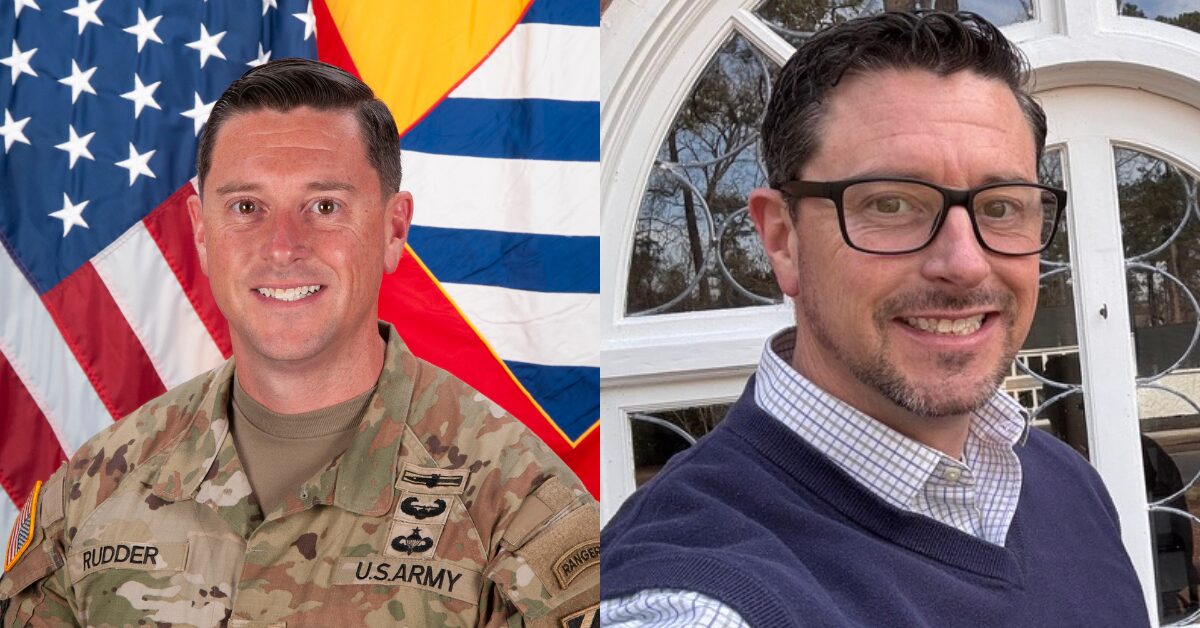
For 23 Years, Brandon Rudder Was the Person Everyone Else Leaned On. He Is Still Learning That It Is OK to Lean Back.
Some mornings, in the weeks before he retired, Brandon would lace up his shoes and head out for a run, the same way he had done thousands of times before in a career that asked everything of him. And somewhere out there, with no one watching and nothing to fix, something would come loose.
Not a breakdown. Not a crisis. Just a release, unprovoked and uninitiated, that would move through him and leave him somewhere between angry and sad without being able to name exactly why.
“I think it was my body naturally just releasing a lot of things,” he said. “Things I didn’t really know were there.”
After nearly 23 years in the Army, 15 deployments, 66 months of combat between Iraq and Afghanistan, a career that took him from private in the 75th Ranger Regiment to Brigade Command Sergeant Major, Brandon was finally putting himself first. It was harder than anything the Army had ever asked of him.
Built to Carry Others
Brandon is the kind of person the Army builds its senior leadership around.
He is steady in a way that makes the people around him feel steadier. He listens before he speaks. He does not leave a problem on the table if he has the ability to solve it. And for most of his career, he had that ability. As a Command Sergeant Major, his role was to be the stop gap, the person you went to when everything else had failed. On any given day, someone was walking into his office with something urgent and personal and heavy, and Brandon would set down whatever he was doing, listen carefully, and help.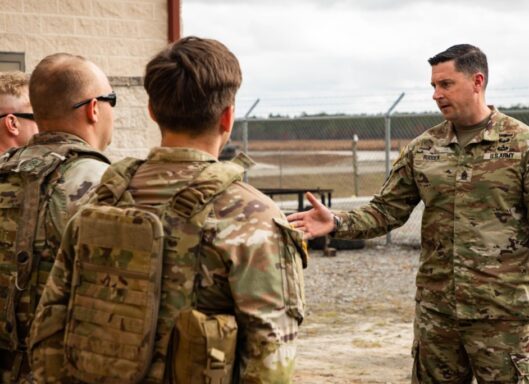
“There’s a weight that comes with that,” he said. “It’s non-relenting.” He carried it willingly. That was never the question. The question that transition asked him, the one he is still answering, is what happens when you spend decades carrying everyone else and then one day the calls stop.
The Quiet
Brandon retired in February 2026 after nearly 23 years of service. His final post was at Fort Stewart, Georgia, where as Brigade Command Sergeant Major he shouldered the human weight of an entire brigade. He is now in Augusta, Georgia, managing a team of sports psychologists through the Army’s Ready and Resilient Program, still around soldiers, still doing meaningful work, still himself.
But those first weeks of transition had a texture to them he had not expected. “You go from being the center of gravity for a lot of people on a daily basis,” he said, “and in very short order, there’s a new person. The Army goes rolling along.”
He had prepared as well as he could. He maintained a strict personal battle rhythm. He kept his physical fitness practice, the one constant that anchored his mornings from the beginning of his career to wherever it goes from here. He had been working with a behavioral health provider before he got out, and for the first time, he had started a small course of medication to help him stay steady through the transition. And there were still days that were harder than he had anticipated. Days when the uncertainty of not knowing what the future held created a kind of internal upregulation he could not fully quiet.
“There were several days where the transition was, in fact, overwhelming,” he said.
What made it harder was something he had not fully expected to feel. A kind of guilt around taking care of himself. “I always felt like if I stopped doing my duty for the Army and pulled back to take care of myself, it felt like I was being selfish,” he said. “Like I wasn’t doing the right thing.” He knows now that was wrong. He knew it then, on some level. But knowing something and feeling it are not always the same.
“What I learned was I did, in fact, need to put myself first,” he said. “It wasn’t selfish. I think I was doing the right thing even though it probably didn’t feel that way at first.”
From Grief to a New Season
The emotional arc of Brandon’s transition did not move in a straight line.
Before he retired, on his own terms and at a time of his own choosing, he went from grief to something that felt, slowly, like hope. The morning runs where something would release inside him without warning. The weight of 23 years finding its way out in the only way it knew how.
By about 60 days before his final day in uniform, something shifted. The behavioral health support was in place. The treatment plan was helping. And what had felt like loss began to feel like something he did not quite have a word for yet. “I felt like I was entering a new season,” he said. “And as I sit here today, it is significantly positive.”
He was careful to add that there are still things he is working through. Some walls are still up. Some questions not fully answered. He said it without apology, the way someone says it when they have done enough work to be honest about where they still have more to do.
His family has been part of that work too. His wife and four children have been steady and present throughout. But he was honest about something that often goes unsaid: they are navigating their own grief too. An entire family identity is changing and they are not just supporting him through it, they are living it right alongside him.
“There’s an entire holistic look at a family identity changing,” he said. “Although it wasn’t overnight, I’m talking to you today and we haven’t yet, since I’ve been out, been a family in the full sense of the word, all together every day. That’s something we’re looking forward to.”
A Reality Check on the Third Floor
The day before this interview, Brandon went to the VA for the first time. He had 90 days of treatment from his active duty providers. The VA had contacted him before he even separated to set up the appointment. Logistically, it all went smoothly. He followed the signs to the third floor.
He was almost to his clinic when he stopped. The sign on the wall read: OIF OEF Veteran Wing.
“It hit me,” he said. “I have a label now. I’m literally in the VA.”
He looked down the hallway. Older veterans in wheelchairs. Men with canes. He stood there for a moment, taking it in, and had a thought that surprised him with its quietness. “Is this how it ends?” He kept walking. His new provider turned out to be kind, thorough, and helpful. No concerns about follow-on care. He left feeling fine.
But the moment stayed with him, the way quiet moments do when you have spent a career never having them. He was not sad. He was not afraid. He was just standing in the middle of something real.
“It was a reality check,” he said. “I wasn’t sad or anything. But I’m like, this is happening.”
Who Is Brandon
The question he keeps returning to is a simple one, and he asks it with a kind of gentle curiosity rather than anxiety. People call him Brandon now. Or Mr. Rudder. Not Sergeant Major. And while he will be the first to say he does not miss the title, something about hearing his own first name still gives him a beat of pause.
“I’m like, well, who’s Brandon?”
He is working on that answer and he is okay with that. He has found purpose in his new role. He still finds the work meaningful. He does not believe he has lost anything essential to who he is. “I haven’t lost any purpose,” he said. “I think I’ll hold on to that for the rest of my life.”
What He Would Tell You
If Brandon could say one thing to a service member reading this, it is about something the Army trains out of people slowly and quietly over the course of a career: Grace for yourself. “The Army builds leaders to focus outward,” he said. “On the mission. On the people around them. That instinct is a strength. But during transition, it can work against you.” He thought about it for a moment. “Rethink the way you approach putting yourself first sometimes. Be good to yourself. Acknowledge that you deserve grace from yourself.”
On his last day in uniform, if he could have sat down with the version of himself standing at that threshold, he knows what he would have said. Keep moving forward. Keep your chin up. Keep helping others, just like you always have.
“That’s the reassurance I would want from myself,” he said. “That the purpose carries forward. Even without the uniform.”
Mission Roll Call’s Veteran Resource Directory is a free, searchable database of nonprofit organizations and veteran service organizations ready to provide support during and after military transition. Visit missionrollcall.org to find resources near you.
If you or someone you know is struggling, the Veterans Crisis Line is available 24 hours a day, 7 days a week. Call 988 and press 1, text 838255, or chat online at veteranscrisisline.net.